The number depends on who counts and when
Ask for Saturn's moons and you'll get different answers on different days. NASA's planet page said that as of March 2025 Saturn had 274 confirmed moons. The Minor Planet Center, which keeps the official record of moon discoveries, announced a further 11 for Saturn in March 2026, taking its total to 285. The JPL list read for this page, on October 19, 2026, has 293. These aren't disagreements. They're snapshots of a count that keeps rising, and that's why this page names the date.
Moons on every planet
| World | Known moons (JPL list) | NASA fact sheet count |
|---|---|---|
| Mercury | 0 | 0 |
| Venus | 0 | 0 |
| Earth | 1 | 1 |
| Mars | 2 | 2 |
| Jupiter | 115 | 95 |
| Saturn | 293 | 274 |
| Uranus | 29 | 28 |
| Neptune | 16 | 16 |
| Pluto | 5 | 5 |
Counts include moons recognized by the International Astronomical Union, in the JPL Solar System Dynamics list read on October 19, 2026. The NASA fact sheet column is older: the sheet was last updated in March 2025, before the latest discoveries were added. Pluto is a dwarf planet.
Why the numbers keep changing
New moons are being found around the giant planets, mostly small, irregular ones only a few kilometers across. Saturn is the best example. In May 2023 the Minor Planet Center published 62 new Saturn moons in a few weeks, taking Saturn to 145 and past Jupiter, which had 92 at the time. In March 2025 it added 128 more.
The faint moons are found by survey teams using wide-field cameras, who photograph the same patch of sky again and again and look for dots that move with a planet. A candidate only becomes a moon once its orbit has been followed long enough to prove that it really circles the planet. So the count can only be as current as the follow-up work.
What counts as a moon
There's no minimum size. The difference between a moon and a ring particle is a matter of record, not of rule. Saturn's rings hold billions of chunks, from grains of dust to pieces the size of a house, and none of them is counted as a moon. Moons are the objects whose orbits have been tracked and logged one by one, which is why the larger moons were found early and the tiny ones are still being added.
The big four of Jupiter
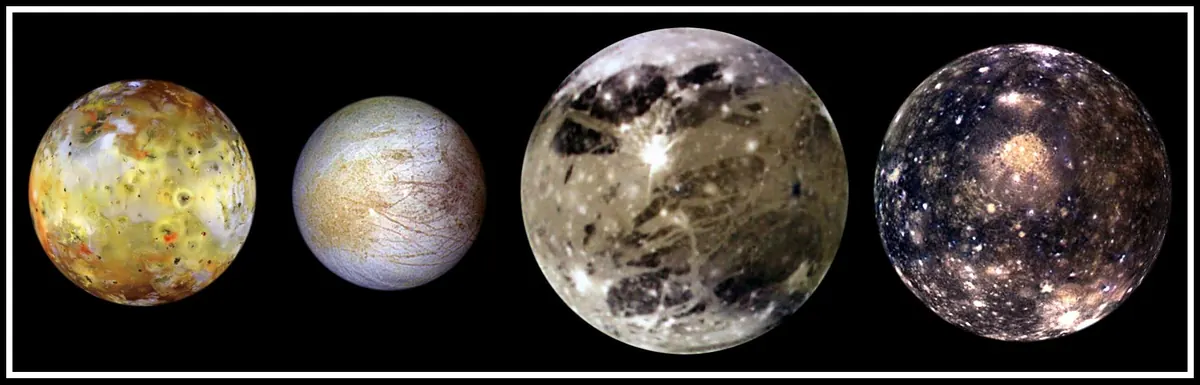
Four of Jupiter's moons, Io, Europa, Ganymede and Callisto, were seen by Galileo in 1610. Ganymede is the largest moon in the solar system, and NASA notes it's bigger than the planet Mercury. Io is the most volcanically active body in the solar system, and Europa probably hides a liquid ocean under its ice. Read more on the pages for Ganymede, Io and Europa.
Earth and Mars
Earth is the only planet with exactly one moon, which is probably the result of a collision billions of years ago. Mars has two small potato-shaped moons, Phobos and Deimos, discovered in 1877, that may be captured asteroids. Phobos is slowly moving toward Mars and will crash into it or break apart in about 50 million years. No third moon has been found since, and the Phobos page shows what a spacecraft saw.
Nothing for Mercury and Venus
The two planets closest to the Sun have no moons at all. Pluto, farther out, has five, Charon, Nix, Hydra, Kerberos and Styx, the largest of which is Charon, about half Pluto's size.
Most of the moons are small
The JPL list read for this page adds up to 461 moons around the eight planets and Pluto. A handful are large, round worlds: our Moon, the four big moons of Jupiter, Titan, and a few more. Most are irregular chunks a few kilometers across, probably captured objects on tilted, distant orbits. That's why the numbers have grown so fast without anything dramatic happening to the planets themselves. Saturn's 293 and Jupiter's 115 are mostly this kind.
What the counts say about each planet
Uranus and Neptune have 29 and 16. The ice giants are far away, and faint moons there are hard to detect, so their counts are probably lower than the truth. Mercury and Venus are different. Nothing has been found orbiting either one, and no survey is likely to add to a count of zero.
Where to look next
The large moons are worlds in their own right, with oceans, volcanoes and thick atmospheres. They have their own hub at moons, with pages for Titan, Enceladus, Io and Triton, and the spacecraft that visited them are on the probes hub.
Most new moons have no name yet
A newly confirmed moon gets a provisional label such as S/2023 S63, built from the year, the planet and a running number. A proper name follows only after the International Astronomical Union approves it, and that takes a while. In the JPL list read for this page, 230 of Saturn's 293 moons and 58 of Jupiter's 115 still carry only a provisional label, compared with 2 of Uranus's 29 and 2 of Neptune's 16. The long list of unnamed Saturn and Jupiter moons shows how recent the surveys are.
Names with rules
Names follow themes. Jupiter's moons are named for lovers and descendants of Zeus, while Uranus's are drawn from characters in the works of Shakespeare and Alexander Pope, and Neptune's from sea gods and nymphs of Greek myth. Saturn's irregular moons are named after giants from Norse, Gallic and Inuit stories. An astronomer can often tell from the name which planet a moon belongs to before looking anything up.
Pluto's family
Pluto's five moons, Charon, Nix, Hydra, Kerberos and Styx, are in the JPL list too. Charon is by far the biggest, and the smaller four were found in Hubble images after Charon itself. For how the discoveries run through history, see moon discoveries by year.
Questions people ask
Which planet has the most moons?
Saturn, with 293 in the JPL list read on October 19, 2026. Jupiter is second with 115.
How many moons does Earth have?
One, the Moon. Earth is the only planet in the solar system with exactly one moon.
How many moons does Mars have?
Two, Phobos and Deimos.
Do Mercury and Venus have moons?
No. They're the only two planets with none.