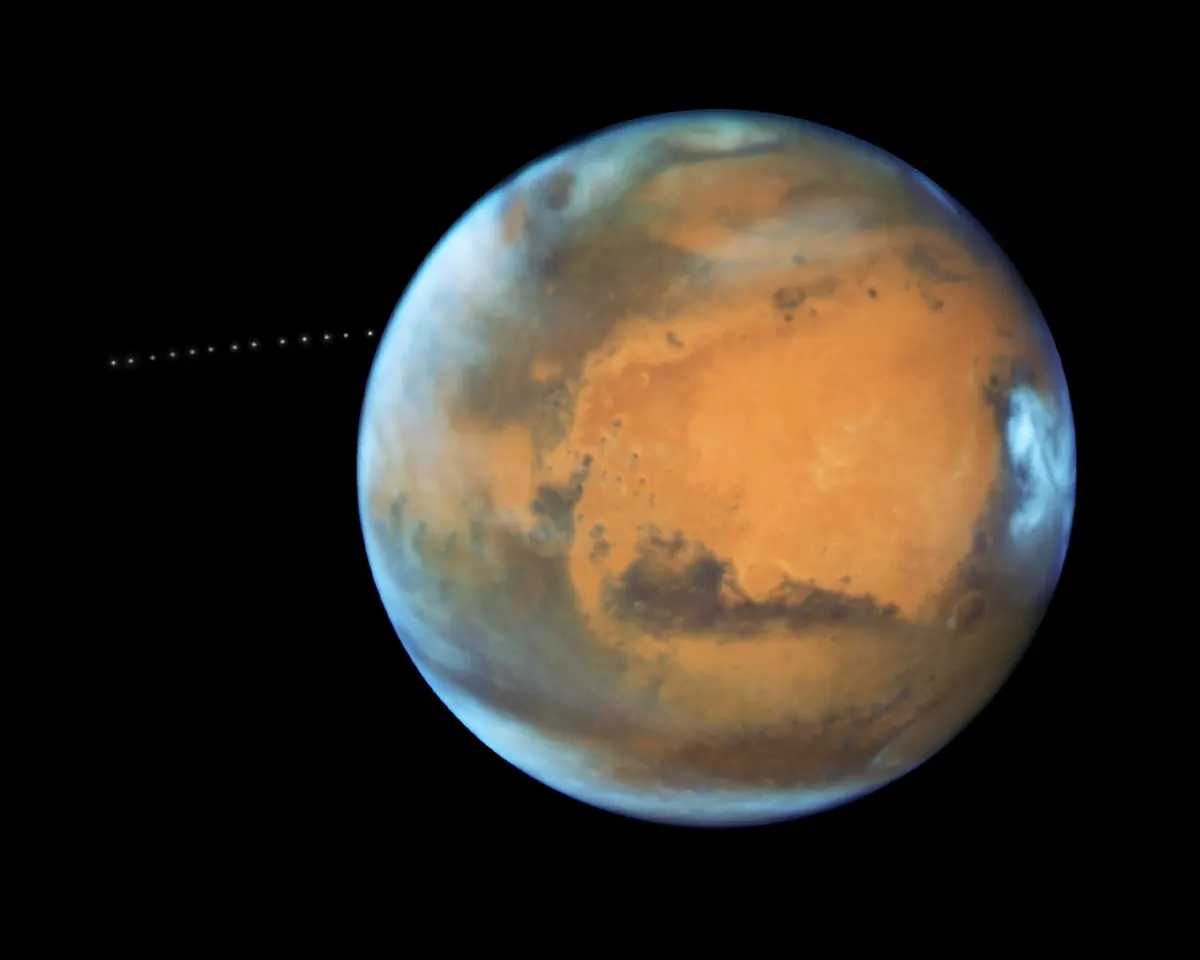
A moon you could nearly throw away
Asaph Hall found Phobos on 17 August 1877, a few days after finding the other Mars moon, Deimos. It's a lump, 27 by 22 by 18 kilometers, with a mean radius of 11.08 kilometers and a density of 1.872 grams per cubic centimeter. That's low for a rocky body, and scientists often read it as a sign of empty space inside.
Using that radius and density, the surface gravity works out at around 5.8 thousandths of a meter per second squared, about one 1,700th of Earth's. The speed needed to leave the surface altogether is only around 11 meters per second, about 41 kilometers per hour. These are my own calculations from NASA's numbers, not figures NASA quotes, but they show how weak Phobos's pull is.
The strange sky
Phobos goes around Mars in 0.31891 days, about 7.7 hours. Mars turns once in about 24.6 hours, so the moon outruns the planet's spin. A person on the Martian surface would see Phobos rise in the west and set in the east, about every 11 hours.
A moon on borrowed time
Phobos is approaching Mars at 1.8 meters every hundred years, and NASA says it'll either crash into Mars or break up into a ring in 50 million years. It was nearly shattered by a giant impact, which left Stickney crater, about 9 km wide and covering around half the moon's width. The crater is named for Chloe Angeline Stickney Hall, mathematician and wife of Asaph Hall. Asaph Hall found Phobos on 17 August 1877, and NASA notes that it's named for the Greek god of fear.
| What | Value |
|---|---|
| Discovered | 17 August 1877 by Asaph Hall |
| Size | 27 by 22 by 18 km |
| Mean radius | 11.08 km |
| Density | 1.872 grams per cubic centimeter |
| Orbit | three laps of Mars per day |
| Surface temperature | from -112 to -4 degrees Celsius |
Phobos has no atmosphere. Measurements of its sunlit and dark sides show extreme swings: the sunlit side reaches about -4 degrees Celsius, and the dark side drops to about -112. Its rock appears to be C-type rock, similar to blackish carbonaceous chondrite asteroids.
Where did it come from?
Nobody is sure. It may be a captured asteroid, but some scientists show evidence that contradicts this theory. ESA says the two Mars moons may be asteroids that were captured into Mars orbit, or the remnants of debris thrown into orbit after a giant collision on Mars. To find out, scientists need a sample.
The mission to fetch a sample
As of 19 October 2026, ESA says Japan's Martian Moons eXploration (MMX) is set to launch on an H3 rocket from the Tanegashima Space Center at 04:41 Japan time on 20 October 2026 (21:41 Central European Summer Time on 19 October 2026). It's expected to enter orbit around Mars in August 2027, orbit Phobos from September 2027, and release the 25-kilogram rover Idefix in early 2029. MMX is led by JAXA, with NASA, the French space agency CNES, Germany's DLR and ESA contributing, and it would be the first mission to collect a sample from a moon other than ours.
Measured: we know this
- Phobos is about 27 by 22 by 18 km across and orbits Mars three times a day.
- It's moving closer to Mars by about 1.8 meters every hundred years.
- Surface temperatures run from about -112 to -4 degrees Celsius.
Inferred: we think this
- Phobos appears to be made of C-type rock, similar to blackish carbonaceous chondrite asteroids.
- NASA says it'll crash into Mars or break up into a ring in 50 million years.
Unknown: we don't know
- How Phobos formed. It may be a captured asteroid, but some scientists show evidence that contradicts this theory.
What would settle it
- A sample returned to laboratories on Earth, which is what MMX is designed to bring home.
In human terms
- Phobos has a mean radius of 11.08 km, and its largest crater, Stickney, is 9 km wide.
- It moves closer to Mars by 1.8 meters every hundred years, and NASA says it'll crash into Mars or break up into a ring in 50 million years.
Questions people ask
Will Phobos crash into Mars?
It's on a collision course, approaching Mars at 1.8 meters every hundred years. NASA says it'll either crash into Mars or break up into a ring in 50 million years.
How big is Phobos?
About 27 by 22 by 18 km across, the larger of Mars's two moons.
What's the MMX mission?
A Japanese-led mission, set to launch on 20 October 2026 Japan time, that's designed to be the first to collect a sample from a moon other than our own and bring it back to Earth.
 Travel time to MarsHow long it takes to get there by different means.All moonsEvery moon page on the site.All probesEvery spacecraft page on the site.Scale of the solar systemThe solar system as a street.
Watching the clock
The inward drift of 1.8 meters every hundred years meters per century sounds trivial, but it adds up. Over 50 million years, the time NASA gives for Phobos to crash or break into a ring, it comes to about 900 kilometers, far more than the moon's own 27-kilometer length. Phobos orbits closer to Mars than the point where the planet's tides push a moon outward, so the tides pull it in instead.
The large crater Stickney, about 9 kilometers wide, is named for Chloe Angeline Stickney Hall, mathematician and wife of Asaph Hall. The impact that made it came close to breaking the moon apart.
What the sample could answer
Whether Phobos is a captured asteroid or was built from debris thrown up around Mars is a question about the early history of the planet itself. The two answers lead to different stories. A sample returned by the Martian Moons eXploration spacecraft, which as of 19 October 2026 was scheduled to launch at 04:41 Japan time on 20 October 2026 (21:41 Central European Summer Time on 19 October 2026), could tell the difference. This page will be updated once the launch is confirmed.
Japan's mission also carries a rover named Idefix, weighing about 25 kilograms, to study the surface. Compare Phobos with the other missions on the missions hub, or with the moons that could hold water on the moons hub.