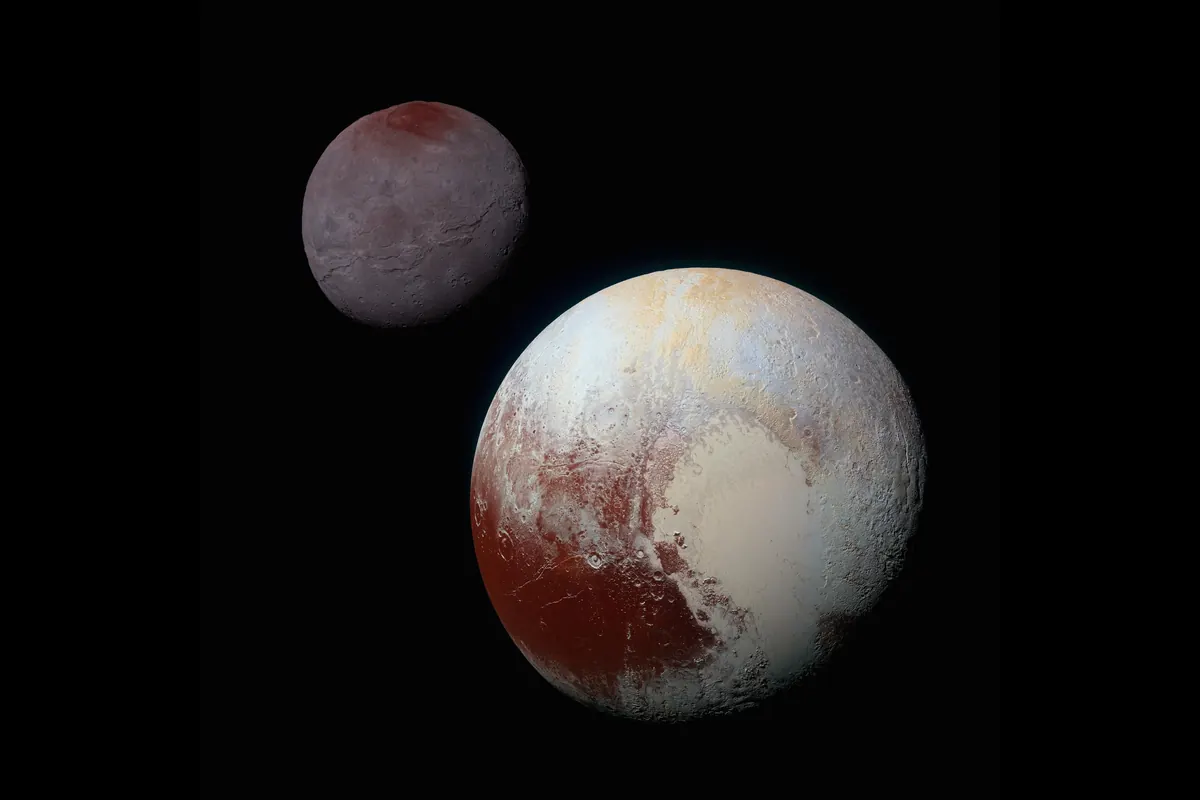
A planet found on photographic plates
Clyde Tombaugh was 24 and a young researcher at Lowell Observatory in Flagstaff, Arizona when he found Pluto on 18 February 1930, from photographic plates taken the month before. The name Pluto was suggested by an 11-year-old English girl, Venetia Burney, on 14 March 1930. A small part of his ashes later flew on New Horizons.
New Horizons launched on 19 January 2006, passed Jupiter, and reached Pluto on 14 July 2015. At closest approach it was about 12,500 km away. A radio signal needed about four and a half hours to cross the 4.77 billion kilometers back to Earth. The "heart" picture was taken a day earlier from 768,000 km.
Pluto was discovered in 1930 and was the ninth planet for 76 years. After the discovery of similar worlds deeper in the Kuiper Belt, the International Astronomical Union reclassified it as a dwarf planet in 2006. The name came from an 11-year-old girl, Venetia Burney of Oxford, who suggested it over breakfast to her grandfather on March 14, 1930. It's the Roman god of the underworld.
Pluto's orbit is unlike the planets': long, oval and tilted. It takes 248 years to go around the Sun, and for about two decades of each trip it moves inside Neptune's orbit.
Pluto in numbers
| Measure | Pluto | Compared with Earth |
|---|---|---|
| Diameter | 2,376 km | 0.19 x Earth |
| Mass | 0.013 x 1024 kg | 0.00218 x Earth |
| Density | 1,850 kg/m3 | 0.34 x Earth |
| Surface gravity | 0.7 m/s2 | 0.07 x Earth |
| Escape velocity | 1.3 km/s | 0.12 x Earth |
| One rotation | 6.4 Earth days (backward) | 6.41 x Earth |
| Sunrise to sunrise | 6.4 Earth days | 6.39 x Earth |
| Year | 247.9 years (90,560 Earth days) | 247.97 x Earth |
| Average distance from the Sun | 5,906.4 million km (39.48 AU) | 39.48 x Earth |
| Average temperature | -225 C (-373 F) | Earth: 15 C |
| Axial tilt | 119.5 degrees | Earth: 23.4 degrees |
| Moons | 5 | Earth: 1 |
| Rings | No | Earth: No |
Numbers from the NASA Planetary Fact Sheet. Moon count from the JPL list read on October 19, 2026.
What makes Pluto different
The atmosphere is thin and made mostly of nitrogen, methane and carbon monoxide. The NASA fact sheet puts the average temperature at about minus 225 degrees Celsius, so cold that water ice behaves like rock. If you stood on Pluto at noon, the Sun would be about 900 times dimmer than on Earth, but still about 300 times brighter than our full moon.
Charon, the biggest of Pluto's five moons, is about half Pluto's size. That makes it the largest moon compared with the world it orbits, which is why the pair are often called a double planet.
Visiting Pluto
NASA's New Horizons is the only spacecraft to have visited Pluto. It flew past the dwarf planet and its moons on July 14, 2015, and the pictures on the Pluto pages come from that flyby.
Known, inferred, unknown
We keep these apart on every science page.
Measured: we know this
- Pluto has five known moons, the largest of which is Charon, about half Pluto's size.
- The average surface temperature is about minus 225 degrees Celsius, according to NASA's fact sheet.
Unknown: we don't know
- Whether there's an ocean deep inside. Pluto's interior is warmer than its surface, and some scientists think it could hold one.
Questions people ask
How long is a day on Pluto?
One rotation takes 6.4 Earth days, but the Sun takes 6.4 Earth days to return to the same place in the sky.
How many moons does Pluto have?
It has 5 known moons, by the JPL list read on October 19, 2026.
Why is Pluto not a planet?
In 2006 the International Astronomical Union classed it as a dwarf planet: it's round and orbits the Sun, but it hasn't cleared other objects from its orbital neighborhood.
Keep exploring
 NeptuneIce giant, 30.18 AU from the Sun.
 How long is a day on each planet?Day length on every planet, and why a day isn't always one spin.
 Planet sizes comparedEvery planet drawn to scale, with diameters next to Earth.
 Weight on other planetsWhat you would weigh on Pluto.
Mountains, craters and frozen plains
The pictures showed mountains 2 to 3 km tall, craters up to 260 km across, valleys up to 600 km long, and plains of frozen nitrogen with no craters. Craters build up over time, so a plain without any is a sign that the surface there's relatively young.
The thin atmosphere is mostly nitrogen, with methane and carbon monoxide also detected. A day lasts about 153 hours, as shown on the day length page.
A moon half its size
Charon is about half Pluto's size and orbits only 19,640 km away, which is about 8 Pluto widths. For comparison, our Moon is about 30 Earth widths away. Pluto has five known moons: Charon, Nix, Hydra, Kerberos and Styx.
After New Horizons passed Pluto, it flew by Arrokoth on 1 January 2019, about 3,500 km away. The New Horizons page follows the mission.
How far out it is
Over its orbit Pluto ranges from about 30 to 49.3 AU from the Sun. The reasons it's no longer counted as a planet are on the why Pluto isn't a planet page.
The travel time page gives the trip times from Earth.