Seven moons worth a closer look
There are hundreds of moons in the solar system, and most of them are small, cold and quiet. The seven on this hub are the ones that aren't. Between them they've got volcanoes, a thick atmosphere, a magnetic field of their own, oceans of water under the ice, a backwards orbit and a slow collision course. Each page has the same layout: the key numbers, a ledger that keeps measurements apart from inferences, and a short list of what would settle the open questions.
Four of the seven are the focus of the search for hidden oceans. Europa and Ganymede orbit Jupiter, Enceladus sprays water into space from Saturn's neighborhood, and Titan has liquid methane on its surface and, as a 2025 study suggests, slush and pockets of water inside. Io is the opposite case, a world with so much volcanic heat that it has hardly any water at all.
Triton is the odd one: it circles Neptune the wrong way, which suggests it was captured from the Kuiper Belt. Phobos, the larger of Mars's two moons, is falling toward its planet by a couple of meters per century and is the target of Japan's Martian Moons eXploration mission.
Several spacecraft are heading to these worlds. NASA's Europa Clipper is due at Jupiter in April 2030, ESA's Juice in July 2031, and NASA's Dragonfly is planned to launch to Titan in 2028. The probes that gave us most of our current knowledge, Cassini, Juno and Voyager 2, have pages of their own. Dates for missions that haven't launched yet can change, and the pages say when they were last checked. Moons are also where the idea of a habitable zone gets complicated. A place doesn't need to be near the Sun to have liquid water, because tides and radioactive decay can supply heat. That's why worlds far from the Sun keep turning up in the search for life, and why this hub exists alongside the rest of the solar system pages.
| Moon | Planet | Mean radius (km) | Density (kg per cubic meter) | Orbit (days) | Why it stands out |
|---|---|---|---|---|---|
| Ganymede | Jupiter | 2,631.2 | 1,940 | 7.154553 | Largest moon in the solar system |
| Titan | Saturn | 2,575 | 1,880 | 15.945421 | Thick atmosphere, liquid methane lakes |
| Io | Jupiter | 1,821.5 | 3,530 | 1.769138 | Most volcanic world known |
| Europa | Jupiter | 1,560.8 | 3,010 | 3.551181 | Ocean under an ice shell |
| Triton | Neptune | 1,353.4 | 2,050 | 5.876854 | Orbits against Neptune's spin |
| Enceladus | Saturn | 252.1 | 1,610 | 1.370218 | Sprays its ocean into space |
| Phobos | Mars | 11.08 | 1,872 | 0.31891 | Spiraling in toward Mars |
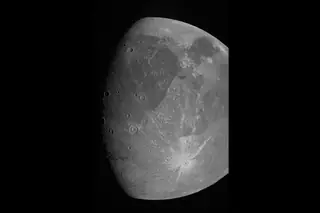 GanymedeThe largest moon, with its own magnetic field.
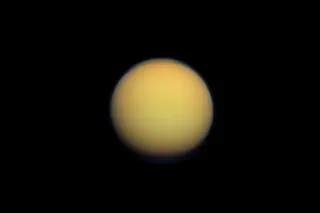 TitanWeather and lakes of liquid methane.
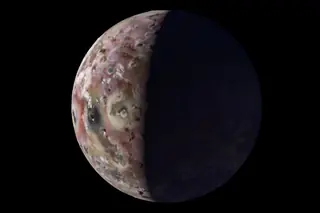 IoThe most volcanic world in the solar system.
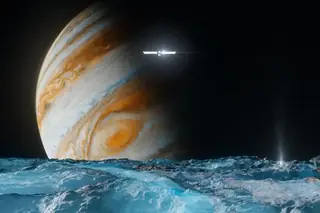 EuropaAn ocean under the ice.
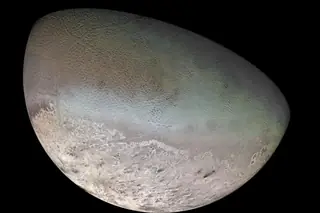 TritonThe backwards moon of Neptune.
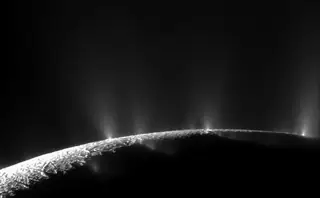 EnceladusA small moon that sprays its ocean into space.
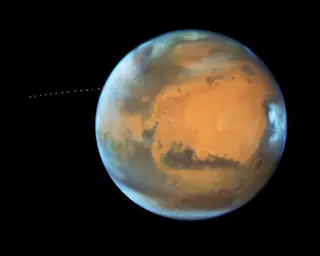 PhobosA moon of Mars on a slow collision course.
Sizes and orbits come from NASA's satellite fact sheets, descriptions from NASA Science pages, and each page lists its sources. Where researchers disagree, the page says what each side found.
Questions people ask
What's the largest moon in the solar system?
Ganymede, a moon of Jupiter, with a radius of 2,631.2 km. Titan is second.
Which moons might have oceans?
Europa, Ganymede and Enceladus are thought to have oceans under their ice. Titan was long thought to have one, but a 2025 study suggests slush and pockets of water instead.
Which moon is the most volcanic?
Io, which has hundreds of volcanoes.