Probes that landed, and a radar map
Mariner 2 launched on 27 August 1962 and passed Venus on 14 December 1962, 34,854 km away. It was the first robotic probe to report back successfully from another planet, and its instruments showed cool clouds over an extremely hot surface.
The Soviet Venera program sent probes between 1961 and 1984, and 10 of them reached the surface. The longest survivor lasted two hours. Venera 7 landed on 15 December 1970 and became the first spacecraft to send data back from the surface of another planet. Its signal from the ground was weak, but it lasted nearly 23 minutes.
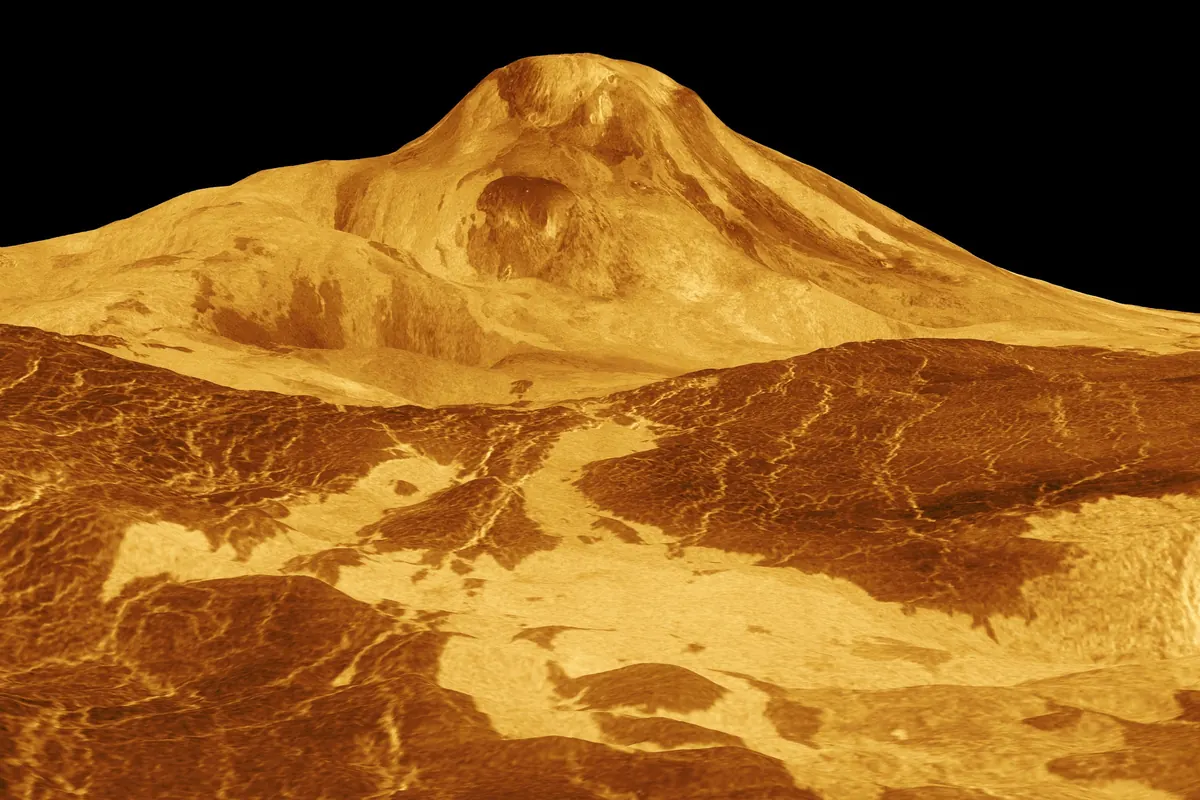
Radar had to do the rest. NASA's Magellan launched on 4 May 1989, reached Venus on 10 August 1990 and mapped about 98 percent of the surface through the clouds. It was lowered into the atmosphere and destroyed on 13 October 1994.
Venus is almost the same size as Earth, which is why it is sometimes called Earth's twin, or its evil twin. The comparison stops at the size. A thick atmosphere traps heat in a runaway greenhouse effect, the surface averages about 464 degrees Celsius, and the air pressure at the ground is more than 90 times what it is at sea level on Earth.
Venus turns the wrong way. It spins slowly in the opposite direction from most planets, so on Venus the Sun would rise in the west. It's the third brightest object in our sky, after the Sun and the Moon, and ancient observers thought it was two objects, a morning star and an evening star.
Venus in numbers
| Measure | Venus | Compared with Earth |
|---|---|---|
| Diameter | 12,104 km | 0.95 x Earth |
| Mass | 4.87 x 1024 kg | 0.816 x Earth |
| Density | 5,243 kg/m3 | 0.95 x Earth |
| Surface gravity | 8.9 m/s2 | 0.91 x Earth |
| Escape velocity | 10.4 km/s | 0.93 x Earth |
| One rotation | 243.0 Earth days (backward) | 244.04 x Earth |
| Sunrise to sunrise | 116.8 Earth days | 116.75 x Earth |
| Year | 225 Earth days | 0.62 x Earth |
| Average distance from the Sun | 108.2 million km (0.72 AU) | 0.72 x Earth |
| Average temperature | 464 C (867 F) | Earth: 15 C |
| Axial tilt | 177.4 degrees | Earth: 23.4 degrees |
| Moons | 0 | Earth: 1 |
| Rings | No | Earth: No |
Numbers from the NASA Planetary Fact Sheet. Moon count from the JPL list read on October 19, 2026.
What makes Venus different
High in the atmosphere, about 50 kilometers up, the picture changes: temperatures run from about 30 to 70 degrees Celsius and the pressure is close to what we have at Earth's surface. At the cloud tops, winds reach about 360 kilometers an hour, and dark streaks appear that absorb ultraviolet light. Scientists can't yet explain why those streaks stay intact in such winds.
Below the clouds the surface has volcanoes and deformed mountains. Venus is named for the Roman goddess of love and beauty, and it's the only planet named for a female god.
Visiting Venus
NASA's Mariner 10 photographed Venus as it flew away from the planet in February 1974, and NASA's Magellan spacecraft later produced three-dimensional views of the surface, such as the one of the volcano Maat Mons on this page.
Known, inferred, unknown
We keep these apart on every science page.
Measured: we know this
- The surface is hot enough to melt lead, about 464 degrees Celsius on average.
- A Venus day is longer than its year when measured against the stars: the planet turns once in about 243 Earth days and goes around the Sun in about 225.
- At about 50 kilometers up, temperature and pressure are similar to Earth's surface.
Inferred: we think this
- Venus probably once had an ocean. NASA describes a vanished ocean and a violent volcanic past, but the evidence is indirect.
- The dark cloud streaks are probably made of fine particles, ice crystals or a compound called iron chloride.
Unknown: we don't know
- What the dark streaks in the clouds really are. A small number of scientists have even asked whether they could be microbial life, though nothing found so far is convincing evidence of that.
Questions people ask
How long is a day on Venus?
One rotation takes 243.0 Earth days, but the Sun takes 116.8 Earth days to return to the same place in the sky.
How many moons does Venus have?
It has no moons.
Why is Venus hotter than Mercury?
Venus has a thick atmosphere that traps heat in a runaway greenhouse effect. Mercury has almost no atmosphere, so most of its heat escapes at night.
Keep exploring
 MercuryRocky planet, 0.39 AU from the Sun.
 EarthRocky planet, 1.00 AU from the Sun.
 How long is a day on each planet?Day length on every planet, and why a day isn't always one spin.
 Planet sizes comparedEvery planet drawn to scale, with diameters next to Earth.
 Weight on other planetsWhat you would weigh on Venus.
A day longer than a year
A Venus day lasts 243 Earth days, longer than the 225-Earth-day year. The planet also spins backward compared with Earth, and its axis is tilted about 3 degrees, so there are almost no seasons. The full comparison is on the day length page.
Hotter than Mercury
Venus is farther from the Sun than Mercury, yet it's the hottest planet. The air is mostly carbon dioxide, with clouds of sulfuric acid. NASA's Venus page quotes 467 C at the surface and a pressure about 93 times sea-level pressure on Earth, while the fact sheet table on this page gives 464 C. Both describe the same hot ground, measured and averaged in slightly different ways.
That heat is why the hottest planet answer is Venus and not the planet nearest the Sun. A thick atmosphere that traps heat counts for more than a short distance.
A young surface
Venus has thousands of volcanoes. NASA says the average age of the surface could be as young as 150 million years, and that Venus has far fewer impact craters than any rocky planet except Earth. One mountain rises 11 km, higher than Mount Everest, per NASA.
Venus is the third brightest object in our sky after the Sun and Moon, and you can follow its changing position from one greatest elongation to the next. The travel time page shows how long the trip takes. Heat and pressure are why the landers lasted so briefly: the longest Venera survivor ran about two hours.