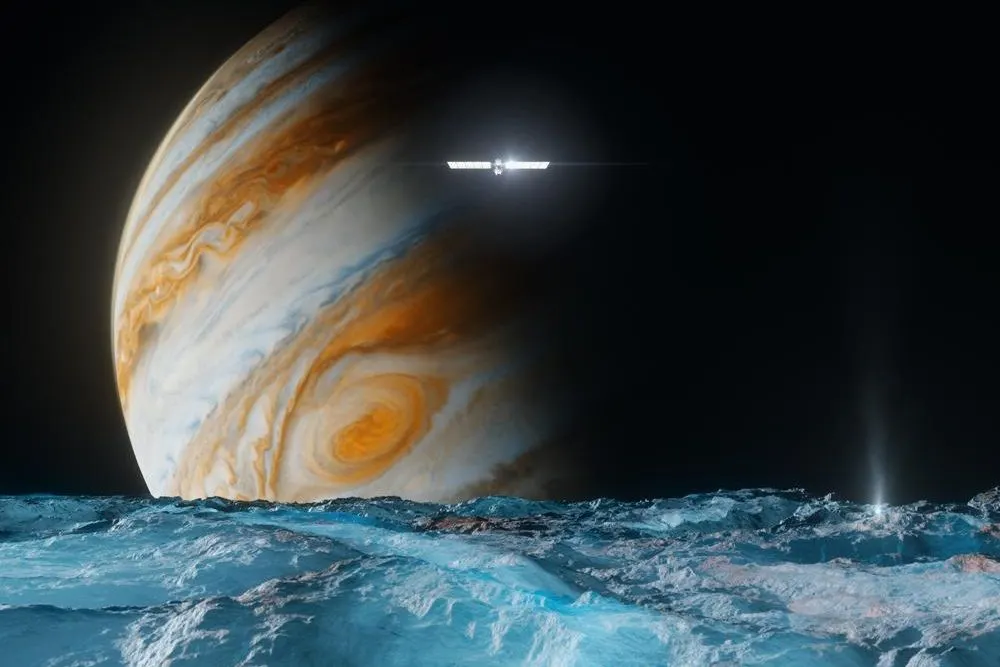
Four moons, one rhythm
Galileo Galilei saw Europa in January 1610, along with Io, Ganymede and Callisto, which is why those four are called the Galilean moons. Europa is the second of them out from Jupiter, at about 671.1 thousand kilometers from the planet, and it goes around once every 3.55 days. Its density, 3,010 kilograms per cubic meter, sits between rocky Io (3,530) and the icier Ganymede (1,940). That fits an ice shell sitting on top of a rocky interior.
The orbits are linked. Io goes around Jupiter in 1.77 days, Europa in 3.55 and Ganymede in 7.15, and each is almost exactly double the one before it: one Ganymede orbit is two Europa orbits and four Io orbits. The three moons tug on one another at the same points in their orbits, over and over, and that keeps their paths slightly stretched instead of perfectly round.
Why an ocean needs a squeeze
A stretched orbit matters because Europa's distance from Jupiter changes a little during each lap, and so does the pull on it. The moon is flexed, like a ball being squeezed and released, and flexing makes heat. It's the same process that drives the volcanoes on Io, only gentler. Scientists think this tidal heating could keep the interior of Europa from freezing solid, though how much heat reaches the ice and the ocean is still being worked out.
That's an inference, not a measurement, and the ledger below keeps the two apart. What has been measured is Europa's response to Jupiter's magnetic field, which the Galileo spacecraft recorded and which looks like what a salty, electrically conductive layer would produce.
| Radius | about 1,561 km |
|---|---|
| Discovered | January 1610, by Galileo |
| Next visitor | NASA's Europa Clipper, launched 14 October 2024, due at Jupiter in 2030 |
In human terms
- Europa is about 3,120 km across, roughly two thirds of the width of the lower 48 United States. If its ice shell is 15 to 25 km thick, that's two to three Everests of ice on top of the ocean.
- Its ocean is often estimated at about twice the water in all of Earth's oceans, but that figure is inferred, not measured directly.
What we know and what we don't
Measured: we know this
- The surface is mostly water ice, young and cracked, with few craters.
- Galileo spacecraft magnetometer data show Europa responds to Jupiter's magnetic field the way a salty, electrically conductive layer would.
Inferred: we think this
- A global salty ocean lies under the ice. Most planetary scientists think so, but it's inferred, not seen.
- Ice shell thickness is estimated, with published ranges from a few km to about 30 km.
Unknown: we don't know
- Whether the ocean touches a rocky seafloor.
- Whether water plumes really erupt. Hubble hints in 2012 and 2016 are disputed.
- Whether anything lives there.
What would settle it
- Europa Clipper flybys measuring ice thickness, composition and plume activity from 2030.
- A later lander or probe to sample the surface or a plume.
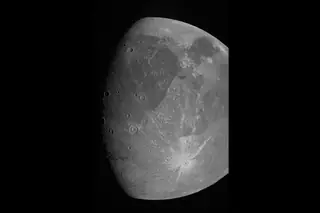 GanymedeThe largest moon, with its own magnetic field.
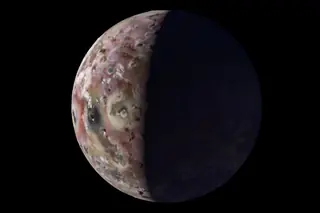 IoThe most volcanic world in the solar system.
Questions people ask
Does Europa have an ocean?
Most planetary scientists think a global salty ocean lies under the ice, but it's inferred, not seen. Galileo magnetometer data fit a salty, electrically conductive layer.
How big is Europa?
About 3,120 km across, slightly smaller than our Moon.
When will Europa Clipper reach Europa?
NASA's Europa Clipper launched on 14 October 2024 and is due at Jupiter in 2030, with flybys of Europa after that.
Could anything live on Europa?
Nobody knows. Whether the ocean touches a rocky seafloor, and whether anything lives there, are both open questions.
Why nobody has gone in yet
No spacecraft has orbited Europa, and the main reason is radiation. Jupiter's magnetic field traps charged particles around the planet, and Europa sits inside that belt. Instruments that are fine in the inner solar system wear out quickly there. So NASA's Europa Clipper is designed to orbit Jupiter and swing past Europa many times, with long gaps between close passes, instead of staying near the moon.
The Galileo spacecraft that gave us the first strong hints was itself ended by sending it into Jupiter on 21 September 2003. The reason was planetary protection: left alone, an old spacecraft could one day have hit Europa, and Europa is one of the places where Earth microbes might survive and confuse a future search for life.
What Clipper is built to settle
Europa Clipper launched on 14 October 2024 and is due at Jupiter in April 2030. Its job is to measure the things the ledger lists as unknown: how thick the ice shell is, what the surface and any material from below are made of, and whether water plumes really erupt. The Hubble hints from 2012 and 2016 are disputed, so the plume question is still open. The Juno spacecraft, which flew past on 29 September 2022, gave a first look at the ice shell using its microwave radiometer. See the Juno page.
Europa isn't the only candidate for a hidden ocean. Enceladus is spraying its ocean into space, and Titan has liquid water inside it, though a late-2025 study suggests slush and pockets of warm water rather than one global ocean. The moons hub lines all seven moons up side by side.
How deep is the ice, how deep the water
The ledger gives an ice shell of about 15 to 25 kilometers. For comparison, the deepest part of Earth's oceans is about 11 kilometers, so Europa's frozen lid is thicker than any Earth ocean is deep, and the water under it's often estimated to be tens of kilometers deep. Those are estimates, and published ranges for the shell run from a few kilometers to about 30.
The surface offers a second clue. Europa is cracked and ridged with very few craters, which means it's young: something keeps resurfacing it, and estimates put its typical age at tens of millions of years, a blink compared with the 4.5 billion years of the solar system. Heat from tidal flexing and slow movement in the ice are the usual explanations, and Clipper's ice-penetrating radar is meant to test them.
Sources
NASA Europa Clipper mission page (science.nasa.gov/mission/europa-clipper). NASA Solar System Exploration: Europa.