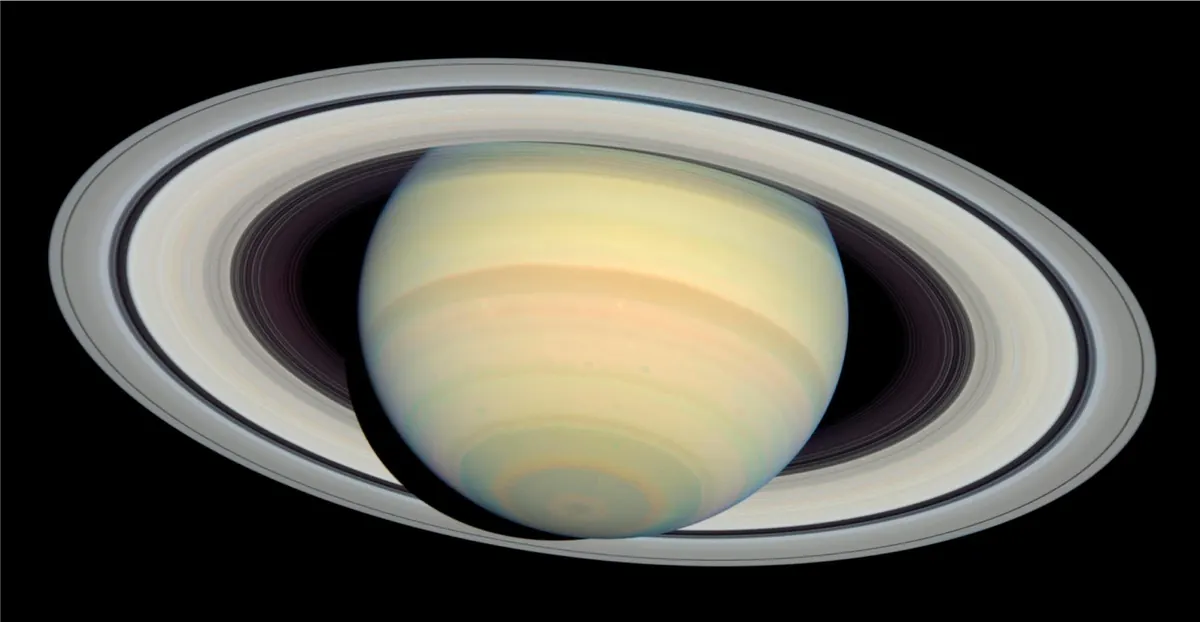
Four visits and one long stay
Pioneer 11 was the first spacecraft to reach Saturn, passing about 21,000 km above the cloud tops on 1 September 1979. It spotted a small moon and a ring nobody had seen. Voyager 2 followed with its closest approach on 26 August 1981.
Then came Cassini. It launched on 15 October 1997, entered orbit around Saturn on 1 July 2004, and sent the Huygens probe down to Titan on 14 January 2005. Over 294 orbits and about 13 years it changed what we know about the planet, and it finished by flying into the atmosphere.
Saturn is 9 times wider than Earth. A day lasts only 10.7 hours, the second shortest in the solar system, and a year lasts about 29.4 Earth years. The axis is tilted 26.73 degrees, similar to Earth's, so Saturn has seasons.
The rings are thought to be pieces of comets, asteroids or shattered moons that broke up before reaching the planet, torn apart by its gravity. They're billions of chunks of ice and rock coated with dust, from grains the size of dust to pieces as big as a house, and a few as large as mountains.
Saturn in numbers
| Measure | Saturn | Compared with Earth |
|---|---|---|
| Diameter | 120,536 km | 9.45 x Earth |
| Mass | 568 x 1024 kg | 95.1 x Earth |
| Density | 687 kg/m3 | 0.12 x Earth |
| Surface gravity | 9 m/s2 | 0.92 x Earth |
| Escape velocity | 35.5 km/s | 3.17 x Earth |
| One rotation | 10.7 hours | 0.45 x Earth |
| Sunrise to sunrise | 10.7 hours | 0.45 x Earth |
| Year | 29.4 years (10,747 Earth days) | 29.43 x Earth |
| Average distance from the Sun | 1,432.0 million km (9.57 AU) | 9.57 x Earth |
| Average temperature | -140 C (-220 F) | Earth: 15 C |
| Axial tilt | 26.7 degrees | Earth: 23.4 degrees |
| Moons | 293 | Earth: 1 |
| Rings | Yes | Earth: No |
Numbers from the NASA Planetary Fact Sheet. Temperature and gravity for gas and ice giants are given at the level where the pressure is one bar, since they have no solid surface. Moon count from the JPL list read on October 19, 2026.
What makes Saturn different
Saturn has been known since ancient times and is the farthest planet from Earth that people discovered with the unaided eye. It's named for the Roman god of agriculture and wealth, the father of Jupiter.
The moon count keeps rising. NASA counted 274 confirmed moons in March 2025, and the list kept by NASA's Jet Propulsion Laboratory now shows more. Two of them stand out: Enceladus, which sprays jets of water into space, and Titan, a smoggy world with lakes of methane. Both have internal oceans that could possibly support life.
Visiting Saturn
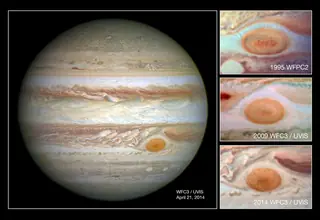
NASA's Cassini spacecraft arrived at Saturn in 2004 and the mission ended on September 15, 2017. The picture on this page is from the Hubble Space Telescope.
Known, inferred, unknown
We keep these apart on every science page.
Measured: we know this
- A day lasts 10.7 hours and the planet is tilted 26.73 degrees.
- The rings are made of ice and rock chunks from dust-sized grains to house-sized pieces.
Inferred: we think this
- The rings came from comets, asteroids or moons that were torn apart by Saturn's gravity.
- Enceladus and Titan have internal oceans.
Questions people ask
How long is a day on Saturn?
One rotation takes 10.7 hours.
How many moons does Saturn have?
It has 293 known moons, by the JPL list read on October 19, 2026.
What are Saturn's rings made of?
Billions of chunks of ice and rock coated with dust, from grains as small as dust to pieces as big as a house, and a few as large as mountains.
Keep exploring
 JupiterGas giant, 5.20 AU from the Sun.
 UranusIce giant, 19.16 AU from the Sun.
 How long is a day on each planet?Day length on every planet, and why a day isn't always one spin.
 Planet sizes comparedEvery planet drawn to scale, with diameters next to Earth.
 Weight on other planetsWhat you would weigh on Saturn.
Saturn leads the moon count, and the moon discoveries by year chart shows how that tally grew. How long would the trip take? See the travel time to Saturn.
How wide, how thin
The rings reach up to 282,000 km from the planet, about 73 percent of the way to the Moon. The main rings are typically only about 10 meters thick. Set the width against the thickness and the ratio is about 28 million to one.
The Cassini Division, a gap of 4,700 km, separates Rings A and B. More on how they compare with the other planets' rings is on the rings page.
The planet that would float
Saturn is the only planet in the solar system with an average density less than water. The fact sheet gives 687 kg per cubic meter, against 1,000 for water, and the comparison is on the density page. The magnetic field is 578 times as strong as Earth's.
At the north pole a jet stream blows in a hexagon about 30,000 km across, with winds of about 322 km/h and a large rotating storm at its center. Voyager first noticed it in the early 1980s.
Where it came from
Saturn took shape about 4.5 billion years ago and settled into its present orbit about 4 billion years ago. Two of its moons get their own pages, Titan and Enceladus, and the Cassini page covers the mission that studied them.
The opposition page lists when Saturn is best placed for viewing, and the travel time page shows how long a spacecraft needs to get there.