Four dots beside Jupiter
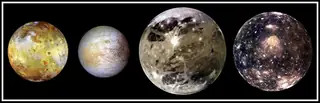
The story starts on January 7, 1610, when Galileo pointed an early telescope at Jupiter and saw small bright points lined up beside it. Night after night they moved, swapping sides of the planet, until he counted four. They were circling Jupiter. That did more than add moons to a list. It showed that not everything in the sky goes around Earth.
The names we use today came later, from Simon Marius, who published them in 1614 in a book called Mundus Jovialis, with a suggestion from Johannes Kepler to name the moons after lovers of the god Zeus: Io, Europa, Ganymede and Callisto. For a long time astronomers simply numbered them, as Galileo had.
Discoveries by decade
The chart is flat for centuries and then climbs. Each early bar is a handful of moons seen through telescopes. The last few decades dominate the list, and they come from just a few planets: since 2000, 275 of the new moons orbit Saturn and 97 orbit Jupiter.
The first moon of each planet
| Planet | First moon found | Name | Moons today |
|---|---|---|---|
| Mars | 1877 | Phobos and Deimos | 2 |
| Jupiter | 1610 | Io, Europa, Ganymede and Callisto | 115 |
| Saturn | 1655 | Titan | 293 |
| Uranus | 1787 | Titania and Oberon | 29 |
| Neptune | 1846 | Triton | 16 |
| Pluto | 1978 | Charon | 5 |
The busiest years
| Year | Moons discovered |
|---|---|
| 2023 | 64 |
| 2004 | 54 |
| 2020 | 49 |
| 2019 | 44 |
| 2003 | 29 |
| 2006 | 29 |
The telescope era
Christiaan Huygens found Saturn's Titan in 1655, and Giovanni Domenico Cassini added Iapetus in 1671, Rhea in 1672, Dione in 1684 and Tethys in 1684. The Cassini-Huygens mission to Saturn is named for the two men. William Herschel then found Uranus's Titania and Oberon in 1787 and Saturn's Mimas and Enceladus in 1789, and William Lassell found Neptune's Triton in 1846, the same year the planet itself was found.
In 1877 Asaph Hall found the two tiny moons of Mars, Phobos and Deimos. In 1892 Edward Emerson Barnard found Jupiter's Amalthea, a small moon close to the planet's glare.
Photographs, spacecraft and surveys
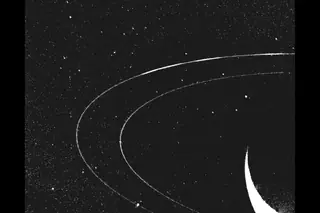
The next wave came from technology. Saturn's Phoebe, found in 1898 by W. H. Pickering from long-exposure photographic plates, is usually counted as the first moon discovered by photography, though some lists date it 1899. Then the spacecraft arrived. Voyager images from 1980 onward added the tiny inner moons of Saturn, such as Pan, Atlas, Prometheus and Pandora, which no earlier telescope could separate from the rings. About 33 moons joined the list between 1979 and 1999.
Since 2000 it has been wide-field digital cameras and computers. Survey teams photograph the same patch of sky night after night and look for faint dots that move with a planet. Most of what they find is small, irregular moons a few kilometers across, probably asteroids and comets captured long ago. The Minor Planet Center added 62 Saturn moons in May 2023, taking its count to 145, and 128 more in March 2025, taking it to 274. The moon count page follows the totals.
The picture on this page
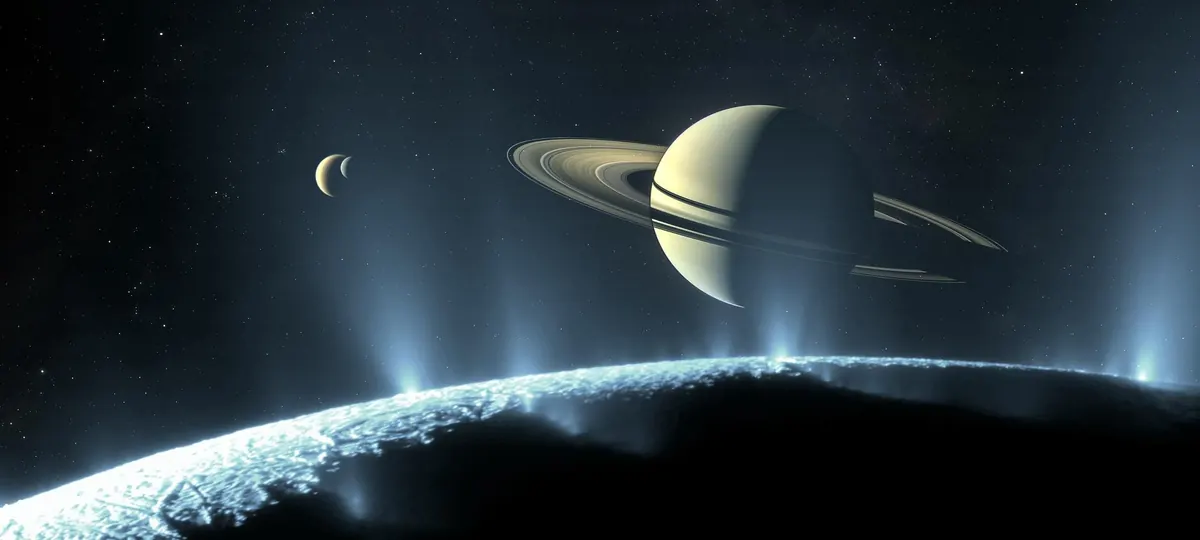
The artwork imagines the view from the south pole of Enceladus, where geysers burst from cracks in the ice. In the distance are two big moons found long ago, Titan and Rhea. Read more about Enceladus and Titan.
Counting is never finished
Each new telescope or spacecraft adds moons, mostly small ones. The totals on this page match the JPL list read on October 19, 2026, and astronomers are still confirming candidates around Jupiter and Saturn. A moon only goes on the list once its orbit has been followed long enough to prove it really circles the planet.
Who finds moons now
For most of history a moon had a person's name attached to the discovery: Galileo, Huygens, Cassini, Herschel, Lassell, Hall, Barnard. The list since the 1970s reads differently. In the JPL table read for this page, 30 of the 460 moons are credited to spacecraft science teams, mainly the Voyager and Cassini imaging teams, and most of the rest are credited to survey teams working with large ground-based telescopes. The age of the lone observer at an eyepiece gave way first to the spacecraft and then to the survey camera.
Why Mars hasn't changed
Mars has had two known moons, Phobos and Deimos, since Asaph Hall found them in 1877, and the count hasn't moved since. It's a useful reminder that a discovery curve doesn't rise everywhere. Giant planets have many small, distant moons that a survey can still find. A small rocky planet has a few moons close in, and those would have been seen long ago. See the moon count page for the totals.
What a new moon needs before it counts
A faint dot in an image isn't yet a moon. It has to be seen again on later nights, and its path has to fit an orbit around the planet and not around the Sun. Only then does the Minor Planet Center publish it. That's one reason a batch of dozens of moons can appear at once: several observing seasons of follow-up can be released together. It's also why many moons in the 2023 and 2025 Saturn announcements were first imaged years before the announcement.
The names on the list
The discoverer column of the JPL table shows how teams have taken over from individuals. The most frequent names are J.-M. Petit and B.J. Gladman, each credited on 212 of the 460 entries, followed by E.J. Ashton on 209. They aren't rivals. A single survey paper can name a dozen observers, and every moon in it carries the full list, so the counts overlap.
Questions people ask
When was the first moon discovered?
Galileo found four moons of Jupiter in 1610. Earth's own Moon has been known forever, so this list starts with those.
How many planetary moons were found since 2000?
392 of the 460 in the JPL list, or 85 percent.
Which year had the most moon discoveries?
2023, with 64 moons logged in that year.
Who discovered Titan?
Christiaan Huygens discovered Titan in 1655. Giovanni Domenico Cassini then found Iapetus in 1671, Rhea in 1672, Dione in 1684 and Tethys in 1684. The Cassini-Huygens mission to Saturn is named for the two men.