Big but not heavy
Ganymede is wider than Mercury, but not as heavy: its mass is 1,481.9 times 10 to the 20 kilograms, only about 45 percent of Mercury's. The reason is what it's made of. Ganymede's density of 1,940 kilograms per cubic meter points to roughly equal parts rock and water ice, while Mercury is mostly metal and rock. Mercury weighs more than twice as much in a smaller body.
Galileo Galilei saw Ganymede in January 1610, along with Io, Europa and Callisto. It goes around Jupiter in 7.15 days, and each of its orbits matches two of Europa's and four of Io's, a pattern that holds the three moons in a steady gravitational rhythm.
Bigger than a planet
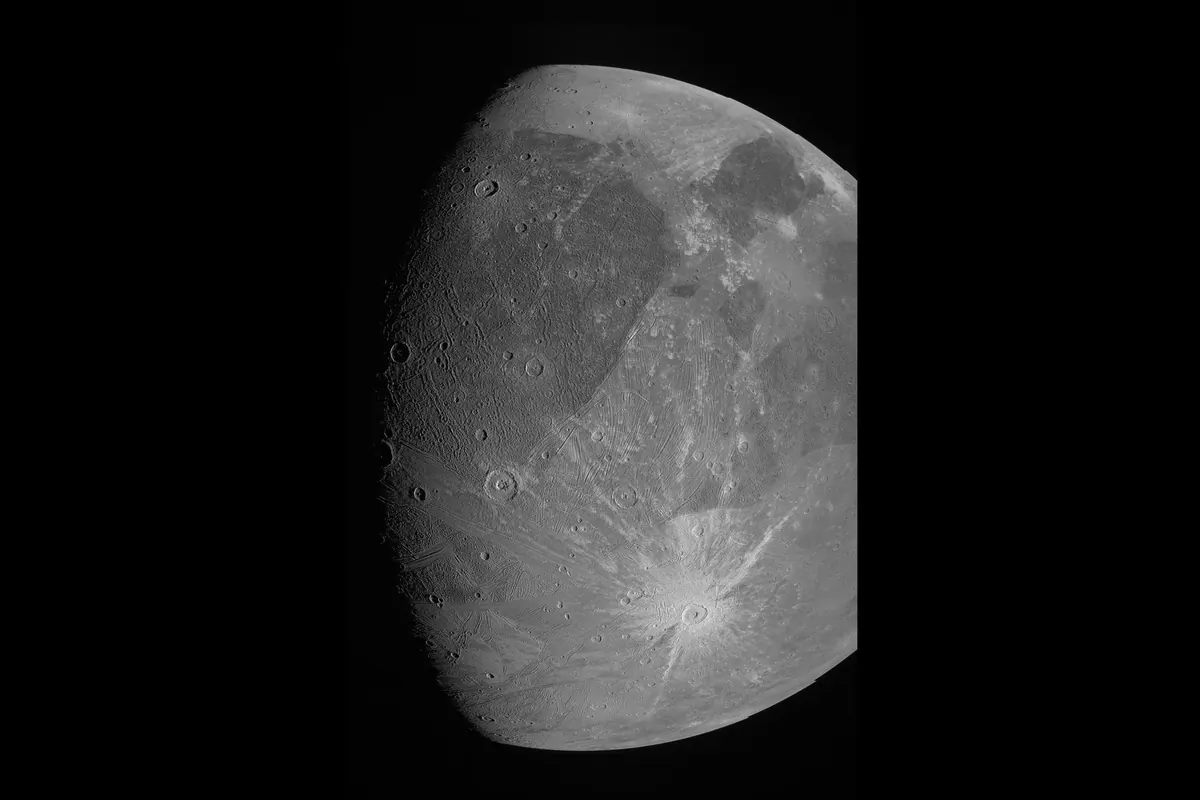
With a radius of 2,631.2 km, Ganymede is a little bigger than Saturn's Titan (2,575 km) and than Mercury (2,439.4 km), although Mercury is more massive (3,301.1 against 1,481.9, in units of 10^20 kg). Ganymede has a density of 1,940 kg per cubic meter, well below Io's. Its surface is a patchwork of two kinds of ground: older, more heavily cratered dark regions, and younger, tectonically deformed bright ones, with bright spots marking recent impact craters.
A moon with a magnetic field
Ganymede is the only moon known to have its own magnetic field, something normally found on planets. The field comes from a metallic iron core, and it creates auroras, ribbons of glowing gas that ring the moon's poles. Around the core NASA describes a shell of rock and then another shell of ice, and there's evidence of a tenuous oxygen atmosphere.
An ocean like a club sandwich
There's strong evidence that Ganymede has an underground saltwater ocean that may hold more water than all the water on Earth's surface, and it might have ice and oceans stacked up in several layers like a club sandwich.
| Moon | Radius (km) | Density (kg per cubic meter) | Distance from Jupiter (thousand km) | Orbit (days) |
|---|---|---|---|---|
| Io | 1,821.5 | 3,530 | 421.8 | 1.769138 |
| Europa | 1,560.8 | 3,010 | 671.1 | 3.551181 |
| Ganymede | 2,631.2 | 1,940 | 1,070.4 | 7.154553 |
| Callisto | 2,410.3 | 1,830 | 1,882.7 | 16.689017 |
Visits
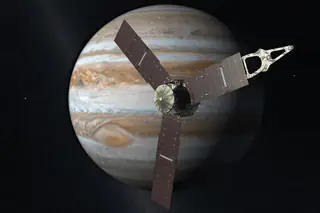
Pioneer 10 took the first close-up pictures on 3 December 1973, Galileo's first encounter was on 26 June 1996, and Juno flew within about 1,038 km on 7 June 2021. The European Space Agency's Juice mission, launched in April 2023, is due at Jupiter in July 2031 and will study Ganymede, Callisto and Europa.
Measured: we know this
- Ganymede's radius is 2,631.2 km, bigger than any other moon and bigger than Mercury.
- It's the only moon known to have its own magnetic field, and the field creates auroras at its poles.
- Juno passed within about 1,038 km on 7 June 2021.
Inferred: we think this
- An underground saltwater ocean exists and may hold more water than all the water on Earth's surface. NASA calls the evidence strong.
- The ocean and ice may be stacked in several layers.
Unknown: we don't know
- How thick and deep the ocean layers are, and whether they touch rock.
- Whether the ocean could support life. Nobody knows.
What would settle it
- Juice, due at Jupiter in July 2031, will study Ganymede with instruments built to measure its ocean and ice.
In human terms
- About 2,631.2 km radius against Titan's 2,575 km: Ganymede is bigger by only about 2 percent.
- NASA says its ocean may hold more water than all the water on Earth's surface.
Questions people ask
What's the largest moon in the solar system?
Ganymede, a moon of Jupiter, with a radius of 2,631.2 km. It's bigger than Mercury and Pluto.
Does Ganymede have a magnetic field?
Yes. It's the only moon known to have one, and the field causes auroras at its poles.
Does Ganymede have water?
Strong evidence suggests an underground saltwater ocean that may hold more water than all of Earth's surface water.
 JunoThe orbiter that flew close past it in 2021.
 TitanThe second largest moon.
 EuropaJupiter's ocean moon.All moonsEvery moon page on the site.
Two kinds of ground
Ganymede's surface is a patchwork. Dark regions are older, more heavily cratered, which means they have been exposed for a long time, and bright regions are younger, tectonically deformed, which means something has reshaped them more recently. The two kinds of terrain sit side by side across the moon, and they tell a story of a world that was active in its past.
There's a hint of what the interior may be doing, too. The Hubble Space Telescope studied Ganymede's auroras in 2015 and found they sway less than they would if the moon had no conductive layer under its surface. That pattern is what you'd expect from a salty ocean, and scientists took it as supporting evidence that one exists.
The closest look in two decades
The Juno flyby on 7 June 2021 brought the spacecraft within about 1,038 kilometers, the closest any spacecraft had been to Ganymede since the Galileo orbiter's last pass in 2000.
The next mission is the European Space Agency's Juice, launched in April 2023 and due at Jupiter in July 2031. ESA plans to place it in orbit around Ganymede, which would make it the first spacecraft to orbit a moon other than our own. Its instruments are built to measure the ocean and the ice above it. For how Juno's work fits in, see the Juno page.
A near twin without a field
Callisto, the outermost Galilean moon, is nearly Ganymede's size, with a radius of 2,410.3 kilometers against Ganymede's 2,631.2. It orbits at about 1.88 million kilometers, almost twice as far from Jupiter, and has no magnetic field of its own. That contrast is useful: two moons of similar size and make-up ended up very different inside, and scientists want to understand why. One clue is the pattern of resonance: Ganymede is locked into the rhythm with Io and Europa, while Callisto sits outside it and gets none of that tidal squeezing, which may help explain why it is colder and quieter.