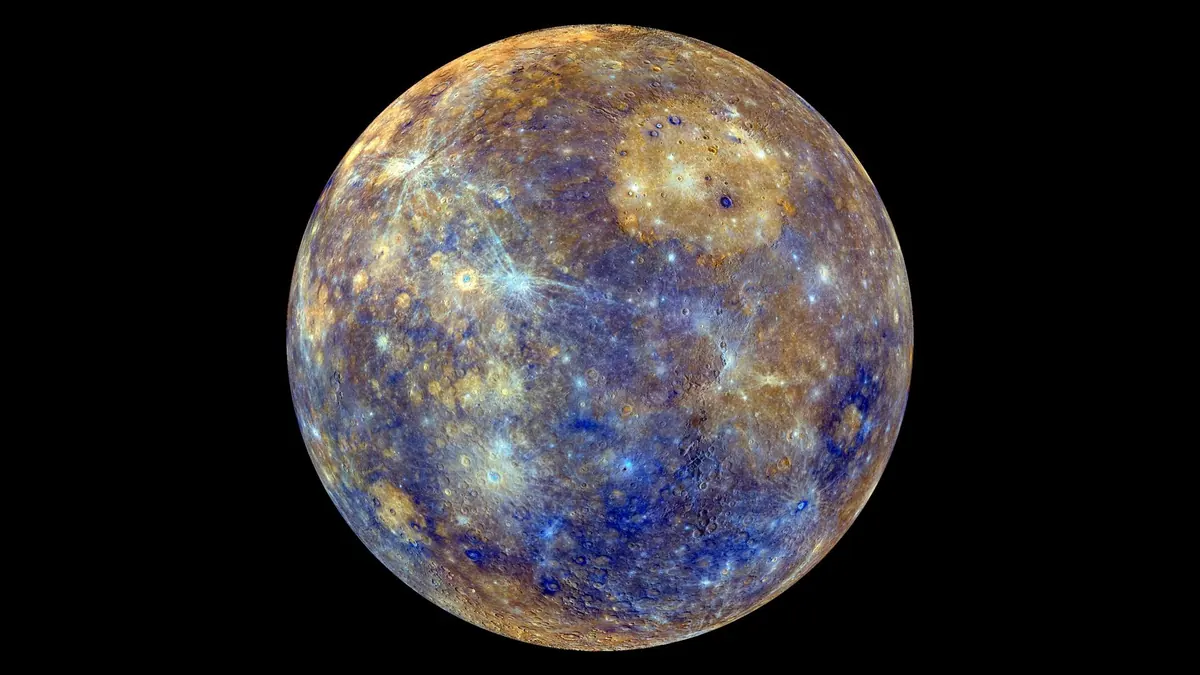
Two spacecraft and one long wait
Mercury is hard to visit, because a spacecraft heading there falls toward the Sun and has to shed a great deal of speed to stay. Two NASA spacecraft have studied it up close.
Mariner 10 launched on 3 November 1973 and flew past Mercury three times, on 29 March 1974, 21 September 1974 and 16 March 1975. It photographed nearly half of the surface, because the same side was in sunlight each time. It was also the first mission to use one planet's gravity to reach another, swinging past Venus on the way. Its radio signals stopped on 24 March 1975, when its nitrogen supply ran out.
MESSENGER launched on 3 August 2004 and went into orbit on 18 March 2011, the first spacecraft to do so. Its primary mission, which finished on 17 March 2012, returned close to 100,000 images. It ran out of propellant and crashed onto the surface on 30 April 2015.
It's also the fastest planet. Mercury goes around the Sun every 88 Earth days, which is why it is named for the swiftest of the ancient Roman gods.
The day is odd. Mercury turns slowly, once every 59 Earth days, but it moves so fast along its egg-shaped orbit that one full day and night takes 176 Earth days, just over two years on Mercury. When the planet is at its closest to the Sun and moving fastest, the morning Sun can appear to rise briefly, set, and rise again from some parts of the surface.
Mercury in numbers
| Measure | Mercury | Compared with Earth |
|---|---|---|
| Diameter | 4,879 km | 0.38 x Earth |
| Mass | 0.33 x 1024 kg | 0.0553 x Earth |
| Density | 5,429 kg/m3 | 0.98 x Earth |
| Surface gravity | 3.7 m/s2 | 0.38 x Earth |
| Escape velocity | 4.3 km/s | 0.38 x Earth |
| One rotation | 58.6 Earth days | 58.90 x Earth |
| Sunrise to sunrise | 175.9 Earth days | 175.94 x Earth |
| Year | 88 Earth days | 0.24 x Earth |
| Average distance from the Sun | 57.9 million km (0.39 AU) | 0.39 x Earth |
| Average temperature | 167 C (333 F) | Earth: 15 C |
| Axial tilt | 0.034 degrees | Earth: 23.4 degrees |
| Moons | 0 | Earth: 1 |
| Rings | No | Earth: No |
Numbers from the NASA Planetary Fact Sheet. Moon count from the JPL list read on October 19, 2026.
What makes Mercury different
Mercury isn't the hottest planet, even though it's the closest. On the day side it can reach about 430 degrees Celsius, but with no atmosphere to hold the heat, the night side drops to about minus 180. Venus, with its thick atmosphere, is hotter.
The planet is dense. Only Earth is denser, because Mercury has a large metal core, about 85 percent of its radius, wrapped in an outer shell only about 400 kilometers thick. Its surface looks like the Moon's, covered in craters. Many are named for artists, musicians and authors, including Dr. Seuss, and the biggest, the Caloris basin, is about 1,550 kilometers across.
Visiting Mercury
Mariner 10 was the first spacecraft to visit Mercury. NASA's MESSENGER flew past three times, then orbited the planet for four years before ending its mission by crashing onto the surface.
Known, inferred, unknown
We keep these apart on every science page.
Measured: we know this
- The day temperature reaches about 430 degrees Celsius and the night temperature falls to about minus 180.
- A solar day lasts 176 Earth days, twice the length of its 88-day year.
- Cliffs hundreds of miles long and up to a mile high cross the surface.
Inferred: we think this
- The core is probably partly molten, because there's evidence of liquid inside it.
- The cliffs are thought to have formed as the interior cooled and shrank over billions of years.
Questions people ask
How long is a day on Mercury?
One rotation takes 58.6 Earth days, but the Sun takes 175.9 Earth days to return to the same place in the sky.
How many moons does Mercury have?
It has no moons.
Is Mercury the hottest planet?
No. Venus is hotter. Mercury's day side can reach about 430 degrees Celsius, but with no atmosphere to hold the heat, the night side drops to about minus 180.
Keep exploring
 VenusRocky planet, 0.72 AU from the Sun.
 How long is a day on each planet?Day length on every planet, and why a day isn't always one spin.
 Planet sizes comparedEvery planet drawn to scale, with diameters next to Earth.
 Weight on other planetsWhat you would weigh on Mercury.
Ice on the planet closest to the Sun
The idea sounds wrong, but NASA says Mercury may have water ice at both poles, inside deep craters in permanent shadow. MESSENGER found water ice at the north pole, which radar from Earth had hinted at for years, along with carbon-containing organic compounds in the same craters.
The shadows exist because Mercury barely tilts. The fact sheet gives 0.034 degrees, so the poles never lean toward the Sun and the Sun stays low on the horizon there. The average temperature is 167 C (the temperature page compares all the planets), yet ice can survive on crater floors the Sun never reaches.
A planet that shrank
Mercury has cliffs hundreds of miles long that rise up to a mile high. NASA explains them as the result of the interior cooling and contracting over billions of years since the planet formed.
The Caloris basin was left by an asteroid early in the solar system's history. The thin exosphere is mostly oxygen, sodium, hydrogen, helium and potassium. The magnetic field is offset from the equator and only 1 percent as strong at the surface as Earth's.
What BepiColombo should add
BepiColombo, a joint mission of the European Space Agency and the Japan Aerospace Exploration Agency, launched on 20 October 2018. ESA built the Mercury Planetary Orbiter and JAXA built Mio, the magnetosphere orbiter.
The plan is nine flybys on the way (one at Earth, two at Venus and six at Mercury) and orbit insertion on 21 November 2026. That date is planned, not confirmed, as of September 2026. Thruster problems in September 2024 pushed the arrival back by about 11 months.
You don't need a spacecraft to see Mercury. The greatest elongation dates show when it climbs far enough from the Sun to find low in the twilight.