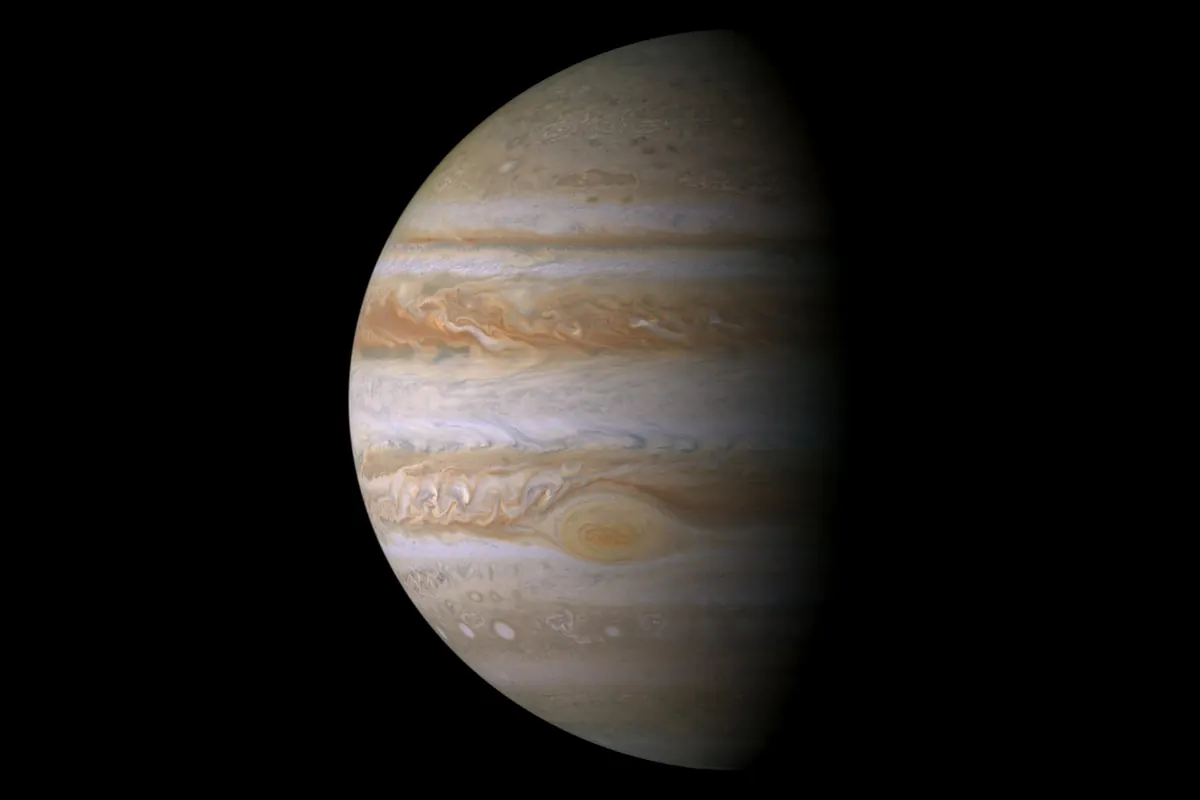
The Great Red Spot, measured
The Great Red Spot has been watched for more than 300 years. NASA describes it as a swirling oval about twice as wide as Earth. Data from the Juno spacecraft puts its depth at about 500 km below the cloud tops, which is shallow next to its width. Three smaller ovals merged into the Little Red Spot, about half the Great Red Spot's size.
The stripes and swirls are cold, windy clouds of ammonia and water floating in an atmosphere of hydrogen and helium. The dark orange stripes are called belts, the lighter ones zones, and they flow east and west in opposite directions.
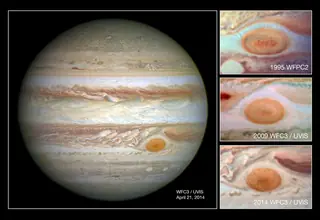
The Great Red Spot is a giant storm bigger than Earth that has raged for hundreds of years. It's shrinking: Hubble images from 1995, 2009 and 2014 show its diameter dropping from just under 21,000 kilometers to about 16,000, and astronomers have followed the downsizing since the 1930s.
Jupiter in numbers
| Measure | Jupiter | Compared with Earth |
|---|---|---|
| Diameter | 142,984 km | 11.21 x Earth |
| Mass | 1898 x 1024 kg | 318 x Earth |
| Density | 1,326 kg/m3 | 0.24 x Earth |
| Surface gravity | 23.1 m/s2 | 2.36 x Earth |
| Escape velocity | 59.5 km/s | 5.31 x Earth |
| One rotation | 9.9 hours | 0.41 x Earth |
| Sunrise to sunrise | 9.9 hours | 0.41 x Earth |
| Year | 11.9 years (4,331 Earth days) | 11.86 x Earth |
| Average distance from the Sun | 778.5 million km (5.20 AU) | 5.20 x Earth |
| Average temperature | -110 C (-166 F) | Earth: 15 C |
| Axial tilt | 3.1 degrees | Earth: 23.4 degrees |
| Moons | 115 | Earth: 1 |
| Rings | Yes | Earth: No |
Numbers from the NASA Planetary Fact Sheet. Temperature and gravity for gas and ice giants are given at the level where the pressure is one bar, since they have no solid surface. Moon count from the JPL list read on October 19, 2026.
What makes Jupiter different
A day on Jupiter lasts 9.9 hours, and a year lasts about 12 Earth years. The planet is nearly upright, tilted only about 3 degrees, so it has no strong seasons.
With 115 moons officially recognized, Jupiter forms a kind of miniature solar system. Galileo saw the four largest in 1610: Io, the most volcanically active body in the solar system; Europa, which probably hides an ocean; Ganymede, the largest moon in the solar system and bigger than Mercury; and Callisto, whose few small craters point to little current surface activity. Jupiter's rings were discovered by Voyager 1 in 1979.
Visiting Jupiter
NASA's Europa Clipper, launched on October 14, 2024, is on its way to study Europa. The picture on this page is a mosaic from the Cassini spacecraft, which passed Jupiter on its way to Saturn.
Known, inferred, unknown
We keep these apart on every science page.
Measured: we know this
- A day lasts 9.9 hours and a year lasts about 4,333 Earth days.
- The Great Red Spot has shrunk from just under 21,000 kilometers across in 1995 to about 16,000 in 2014.
Inferred: we think this
- A liquid ocean with the ingredients for life may lie under the frozen crust of Europa.
Unknown: we don't know
- Whether life could exist in any of Jupiter's moons. Europa is one of the likeliest places in the solar system to look.
Questions people ask
How long is a day on Jupiter?
One rotation takes 9.9 hours.
How many moons does Jupiter have?
It has 115 known moons, by the JPL list read on October 19, 2026.
Is Jupiter's Great Red Spot shrinking?
Yes. Hubble images show its diameter falling from just under 21,000 kilometers in 1995 to about 16,000 kilometers in 2014. Astronomers have followed the shrinking since the 1930s.
Keep exploring
 MarsRocky planet, 1.52 AU from the Sun.
 SaturnGas giant, 9.57 AU from the Sun.
 How long is a day on each planet?Day length on every planet, and why a day isn't always one spin.
 Planet sizes comparedEvery planet drawn to scale, with diameters next to Earth.
 Weight on other planetsWhat you would weigh on Jupiter.
Jupiter's moon count has climbed through the decades, as the discoveries by year chart shows.
A weather system with no ground
Winds at the equator reach up to 539 km/h. The three cloud decks span about 71 km: ammonia ice on top, ammonium hydrosulfide crystals in the middle, and water ice and vapor below. Juno found that the jet streams reach about 3,200 km down, far deeper than the clouds you can see.
The planet is the largest in the solar system and still spins in 9.9 hours, the shortest day of any planet.
A radiation belt around a planet
The magnetic field is 16 to 54 times as strong as Earth's. The magnetosphere extends 1 to 3 million km toward the Sun and its tail stretches more than 1 billion km, as far as Saturn's orbit. Charged particles trapped inside create radiation that can damage spacecraft.
The rings are made of small, dark particles, and the ringed planets page compares them with the other ring systems.
The missions
Voyager 2 made its closest approach on 9 July 1979. New Horizons passed on 28 February 2007, about 2.3 million km away, on its way to Pluto. Galileo arrived on 7 December 1995, and its atmospheric probe survived about 58 minutes in the clouds. The orbiter was deliberately sent into Jupiter on 21 September 2003 so it couldn't contaminate Europa.
Juno launched on 5 August 2011 and entered orbit on 4 July 2016. Its measurements suggest a "fuzzy" core of rock and metallic hydrogen, and it imaged clusters of stable cyclones at the poles. NASA extended the mission in 2021 to September 2025, and Juno was still returning data in 2026.
The Juno page has the orbit details, and the Europa page covers the moon that Europa Clipper is heading for. The travel time page shows how long a trip takes. When Jupiter is brightest, the opposition page tells you when to look.