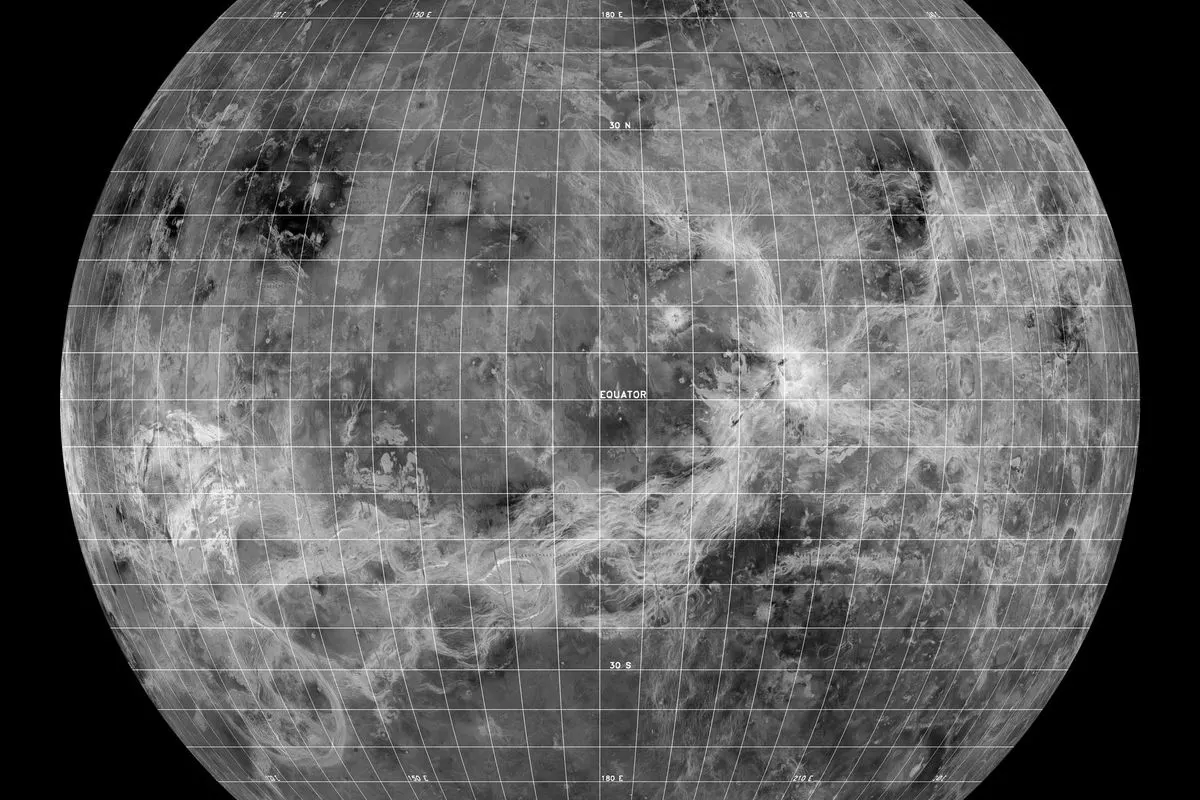
The first planetary mission took 109 days
Mariner 2 left Cape Canaveral on August 27, 1962 and passed Venus 109 days later, on December 14, at a range of 34,854 km. NASA counts it as the first successful planetary science mission, and it found Venus to be far hotter than expected.
Mariner 2 didn't stop. It flew past, measured what it could and carried on. Almost every Venus trip since has had to decide how much of that speed to burn off.
Getting down is harder than getting there
The surface is the other half of the story. NASA puts it at about 872 degrees Fahrenheit (467 Celsius), hot enough to melt lead, with air pressure about 93 times that at sea level on Earth. The Soviet Venera 7 landed on December 15, 1970, 120 days after launch, and its lander transmitted for 23 minutes. Venera 13 touched down on March 1, 1982 and kept working for 127 minutes, against an expected 30. Guinness lists it as the longest anything has lasted on Venus.
The extremes are the subject of the hottest planet, which explains why Venus is hotter than Mercury.
Travel time by vehicle
| Vehicle | Speed | Closest | Typical | Farthest |
|---|---|---|---|---|
| Walking | 3 mph | 903 years | 3,535 years | 6,167 years |
| Bicycle | 12 mph | 226 years | 884 years | 1,542 years |
| Car on a highway | 65 mph | 41.7 years | 163 years | 285 years |
| Passenger jet | 570 mph | 4.8 years | 18.6 years | 32.5 years |
| SR-71 Blackbird, its official speed record | 2,193 mph | 451 days | 4.8 years | 8.4 years |
| Voyager 1, about 17 km/s | 38,028 mph | 26 days | 102 days | 178 days |
| Parker Solar Probe at closest approach, 692,000 km/h | 429,989 mph | 2 days 7 hours | 9 days | 16 days |
| Light | 670,616,629 mph | 2 minutes 7 seconds | 8 minutes 19 seconds | 14 minutes 31 seconds |
How long real spacecraft took
Mariner 2 needed 109 days. Spacecraft rarely fly straight at a target. They follow curved paths timed to launch windows, so the trip is longer than the distance alone suggests.
| Mission | Launched | Arrived | Trip time | What happened |
|---|---|---|---|---|
| Mariner 2 | August 27, 1962 | December 14, 1962 | 109 days | Closest approach to Venus |
Why the answer changes
Venus is 6.8 times farther away at its farthest than at its closest, so every travel time above is 6.8 times longer at the far end. The distance depends on where both planets are in their orbits. The closest figure is the smallest possible gap, and the typical figure is the midpoint between the closest and the farthest.
Try your own speed
Other destinations
 The MoonBy car, 145 days at the closest.
 MarsBy car, 59.5 years at the closest.
 The SunBy car, 160 years at the closest.
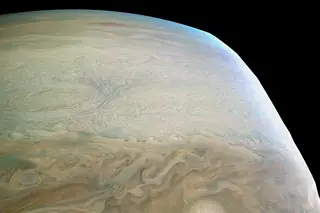 JupiterBy car, 642 years at the closest.
An orbit that needs braking
ESA's Venus Express launched on November 9, 2005 and fired its main engine for about 50 minutes on April 11, 2006, slowing by roughly 1,251 meters per second so that Venus could capture it. That's 153 days from launch to orbit. A spacecraft that arrives at cruising speed and doesn't brake simply flies past, as Mariner 2 did.
Close, but not always the closest
The fact sheet gives Venus a minimum distance from Earth of 38,200,000 km, closer than Mars (54,600,000 km) or Mercury (77,300,000 km). The maximum is 261,000,000 km, with Venus on the far side of the Sun, which is 6.8 times as far. Light covers the shortest gap in 2 minutes 7 seconds and the longest in 14 minutes 31 seconds, so a radio round trip takes between about 4 and 29 minutes.
A day longer than a year
Venus is odd in another way. NASA says a day there lasts 243 Earth days, longer than the 225-day year, and the Sun rises in the west because Venus spins backward. That's covered in how long a day lasts on each planet. You can see Venus at its best, in the evening or the morning sky, in Venus at greatest elongation. For the planet itself, see Venus.
The speed Venus would demand
Suppose you wanted to reach Venus in the 76 hours Apollo 11 needed to enter lunar orbit. At the closest distance in the fact sheet, 38,200,000 km, that means averaging 503,736 km/h, or 313,007 mph, for the whole trip. Venus is the closest planet in the table, and even so the sum is large. Stretch the same trip to one year and the average falls to 4,358 km/h (2,708 mph), a figure a spacecraft can reach, which is why real missions take months or years.
Sunlight at Venus
Sunlight gets weaker with the square of the distance. With Venus at 0.72 times Earth's distance from the Sun on average, it receives about 1.91 times as much sunlight as Earth does. Light from the Sun takes 6.0 minutes to get there, against 8.3 minutes to reach Earth. The distances come from the NASA fact sheet and the sums are done here.
A year, a pull and the moons
Venus takes 225 days to go round the Sun, which is 0.62 Earth years. Surface gravity is 0.91 times Earth's, so a 70 kg person would read about 63 kg on a scale there. The fact sheet lists no moons. Try your own numbers in the weight calculator or the age calculator.
How often Earth and Venus line up
Earth laps Venus on a regular schedule. Using the orbital periods in the fact sheet, the two planets return to the same relative positions every 584 days, about 19.2 months. That's the rhythm that mission planners work to, although the gap between launch and arrival depends on the route chosen, not on this number alone. It's the same method used on the Mars page, where the pattern gives a launch window roughly every 26 months.
Venus against Earth
Venus is nearly Earth's twin in pull, at 0.907 times Earth's surface gravity, and a year there lasts 224.7 days. The distance from the Sun is 0.72 times Earth's, so sunlight is about 1.9 times as strong. Even so, the surface is far hotter than anything on Earth, and the reasons are in the Venus page.