The next ten greatest elongations
| Date | Angle from the Sun | Sky | Height at twilight, 40 N | Height at twilight, 30 S |
|---|---|---|---|---|
| January 3, 2027 | 47.0 degrees | Morning, west of the Sun | 26 degrees | 27 degrees |
| March 22, 2028 | 46.1 degrees | Evening, east of the Sun | 36 degrees | 15 degrees |
| August 10, 2028 | 45.8 degrees | Morning, west of the Sun | 29 degrees | 23 degrees |
| October 27, 2029 | 47.0 degrees | Evening, east of the Sun | 13 degrees | 37 degrees |
| March 17, 2030 | 46.6 degrees | Morning, west of the Sun | 13 degrees | 35 degrees |
| June 2, 2031 | 45.4 degrees | Evening, east of the Sun | 28 degrees | 25 degrees |
| October 21, 2031 | 46.4 degrees | Morning, west of the Sun | 34 degrees | 17 degrees |
| January 7, 2033 | 47.2 degrees | Evening, east of the Sun | 30 degrees | 24 degrees |
| May 29, 2033 | 45.9 degrees | Morning, west of the Sun | 13 degrees | 34 degrees |
| August 12, 2034 | 45.9 degrees | Evening, east of the Sun | 11 degrees | 36 degrees |
Heights are for local solar time, 45 minutes after sunset for an evening elongation and 45 minutes before sunrise for a morning one, at 40 degrees north and 30 degrees south. The higher the planet, the easier it's to see over the horizon haze.
What greatest elongation means
Venus orbits inside Earth's orbit, so it never strays far from the Sun in the sky. It swings from the evening sky to the morning sky and back, taking about 19 months for the cycle. Greatest elongation is when it appears farthest from the Sun in our sky. It's a good time to look because the planet is as high as it gets at twilight, although it isn't always the brightest moment. In this list the angle runs from 45.4 degrees (June 2, 2031) to 47.2 degrees (January 7, 2033).
The best appearance in this list
From 40 degrees north the highest Venus gets at twilight in this list is 36 degrees, at the elongation on March 22, 2028. From 30 degrees south it's 37 degrees, on October 27, 2029. Which ones are best depends on the angle the ecliptic makes with the horizon at sunset or sunrise, which changes with the season and your latitude.
A 19-month pattern
Venus runs through a cycle of evening and morning appearances that repeats every 584 days, about 19 months. It spends several months in the evening sky, vanishes into the Sun's glare, and returns in the morning. Greatest elongation, the date when it stands farthest from the Sun, comes once in each half. The next is on January 3, 2027, when Venus is 47.0 degrees from the Sun in the morning sky.
Because the cycle is 583.9 days, five of them add up to 7.99 years. In other words, Venus draws nearly the same pattern against the calendar every eight years, and the dates of its elongations shift by only about 2 days over that time.
The oldest planet record
People have tracked Venus for thousands of years. The Venus tablet of Ammisaduqa, a Babylonian record of the planet's first and last appearances over 21 years, survives in copies from the 7th century BC. In the Americas, the Maya wrote down the cycle in the Dresden Codex, which uses the figure of 584 days, within a day of the modern mean of 583.92 days.
Both cultures tied the appearances to omens and ritual, so they had a strong reason to record them accurately. The accuracy of the numbers shows how much careful, repeated looking was involved.
Phases that changed astronomy
In 1610, Galileo turned his telescope on Venus and saw that it showed phases like the Moon's. It was a thin crescent when closest and a small, full disk when far away. That couldn't happen if Venus circled Earth, as the old model said, but it fit if Venus circled the Sun. Galileo wrote that discovery up in a coded announcement before he explained it.
At greatest elongation, Venus is about half lit, like a quarter Moon. It then grows larger and thinner as it swings toward Earth, and the brightest moment of the cycle comes a month or so after elongation, when the crescent is larger. At best Venus reaches a magnitude of about -4.6, far brighter than any star, and bright enough to cast a shadow from a dark site.
How wide the angle gets
The angle from the Sun varies. In the list above it runs from 45.4 degrees (June 2, 2031) to 47.2 degrees (January 7, 2033), because Venus's orbit is slightly oval and Earth's distance from the Sun changes over the year. The wider the angle, the longer Venus stays up after sunset or before sunrise.
How high it appears also depends on where you are and the season. The table above gives its height at twilight for 40 degrees north and 30 degrees south. In general it's highest when the line of the ecliptic stands steeply from the horizon, which is spring evenings and autumn mornings in the Northern Hemisphere.
Transits and how rare they are
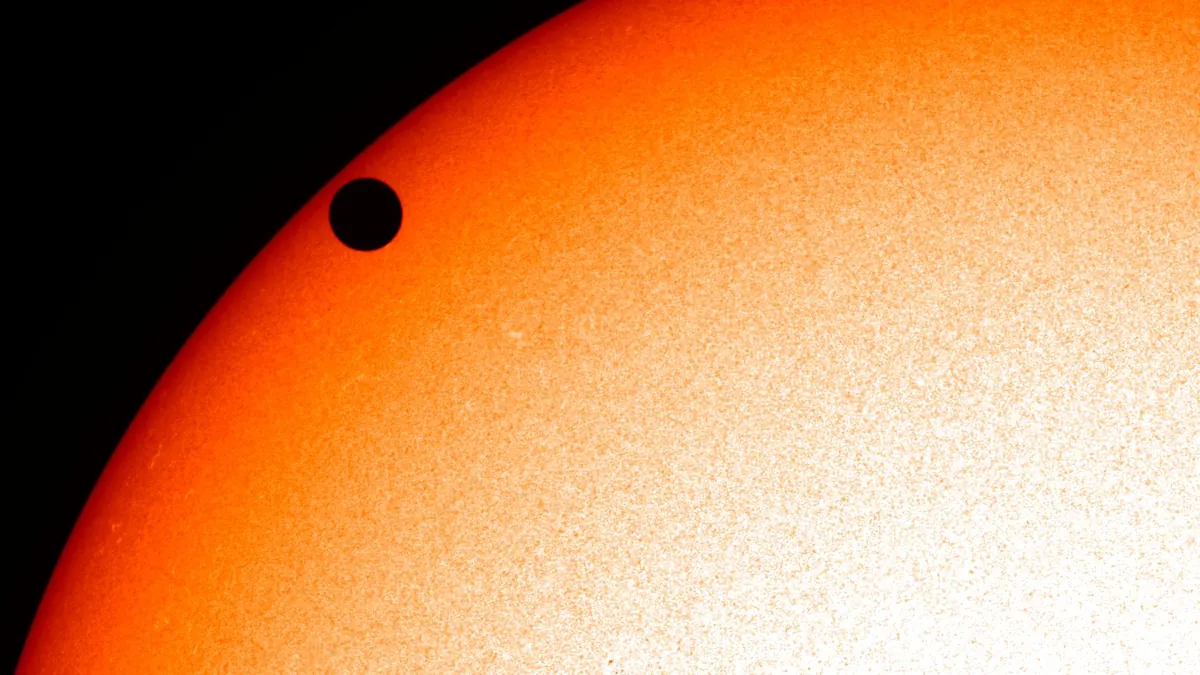
Occasionally Venus passes directly in front of the Sun. The last transits were on June 8, 2004 and June 5, 2012, and the next is in 2117. They come in pairs eight years apart, with gaps of more than a century between pairs. Transits were once the best way to measure the distance to the Sun, which is why 18th-century expeditions traveled around the world to watch them.
A Venus transit needs the same solar filters as an eclipse, and the next solar eclipse page has the safety rules. Mercury makes transits much more often, and you can read about its schedule on the Mercury elongation page. For the outer planets and their closest approaches, see planet oppositions.
Picking your evening or morning
Of the next ten greatest elongations, 5 are in the evening sky and 5 in the morning. From 40 degrees north, the best twilight view is 36 degrees high on March 22, 2028. From 30 degrees south, it's 37 degrees on October 27, 2029.
The easiest way to watch is to start before the date. Venus is usually visible for months either side of greatest elongation, and every week it changes its shape and its height. A pair of binoculars is enough to see the half-lit disk, and a small telescope shows the crescent as it narrows.
Venus is bright enough to find in a blue daytime sky if you know exactly where to look. Use the Moon as a guide on a day when the crescent is near it, shade your eyes from the Sun, and scan with binoculars until a small white point appears.
 Planet oppositionsWhen Mars, Jupiter and the outer planets are closest.
 Mercury elongationThe other inner planet.
 Sky calendarEvery sky page.
Questions people ask
When is Venus at greatest elongation next?
January 3, 2027, 47.0 degrees west of the Sun.
Is Venus a morning or evening object after that?
After the elongation on January 3, 2027 it's in the morning sky.
How far from the Sun can Venus get?
In this list between 45.4 and 47.2 degrees.
What does greatest elongation mean?
It's when an inner planet appears farthest from the Sun in the sky, which is a good time to look for it at twilight.