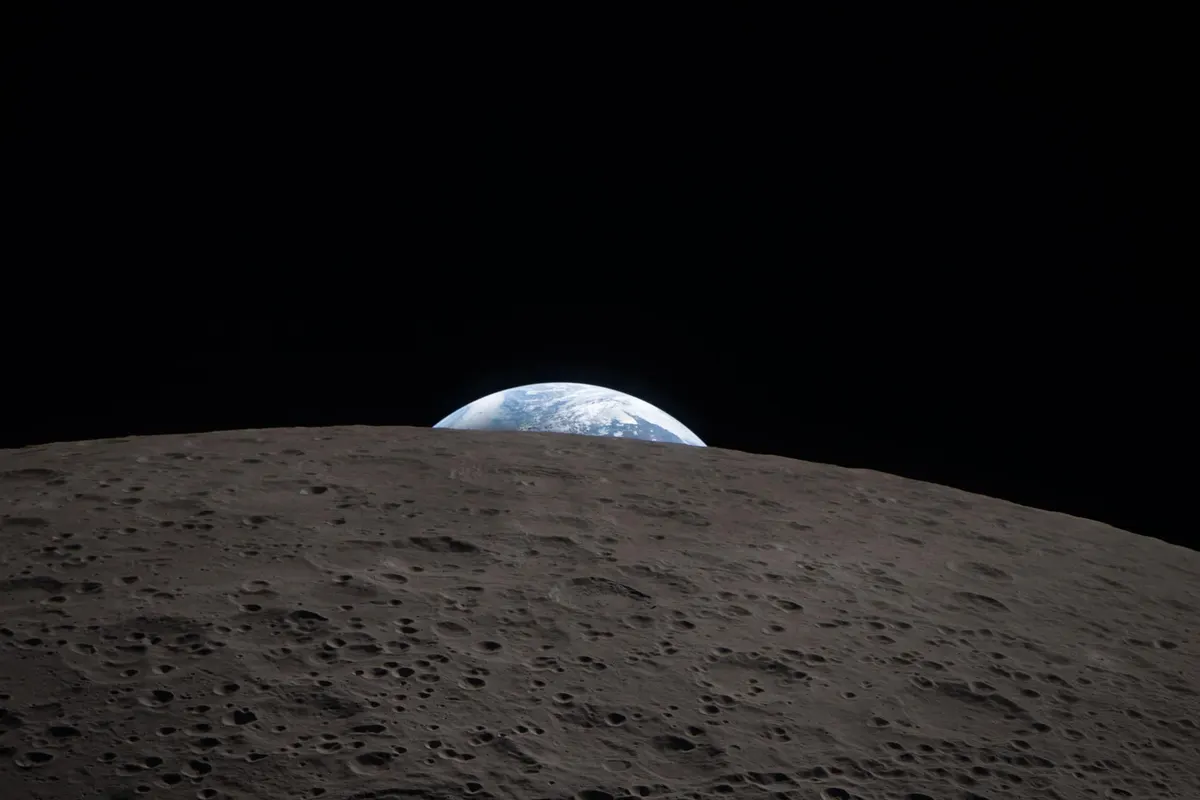
The fastest trip was a crash
The quickest way to the Moon is to hit it. The Soviet probe Luna 2 left Earth on September 12, 1959 and struck the lunar surface about 38 hours later, on the evening of the next day. NASA lists it as the first spacecraft to impact the Moon. Nothing on board needed to slow down, so it simply arrived at full speed.
That's why the table below can look slow by comparison. A car at 65 mph would need 145 days to cover even the Moon's shortest distance, and a passenger jet would still need 17 days. A spacecraft that wants to stay has a different problem from one that only wants to arrive. Many Moon missions since Luna 2 have wanted to stay, to orbit, to land or to come home, and that costs time. The list is in every Moon landing and how many missions have gone to the Moon.
Why Apollo took three days
Apollo 8, the first crew to leave Earth orbit, needed 69 hours from launch to lunar orbit. Apollo 11 took 75 hours and 50 minutes to enter orbit and about 102 hours and 45 minutes to touch down, according to NASA's mission overview.
The timeline shows where the time went. Two hours and 44 minutes after liftoff the Saturn V's third stage fired for five minutes and 48 seconds to send the spacecraft toward the Moon. Then the crew coasted for roughly 73 hours, slowing as Earth's gravity pulled back, until a 357-second burn behind the Moon let the Moon's gravity capture them. The coast is long because speed is the costly part of the trip, not distance. More of the Apollo story is in Apollo by the numbers.
Travel time by vehicle
| Vehicle | Speed | Closest | Typical | Farthest |
|---|---|---|---|---|
| Walking | 3 mph | 8.6 years | 9.1 years | 9.6 years |
| Bicycle | 12 mph | 2.1 years | 2.3 years | 2.4 years |
| Car on a highway | 65 mph | 145 days | 153 days | 162 days |
| Passenger jet | 570 mph | 17 days | 17 days | 18 days |
| SR-71 Blackbird, its official speed record | 2,193 mph | 4 days 7 hours | 4 days 13 hours | 4 days 19 hours |
| Voyager 1, about 17 km/s | 38,028 mph | 5 hours 56 minutes | 6 hours 16 minutes | 6 hours 37 minutes |
| Parker Solar Probe at closest approach, 692,000 km/h | 429,989 mph | 31 minutes 30 seconds | 33 minutes 20 seconds | 35 minutes 10 seconds |
| Light | 670,616,629 mph | 1.2 seconds | 1.3 seconds | 1.4 seconds |
How long real spacecraft took
Apollo 8 needed 2 days 21 hours and Apollo 11 4 days 7 hours. Spacecraft rarely fly straight at a target. They follow curved paths timed to launch windows, so the trip is longer than the distance alone suggests.
| Mission | Launched | Arrived | Trip time | What happened |
|---|---|---|---|---|
| Apollo 8 | December 21, 1968 | December 24, 1968 | 2 days 21 hours | Entered lunar orbit |
| Apollo 11 | July 16, 1969 | July 20, 1969 | 4 days 7 hours | Landed in the Sea of Tranquility |
Why the answer changes
The Moon is 1.1 times farther away at its farthest than at its closest, so every travel time above is 1.1 times longer at the far end. The Moon's orbit is an ellipse, with a closest point (perigee) of 225,744 miles and a farthest point (apogee) of 251,966 miles. The typical figure is its average distance.
Try your own speed
Other destinations
 MarsBy car, 59.5 years at the closest.
 The SunBy car, 160 years at the closest.
 VenusBy car, 41.7 years at the closest.
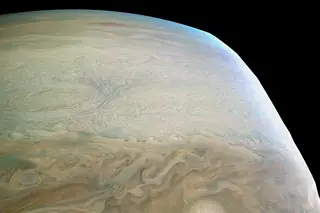 JupiterBy car, 642 years at the closest.
Artemis II: ten days there and back
In April 2026 four astronauts became the first people to travel to the Moon in more than half a century. Artemis II launched at 6:35 p.m. on April 1 and splashed down off San Diego after a nearly 10-day trip. It flew around the Moon and back, and at its farthest it was 252,756 miles from Earth, which NASA says passed the distance record set by Apollo 13 in 1970. The crew are counted in how many people have gone to the Moon.
The slow way: an ion engine
At the other extreme, ESA's SMART-1 launched on September 27, 2003 and was captured by the Moon on November 15, 2004, a trip of 415 days, or about 14 months. It used an ion engine, which pushes very gently with electrically charged xenon gas. ESA says the voyage was neither quick nor direct, and that it was only the second spacecraft to use ion propulsion as its main engine. The gain is fuel. SMART-1 spiraled outward from Earth for months, then let the Moon's gravity capture it in a gentle pull.
Why the Moon's distance moves
The Moon's orbit is an ellipse, so its distance changes. It's 363,300 km from Earth at its closest and 405,500 km at its farthest, a spread of about 12 percent. Light covers the shortest gap in 1.2 seconds and the longest in 1.4 seconds. A radio call to the Moon and back therefore has a delay of 2.4 to 2.7 seconds. Compare that with the delay to Mars in the Mars page, or try your own distance in the light travel calculator.
What the table leaves out
Every speed in the table is a steady cruise. A real Moon trip is a series of burns: one to leave Earth, small corrections along the way and one to be captured. The table shows how big the gap is. Luna 2, Apollo, Artemis II and SMART-1 show four very different ways of crossing it.
Gravity and the lunar month
The Moon pulls at 0.166 of Earth's gravity, about 1.6 meters per second squared. A 70 kg person would read about 12 kg on a scale there, which is why Apollo astronauts bounded across the surface. It circles Earth once every 27.3 days. The weight maths is in the weight calculator.
If Apollo had to hurry
Apollo 11 needed 76 hours to enter lunar orbit. Covering the Moon's closest distance, 363,300 km, in that time means averaging 4,791 km/h, or 2,977 mph. Across the longest gap, 405,500 km, the same trip would need 5,347 km/h. Real missions don't average these speeds, because they coast: a long fast burn, a slow middle and a braking burn at the end.
The same distance by light and by jet
A radio signal needs 1.3 seconds to cover the average distance, 384,400 km, and a passenger jet at 570 mph would need 17 days. A car at 65 mph would need 153 days. Apollo's crew did it in a little over three days, which is quick compared with any road trip and slow compared with light.