The surprise
You would expect the planet closest to the Sun to be the hottest. Mercury does get far more sunlight: 9,083 watts for every square meter, against 2,601 on Venus. But Mercury isn't the hottest planet. NASA gives that title to Venus, thanks to its dense atmosphere.
| Measure | Venus | Mercury | Earth |
|---|---|---|---|
| Average temperature | 464 C | 167 C | 15 C |
| Distance from the Sun (million km) | 108.2 | 57.9 | 149.6 |
| Sunlight at the planet (W/m2) | 2,601 | 9,083 | 1,361 |
| Share of sunlight reflected (Bond albedo) | 0.77 | 0.07 | 0.29 |
| Surface pressure (bars) | 92 | 0 | 1 |
Sunlight and albedo values from the NASA Planetary Fact Sheet detail pages for each planet. Pressure is at the surface.
The first thermometer to reach Venus
Nobody knew how hot Venus was until spacecraft went there. NASA's Mariner 2 flew past on December 14, 1962, the first successful flyby of another planet, and its instruments showed that the planet's surface was extremely hot. The surface itself was reached on December 15, 1970, when the Soviet Union's Venera 7 landed and sent a signal back. It lasted only about 23 minutes. NASA says that ten Venera landers reached the surface in all, and the longest of them survived about 2 hours.
What the atmosphere does
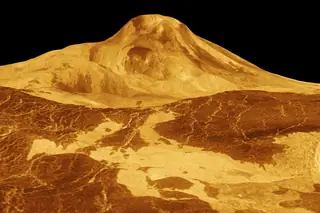
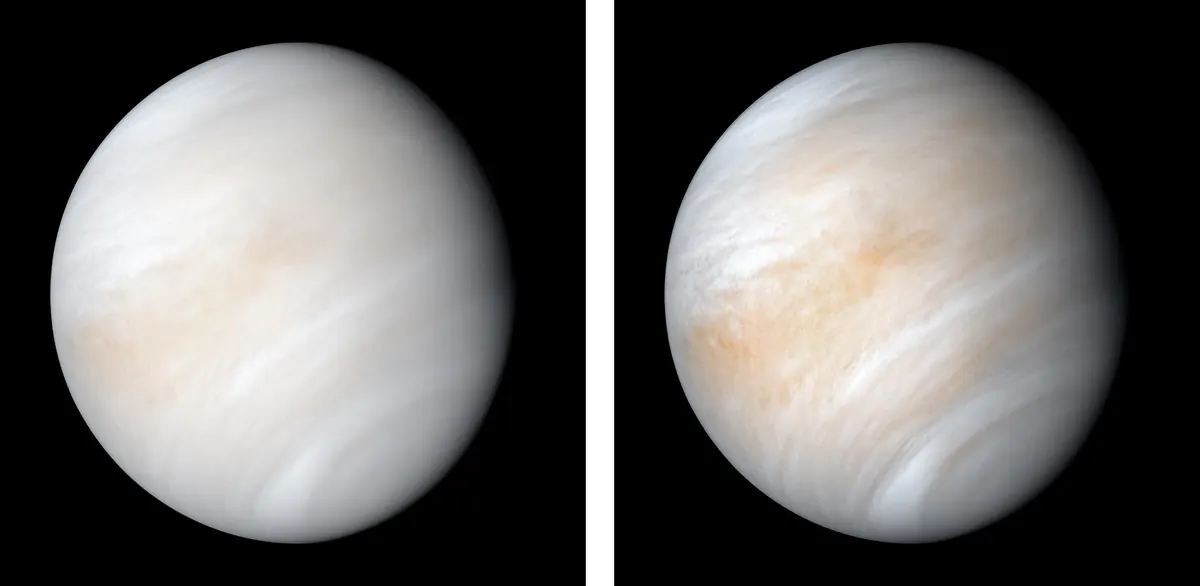
Venus is wrapped in thick, persistent clouds. Its atmosphere traps heat in a runaway greenhouse effect, and the pressure at the surface is about 92 times what it is at sea level on Earth. Venus reflects 77 percent of the sunlight that hits it, yet it still ends up far hotter than Mercury, which reflects only 7 percent.
A quick sum shows how much work the greenhouse does. Averaged over the whole sphere, and counting only the sunlight that isn't reflected, Venus absorbs about 150 watts per square meter, and Mercury about 2,116. Mercury takes in about 14 times as much heat, and yet it's the colder world. The difference is the air.
Mercury's extremes
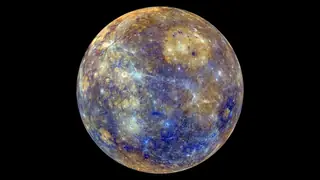
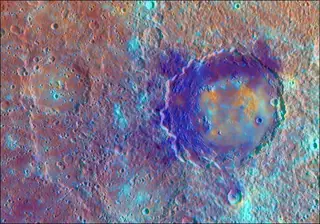
With almost no atmosphere, Mercury can't hold heat. On the day side it can reach about 430 degrees Celsius, still cooler than the average surface of Venus, and the night side can fall to about minus 180. Venus has no such night chill, because the thick air carries heat around the planet. Oddly, NASA says Mercury may hold water ice in permanently shadowed craters near its poles.
Two numbers for one planet
NASA's Venus page gives a surface temperature of 467 C and a pressure of 93 times Earth's. The fact sheet gives 464 C and 92 bar. The gap is small, and it's a reminder that a planet's temperature is a range of readings and not a single number.
A mild layer in the clouds
About 50 kilometers up in the atmosphere of Venus, temperatures run from about 30 to 70 degrees Celsius and the pressure is close to what we have on Earth's surface. That's one reason scientists ask whether anything could live in the clouds. In 2020 a team reported in Nature Astronomy that it had detected phosphine, a gas linked to life on Earth, at around 20 parts per billion, and later analyses lowered the figure to 7 or less. The finding is disputed, and nothing found so far is convincing evidence of life.
What Venus teaches us
Venus is close to Earth in size and structure, which is why it is sometimes called Earth's twin. Its history is a warning about what a runaway greenhouse effect can do. NASA also describes a vanished ocean on Venus, evidence that it was once very different. See the temperature of every planet to set it against the others, or the Venus page for the full profile.
Why the answer matters for Earth
Venus is the extreme case of something that also happens here. Earth's atmosphere keeps the planet about 34 degrees warmer than it would be without it, and Venus shows how far the same mechanism can go when the air is thick and carbon dioxide dominates. Scientists compare the two worlds because they're close in size and made of similar material, and because they ended up so different.
Could anything survive there?
At the surface, no. The longest any lander lasted was about 2 hours. But the cooler layer of cloud 50 kilometers up has kept scientists curious. The idea is old and unproven, and the phosphine result remains argued over. The order of the planets puts Venus second from the Sun.
What 92 bars feels like
The pressure at the surface of Venus is about 92 times Earth's. On Earth the same pressure would be found roughly 920 meters under the sea, since each ten meters of water adds about one bar. A craft landing on Venus has to cope with that pressure and the heat at the same time, which is part of why the Soviet landers lasted only minutes to hours.
Hot enough for lead
Lead melts at about 327 degrees Celsius. The average surface temperature of Venus is 464, well above that. A kitchen oven typically tops out at about 250 C, so the surface of Venus is roughly twice as hot as the top setting on an oven.
The reading you'll see elsewhere
Different sources quote the temperature of Venus as 462, 464 or 467 degrees, and the pressure as 92 or 93 bars. The differences are small and come down to rounding, the date of the table, and whether the figure is for one site or an average. The average on this page comes from the NASA fact sheet, and NASA's own Venus page is used for the history above. Both agree that no other planet comes close.
Questions people ask
Which planet is the hottest in the solar system?
Venus, which averages 464 C. A thick atmosphere traps heat in a runaway greenhouse effect.
Why is Venus hotter than Mercury?
Mercury is closer to the Sun and gets about 3.5 times more sunlight, but it has almost no atmosphere. Venus has an atmosphere that presses on the surface with about 92 times the pressure of Earth's, and it traps heat.
How hot is the surface of Venus?
The fact sheet gives an average of 464 C, hot enough to melt lead. NASA's Venus page gives 467 C.
Is it cool anywhere on Venus?
High in the atmosphere, about 50 kilometers up, temperatures run from about 30 to 70 degrees Celsius and the pressure is similar to Earth's surface.