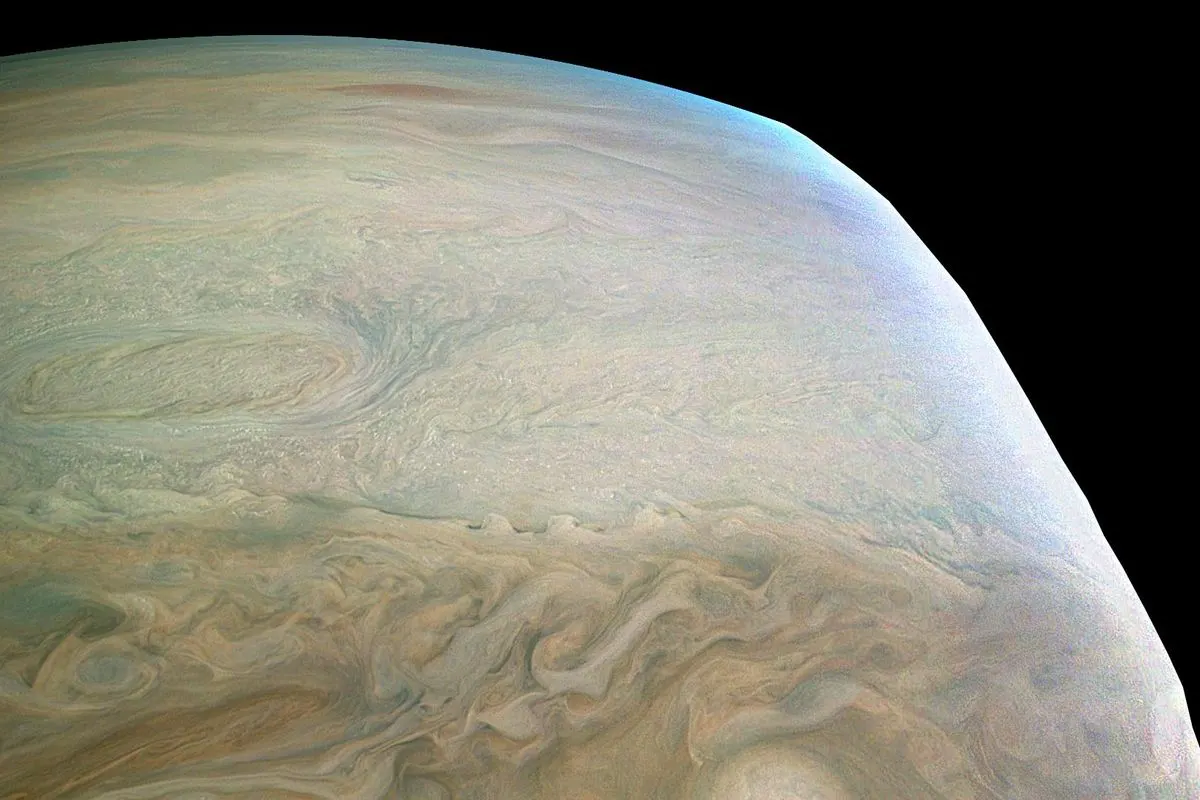
Pioneer and Voyager did it in under two years
The first spacecraft to reach Jupiter, Pioneer 10, launched on March 2, 1972 and made its closest approach on December 4, 1973 (Universal Time), a flight of 642 days. NASA designed it for a 21-month mission and it kept working for more than 30 years. Voyager 1 took 547 days, launching on September 5, 1977 and reaching Jupiter on March 5, 1979.
These were flybys, and flybys are fast. They aim for Jupiter at full speed, borrow some of its orbital motion and carry on. Pioneer 10 passed at a range of about 130,354 km. Voyager 1's own story is in the Voyager 1 page.
Staying takes five years
Juno was built to stay. It launched on August 5, 2011 and entered orbit on July 4, 2016 (California time), a trip of 4.9 years. It didn't fly straight there. It looped back past Earth on October 9, 2013, and the flyby raised its speed by more than 8,800 mph, from about 78,000 mph to about 87,000 mph relative to the Sun.
The lesson is the same as at Mars. The fast trips can't stop, and the missions that stop are slow. The spacecraft is covered in the Juno page.
Travel time by vehicle
| Vehicle | Speed | Closest | Typical | Farthest |
|---|---|---|---|---|
| Walking | 3 mph | 13,905 years | 18,394 years | 22,884 years |
| Bicycle | 12 mph | 3,476 years | 4,599 years | 5,721 years |
| Car on a highway | 65 mph | 642 years | 849 years | 1,056 years |
| Passenger jet | 570 mph | 73.2 years | 96.8 years | 120 years |
| SR-71 Blackbird, its official speed record | 2,193 mph | 19.0 years | 25.2 years | 31.3 years |
| Voyager 1, about 17 km/s | 38,028 mph | 401 days | 530 days | 659 days |
| Parker Solar Probe at closest approach, 692,000 km/h | 429,989 mph | 35 days | 47 days | 58 days |
| Light | 670,616,629 mph | 32 minutes 43 seconds | 43 minutes 17 seconds | 53 minutes 51 seconds |
How long real spacecraft took
Voyager 1 needed 547 days and Juno 4.9 years. Spacecraft rarely fly straight at a target. They follow curved paths timed to launch windows, so the trip is longer than the distance alone suggests.
| Mission | Launched | Arrived | Trip time | What happened |
|---|---|---|---|---|
| Voyager 1 | September 5, 1977 | March 5, 1979 | 547 days | Closest approach to Jupiter |
| Juno | August 5, 2011 | July 5, 2016 | 4.9 years | Entered orbit around Jupiter |
Why the answer changes
Jupiter is 1.6 times farther away at its farthest than at its closest, so every travel time above is 1.6 times longer at the far end. The distance depends on where both planets are in their orbits. The closest figure is the smallest possible gap, and the typical figure is the midpoint between the closest and the farthest.
Try your own speed
Other destinations
 The MoonBy car, 145 days at the closest.
 MarsBy car, 59.5 years at the closest.
 The SunBy car, 160 years at the closest.
 VenusBy car, 41.7 years at the closest.
Europa Clipper takes the long way round
NASA's Europa Clipper launched on October 14, 2024 and is due at Jupiter in April 2030, a trip of about 5.5 years that covers about 1.8 billion miles. Its path takes it past Mars in 2025 and back past Earth on December 3, 2026, gaining speed from each planet. It'll then make 49 close passes of the moon Europa. Read about the target in Europa and about its neighbor Io.
A target that moves
Jupiter is 588,500,000 km away at the closest point in the fact sheet and 968,500,000 km at the farthest, so a flight time can differ by about 65 percent depending on the date. Light needs 32 minutes 43 seconds to reach it at best and 53 minutes 51 seconds at worst. The best viewing dates, when Jupiter is brightest in the sky, are in Jupiter at opposition.
What a car would manage
At 65 mph a car would need 642 years to reach Jupiter at its closest, and a passenger jet 73.2 years. Real spacecraft cruise at tens of thousands of miles an hour and still take years. The planet is covered in Jupiter.
The speed Jupiter would demand
Suppose you wanted to reach Jupiter in the 76 hours Apollo 11 needed to enter lunar orbit. At the closest distance in the fact sheet, 588,500,000 km, that means averaging 7,760,443 km/h, or 4,822,116 mph, for the whole trip. Jupiter is the first giant on the way out, and the gap is already huge. Stretch the same trip to one year and the average falls to 67,134 km/h (41,715 mph), a figure a spacecraft can reach, which is why real missions take months or years.
Sunlight at Jupiter
Sunlight gets weaker with the square of the distance. With Jupiter at 5.20 times Earth's distance from the Sun on average, it receives about 0.0369 times as much sunlight as Earth does. Light from the Sun takes 43.3 minutes to get there, against 8.3 minutes to reach Earth. The distances come from the NASA fact sheet and the sums are done here.
A year, a pull and the moons
Jupiter takes 4,331 days to go round the Sun, which is 11.86 Earth years. Surface gravity is 2.36 times Earth's, so a 70 kg person would read about 165 kg on a scale there. The fact sheet lists 95 known moons. Try your own numbers in the weight calculator or the age calculator.
How often Earth and Jupiter line up
Earth laps Jupiter on a regular schedule. Using the orbital periods in the fact sheet, the two planets return to the same relative positions every 399 days, about 13.1 months. That's the rhythm that mission planners work to, although the gap between launch and arrival depends on the route chosen, not on this number alone. It's the same method used on the Mars page, where the pattern gives a launch window roughly every 26 months.
Three flights compared
Pioneer 10 took 642 days, Voyager 1 took 547 days and Juno took 1,795 days. Juno was the slowest by far, partly because it looped back past Earth and partly because it was the only one that had to enter orbit.