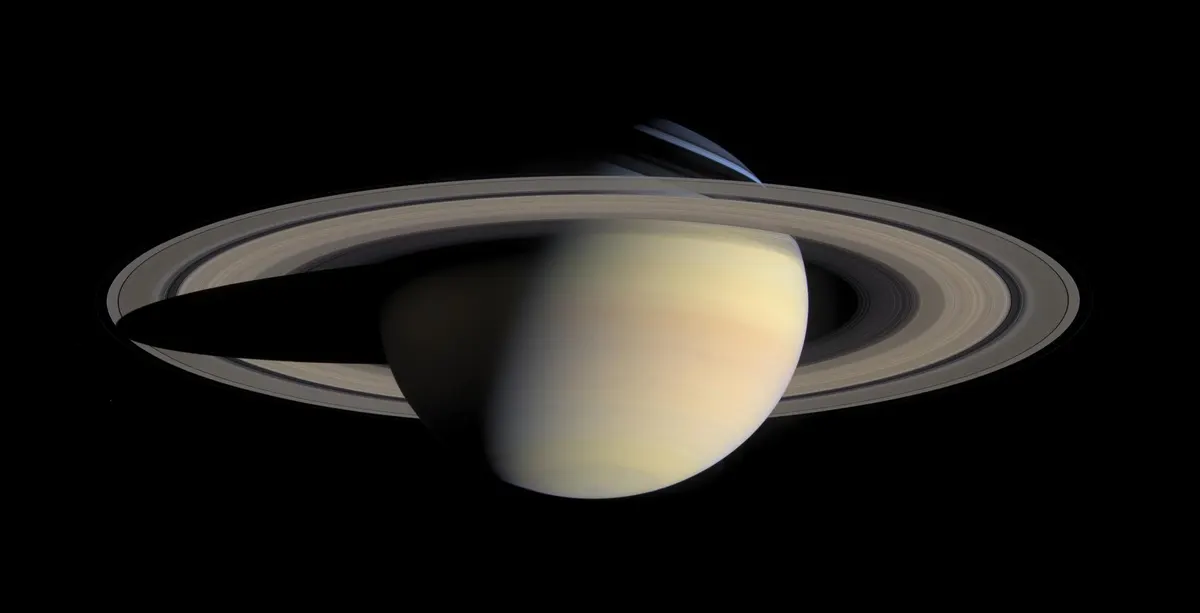
Pioneer 11 got there first
Pioneer 11 launched on April 6, 1973, flew past Jupiter on December 3, 1974 and reached Saturn on September 1, 1979, a total of 6.4 years. Its closest approach was at a range of about 20,900 km, and NASA calls it the first spacecraft to study Saturn. Voyager 1 launched in 1977 and reached Saturn on November 12, 1980, a trip of 3.2 years.
Both were flybys, which is why they were fast. Saturn is 1,205,500,000 km from Earth at best and 1,658,600,000 km at worst, and a spacecraft that doesn't need to stop can cover it in a few years.
Cassini needed four gravity assists
Cassini-Huygens launched on October 15, 1997 and arrived on July 1, 2004, after 6.7 years. Instead of heading straight for Saturn it swung past Venus in April 1998 and June 1999, Earth in August 1999 and Jupiter in December 2000, as ESA lists them. ESA says those swing-bys gave it the cumulative boost it needed to reach Saturn.
Cassini then stayed for 13 years and ended with a deliberate dive into the planet on September 15, 2017. The story is told in the Cassini page.
Travel time by vehicle
| Vehicle | Speed | Closest | Typical | Farthest |
|---|---|---|---|---|
| Walking | 3 mph | 28,484 years | 33,837 years | 39,190 years |
| Bicycle | 12 mph | 7,121 years | 8,459 years | 9,797 years |
| Car on a highway | 65 mph | 1,315 years | 1,562 years | 1,809 years |
| Passenger jet | 570 mph | 150 years | 178 years | 206 years |
| SR-71 Blackbird, its official speed record | 2,193 mph | 39.0 years | 46.3 years | 53.6 years |
| Voyager 1, about 17 km/s | 38,028 mph | 2.2 years | 2.7 years | 3.1 years |
| Parker Solar Probe at closest approach, 692,000 km/h | 429,989 mph | 73 days | 86 days | 100 days |
| Light | 670,616,629 mph | 1 hour 7 minutes | 1 hour 19 minutes | 1 hour 32 minutes |
How long real spacecraft took
Voyager 1 needed 3.2 years and Cassini 6.7 years. Spacecraft rarely fly straight at a target. They follow curved paths timed to launch windows, so the trip is longer than the distance alone suggests.
| Mission | Launched | Arrived | Trip time | What happened |
|---|---|---|---|---|
| Voyager 1 | September 5, 1977 | November 12, 1980 | 3.2 years | Closest approach to Saturn |
| Cassini | October 15, 1997 | July 1, 2004 | 6.7 years | Entered orbit around Saturn |
Why the answer changes
Saturn is 1.4 times farther away at its farthest than at its closest, so every travel time above is 1.4 times longer at the far end. The distance depends on where both planets are in their orbits. The closest figure is the smallest possible gap, and the typical figure is the midpoint between the closest and the farthest.
Try your own speed
Other destinations
 The MoonBy car, 145 days at the closest.
 MarsBy car, 59.5 years at the closest.
 The SunBy car, 160 years at the closest.
 VenusBy car, 41.7 years at the closest.
The next arrival is already planned
NASA's Dragonfly rotorcraft is scheduled to launch no earlier than July 2028 and arrive at Saturn's moon Titan in late 2034, a trip of about 6.3 years. It'll fly to different places on Titan to study the moon's chemistry. To see why Titan matters, read about Titan and its neighbor Enceladus.
A very long radio line
Radio signals take 67.0 minutes to reach Earth from Saturn at its closest and 92.2 minutes at its farthest, so a round trip can take about 3 hours at the worst of it. No one drives a spacecraft at Saturn with a joystick. It works from commands sent hours earlier.
Counting the years
At 65 mph a car would need 1,315 years to reach Saturn at its closest, and a passenger jet 150 years. The real spacecraft above did it in years, not millennia, but never in a straight line. The planet is covered in Saturn and its best viewing night is in Saturn at opposition.
The speed Saturn would demand
Suppose you wanted to reach Saturn in the 76 hours Apollo 11 needed to enter lunar orbit. At the closest distance in the fact sheet, 1,205,500,000 km, that means averaging 15,896,710 km/h, or 9,877,758 mph, for the whole trip. Saturn roughly doubles the distance again. Stretch the same trip to one year and the average falls to 137,520 km/h (85,451 mph), a figure a spacecraft can reach, which is why real missions take months or years.
Sunlight at Saturn
Sunlight gets weaker with the square of the distance. With Saturn at 9.57 times Earth's distance from the Sun on average, it receives about 0.0109 times as much sunlight as Earth does. Light from the Sun takes 79.6 minutes to get there, against 8.3 minutes to reach Earth. The distances come from the NASA fact sheet and the sums are done here.
A year, a pull and the moons
Saturn takes 10,747 days to go round the Sun, which is 29.42 Earth years. Surface gravity is 0.92 times Earth's, so a 70 kg person would read about 64 kg on a scale there. The fact sheet lists 274 known moons. Try your own numbers in the weight calculator or the age calculator.
How often Earth and Saturn line up
Earth laps Saturn on a regular schedule. Using the orbital periods in the fact sheet, the two planets return to the same relative positions every 378 days, about 12.4 months. That's the rhythm that mission planners work to, although the gap between launch and arrival depends on the route chosen, not on this number alone. It's the same method used on the Mars page, where the pattern gives a launch window roughly every 26 months.
Where the seven years went
Cassini's flight splits into two halves. From launch to its Jupiter swing-by in December 2000 took about 3.2 years, and the leg from Jupiter to Saturn took about 3.5 more. The first half was the winding part, circling the inner solar system to pick up speed. The second was a direct run outward. Pioneer 11 and Voyager 1 skipped the winding and took 6.4 and 3.2 years, but neither could stop.