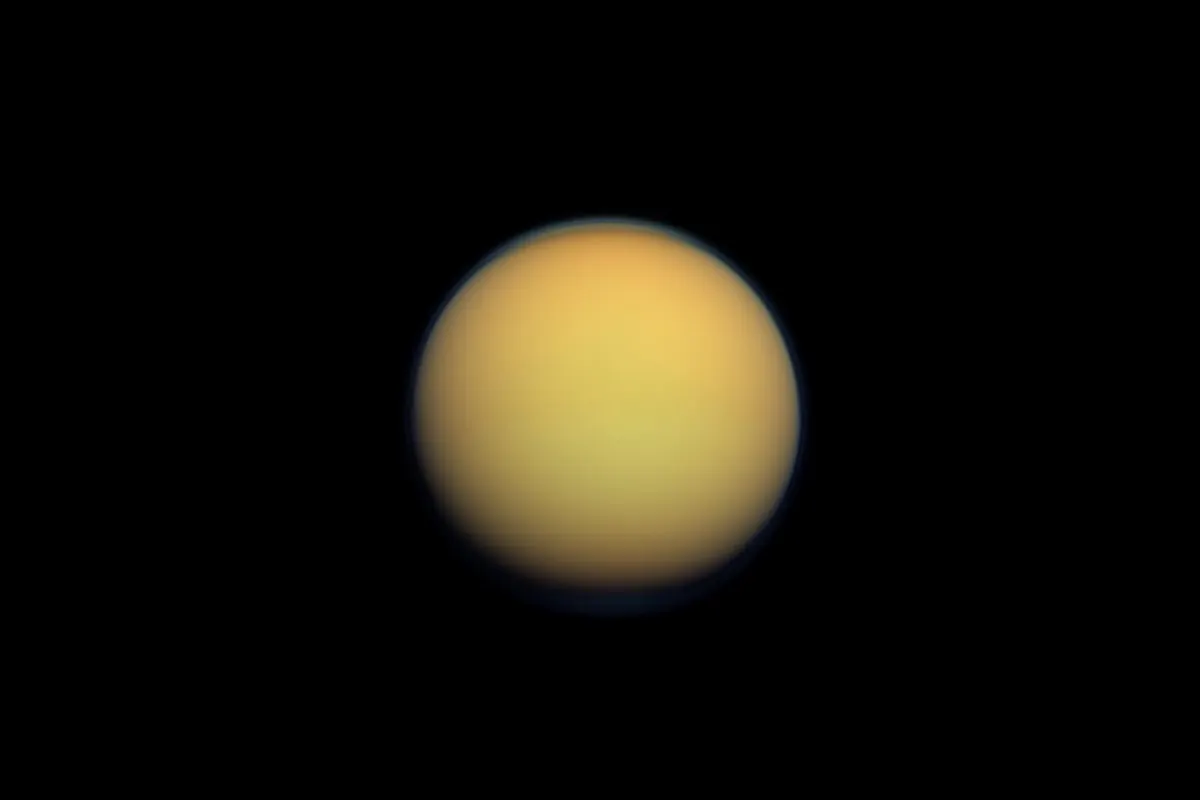
A moon with its own probe
Christiaan Huygens found Titan on 25 March 1655, and the probe that landed on it in 2005 carries his name. For more than three centuries Titan was a point of light with a haze around it. Pioneer 11 passed by on 1 September 1979, and Voyager 1 followed in 1980, but both could only see the orange haze. It took Cassini's radar and infrared instruments to see through it.
By one measure Titan is a small world: its mass is 1,345.5 times 10 to the 20 kilograms, less than half of Mercury's 3,301.1, even though Titan is the bigger of the two. Its density of 1,880 kilograms per cubic meter tells you why. Titan is roughly half water ice and half rock, which makes it light for its size.
An orange world with an Earth-like cycle
NASA describes Titan as the second largest moon in the solar system. Only Jupiter's moon Ganymede is larger, by just 2 percent. It's bigger than the planet Mercury. Its surface is hidden by an orange haze, and its air is about 95 percent nitrogen and 5 percent methane, with pressure about 60 percent greater than on Earth. Because Titan has less gravity than Earth, the atmosphere stretches about 600 km into space, 10 times higher than Earth's.
Titan is the only place besides Earth known to have liquid on its surface. Methane condenses into clouds and rain, runs along river channels and fills lakes, and then evaporates again, in a cycle that mirrors Earth's water cycle. Cassini found three seas and hundreds of smaller lakes. In the dunes near the equator the sand is made of dark hydrocarbon grains that NASA says look like coffee grounds, and there are few impact craters, so the surface must be young.
| What | Value |
|---|---|
| Discovered | 25 March 1655 by Christiaan Huygens |
| Radius | 2,575 km, nearly 50 percent wider than Earth's Moon |
| Mass (units of 10^20 kg) | 1,345.5 |
| Density | 1,880 kg per cubic meter |
| Distance from Saturn | 1,221,870 km |
| Orbit | 15.945 days, tidally locked |
| Sunlight | about 100 times fainter than at Earth |
Does Titan have an ocean?
For years the answer looked like yes. Cassini's gravity measurements, among other data, pointed to a layer of liquid water about 55 to 80 km down. Then on 17 December 2025, a study in Nature led by NASA's Jet Propulsion Laboratory reanalyzed the Cassini data and suggested something different: Titan's interior is more likely ice, with layers of slush and small pockets of warm water near the rocky core. It's a good reminder that moons are measured from a distance, and the models can change.
Measured: we know this
- Titan has three seas and hundreds of smaller lakes, and a nitrogen and methane atmosphere that extends about 600 km up.
- The surface temperature is about -179 degrees Celsius.
- Huygens reached the surface on 14 January 2005.
Inferred: we think this
- Titan hides liquid water in its interior. The December 2025 analysis favors slush and pockets of warm water over a single global ocean.
- Methane might be resupplied by cryovolcanoes, which erupt chilled water instead of molten rock. NASA says researchers suspect this but aren't certain.
Unknown: we don't know
- Where the methane in Titan's atmosphere comes from. Sunlight breaks it down continuously, so something has to replenish it.
- Whether life of any kind exists there. NASA says there's no evidence so far.
What would settle it
- NASA's Dragonfly rotorcraft, planned to launch in 2028 and spend three years making multiple landings.
In human terms
- Sunlight takes about 80 minutes to reach Titan and is about 100 times fainter than at Earth.
- Titan circles Saturn every 15.945 days, and one side always faces the planet.
Questions people ask
Does Titan have an atmosphere?
Yes, and it's the only moon in the solar system with a thick one. It's about 95 percent nitrogen and 5 percent methane, with surface pressure about 60 percent greater than on Earth.
Is there an ocean on Titan?
Cassini data suggested a hidden global ocean of water, but a December 2025 study published in Nature argues the interior is more likely ice with slush and small pockets of warm water. The question is open.
Is Titan bigger than Mercury?
Yes. NASA says Titan is bigger than the planet Mercury, though Mercury is more massive (3,301.1 against 1,345.5, in units of 10^20 kg). Only Ganymede is a larger moon.
 CassiniThe mission that explored Saturn and Titan for 13 years.
 EnceladusSaturn's small, bright, geyser-spraying moon.
 GanymedeThe only larger moon.All moonsEvery moon page on the site.
A thick atmosphere on a small moon
It's unusual for such a small body to hold on to so much air. Titan's atmosphere reaches about 600 kilometers up, roughly 10 times higher than Earth's, and at the surface the pressure is about 60 percent greater than on Earth. Part of the reason is cold: at -179 degrees Celsius, nitrogen molecules move slowly, and even a weak gravity can keep hold of them. A warmer moon of the same size would have lost its air long ago.
That air is also what makes the next mission possible. A thick atmosphere gives a rotorcraft something to push against, and the weak gravity makes the job easier still. NASA's Dragonfly is a car-sized rotorcraft, powered by a nuclear battery, that's meant to hop between sites on the surface.
Seasons on a slow calendar
Titan goes around Saturn, and Saturn goes around the Sun, in a bit under 30 years. That means a Titan season lasts around seven Earth years, and the 13 years Cassini spent at Saturn covered only about half a Saturn year. The methane clouds and lakes change with those seasons, which is part of why a short visit can't show how the methane cycle works. See the page on Cassini for what the long stay found.
Dragonfly is planned to launch in 2028 and then spend three years making multiple landings. The mission is designed to look at the chemistry of the surface and the organic material that falls from the atmosphere. If you'd like to compare Titan with the other moons that might hold liquid water, the moons hub puts all seven side by side.
Twins with different strengths
Titan and Ganymede are almost the same size, within about two percent, and have nearly the same density. Yet Ganymede is notable for its magnetic field and Titan for its thick air and liquid surface. Two similar-sized balls of ice and rock ended up with very different personalities, and working out why is a puzzle for planetary scientists.