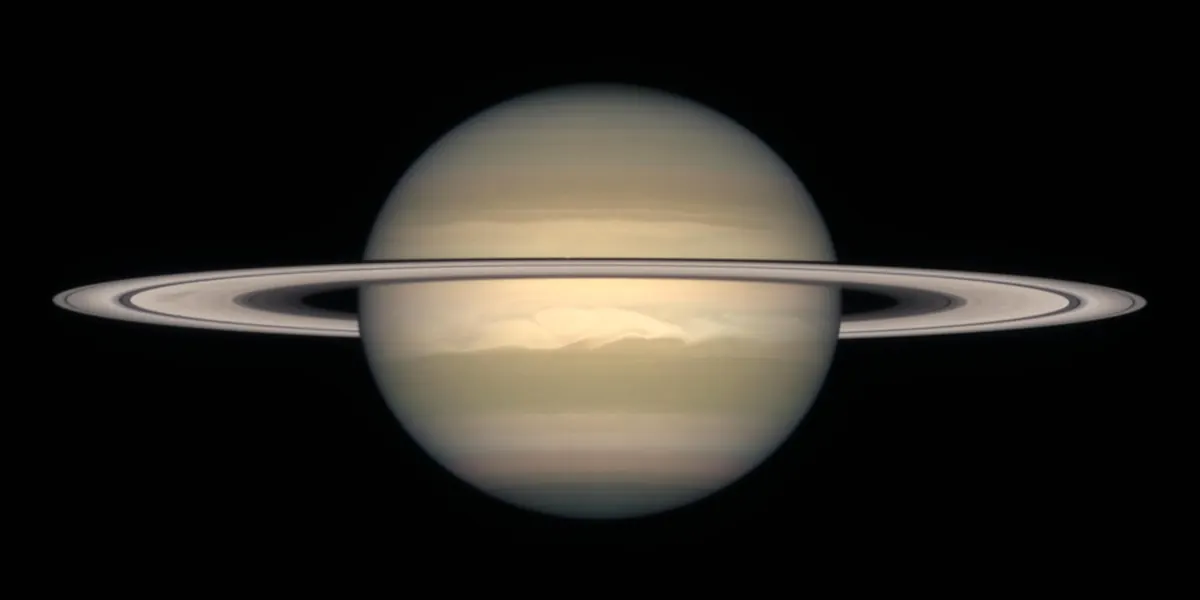
The next eight oppositions
| Date | Time | Distance from Earth | In kilometers |
|---|---|---|---|
| October 18, 2027 | 00:00 UTC | 8.347 AU | 1249 million km |
| October 30, 2028 | 17:08 UTC | 8.247 AU | 1234 million km |
| November 13, 2029 | 14:41 UTC | 8.161 AU | 1221 million km |
| November 27, 2030 | 15:39 UTC | 8.096 AU | 1211 million km |
| December 11, 2031 | 18:48 UTC | 8.055 AU | 1205 million km |
| December 24, 2032 | 22:45 UTC | 8.042 AU | 1203 million km |
| January 8, 2034 | 02:02 UTC | 8.056 AU | 1205 million km |
| January 22, 2035 | 03:15 UTC | 8.097 AU | 1211 million km |
Opposition is when the planet is on the opposite side of Earth from the Sun, so it rises at sunset, is highest at midnight and stays up all night. Dates are calculated in UTC and checked against NASA's JPL Horizons: dates agree to about an hour and distances to within 1 percent.
Saturn and the tilt of its rings
Saturn takes about 29 years to go round the Sun, so Earth catches up with it 13 days after a full year, and the opposition date moves about 13 days later each year. The distance varies from 8.04 AU to 8.35 AU in the next eight.
What changes year to year is the tilt of the rings. At the oppositions listed they're tilted toward Earth by between 13 degrees (October 18, 2027) and 26 degrees (December 11, 2031). At 0 degrees the rings are edge-on and almost vanish; the larger the tilt, the more open they look.
| Opposition | Ring tilt | Face of the rings we see |
|---|---|---|
| October 18, 2027 | 13 degrees | south face |
| October 30, 2028 | 18 degrees | south face |
| November 13, 2029 | 22 degrees | south face |
| November 27, 2030 | 25 degrees | south face |
| December 11, 2031 | 26 degrees | south face |
| December 24, 2032 | 26 degrees | south face |
| January 8, 2034 | 24 degrees | south face |
| January 22, 2035 | 21 degrees | south face |
What opposition does and doesn't mean
Opposition is a good time to look because the planet is up all night and close. But the closest approach to Earth falls a few days either side of opposition, not exactly on it, because the planets orbit in ellipses and Earth is moving too. In this list Saturn is nearest, at 8.04 AU, at the opposition on December 24, 2032, and farthest, at 8.35 AU, on October 18, 2027.
The planet that keeps changing its rings
The next opposition is on October 18, 2027. What makes each year's view different is the tilt of the rings, so it's worth checking before you plan a night at the eyepiece.
Saturn's axis is tilted about 27 degrees to its orbit, according to NASA's fact sheet, and the rings lie in the planet's equator, so they tilt with it. As Saturn goes round the Sun in 29 years, we see them from a changing angle. Twice per orbit the rings are edge-on to Earth and almost vanish, and about midway between those moments they open as wide as they get, at about 27 degrees.
Why the rings disappeared in 2025
Earth passed through the plane of Saturn's rings in March 2025, and for a few weeks the rings were almost invisible from here, thin as a line in the largest telescopes. In small telescopes Saturn looked almost ringless. The same thing happens twice per Saturn year, so it comes round again at intervals of about fourteen and a half years.
The next ring plane crossings are on October 17, 2038, April 2, 2039 and July 11, 2039. Earth crosses three times within 267 days, because its own orbit carries it back and forth across the plane while Saturn hardly moves.
How Galileo got it wrong, and Huygens got it right
When Galileo looked at Saturn in 1610, his telescope showed a planet with what looked like handles or two smaller bodies on its sides. In later years they vanished, which puzzled him. The ring wasn't recognized as a ring for decades. In 1655, Christiaan Huygens, with a better telescope, worked out that the planet was surrounded by a thin, flat ring that didn't touch it, and he described it in his 1659 book Systema Saturnium.
The disappearance was the missing clue. When Earth crosses the plane of a thin ring, the ring seems to vanish. That fits a ring that's extremely thin compared with its width, which still astonishes people today.
What Cassini saw
The Cassini spacecraft was Saturn's resident explorer. It launched on October 15, 1997 and ended its mission on September 15, 2017, when controllers sent it into Saturn's atmosphere so that it couldn't contaminate the moons. Along the way it mapped the rings and found moons, geysers on Enceladus and a hydrocarbon sea on Titan. NASA's fact sheet now lists 274 moons for Saturn, more than any other planet.
What to look for
Any small telescope at 30 times magnification shows the rings, the shadow of the planet on them and Titan as a small star near the planet. A larger one shows the Cassini Division, the dark gap between the two main rings. Around opposition the rings also look brighter than usual, a boost known as the opposition surge, because the Sun is right behind us and ring particles throw light straight back.
Saturn's distance varies little from one opposition to the next, so the tilt is the thing to watch. Compare the dates with Jupiter's oppositions, since the two giants line up in the sky every twenty years or so, and see planet oppositions for the other outer planets and Mars for the one with the most changeable distance.
Where the tilt is heading
At the first opposition in the table, on October 18, 2027, the rings are tilted 13 degrees toward Earth. By the last of the eight, on January 22, 2035, the tilt is 21 degrees. Across the list the narrowest is 13 degrees (October 18, 2027) and the widest is 26 degrees (December 11, 2031).
These are planetocentric angles, the angle between the ring plane and the line from Saturn to Earth, which is the figure usually quoted for how far the rings are open, and the reason the maximum is about 27 degrees. The tilt that JPL Horizons lists as the sub-Earth latitude is a larger number, because it's measured on Saturn's flattened surface.
 Planet oppositionsWhen each planet next reaches opposition.
 Jupiter oppositionThe next dates and distances.
 Venus elongationWhen Venus is farthest from the Sun in the sky.
Questions people ask
When is Saturn at opposition next?
October 18, 2027, at 8.35 AU from Earth.
How often is Saturn at opposition?
About every 378 days, which is the time Earth takes to catch up with the planet again.
When is Saturn closest to Earth?
Closest approach is within a few days of opposition. The nearest opposition in the next eight is December 24, 2032, at 8.04 AU.
What does opposition mean?
The planet is on the opposite side of Earth from the Sun, so it rises at sunset and stays up all night.