The second launch that got there first
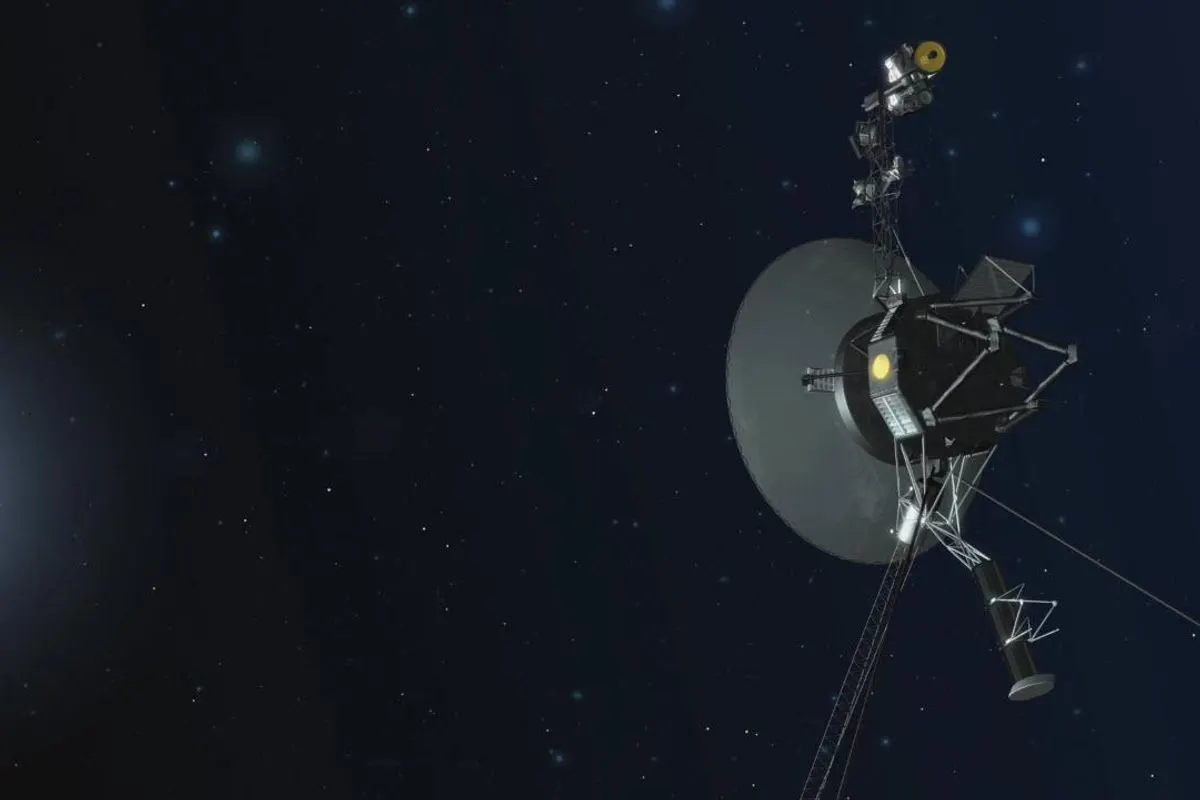
Voyager 1 left the ground on 5 September 1977, sixteen days after its twin, Voyager 2, which went up on 20 August 1977. The numbers follow the flight paths, not the launch order: Voyager 1 was on the faster route and would reach Jupiter and Saturn before its sister, even though it flew second. Both rode a Titan IIIE-Centaur from Cape Canaveral.
Jupiter came first, on 5 March 1979, with a closest approach of about 280,000 kilometers. Saturn followed on 12 November 1980, at about 126,000 kilometers. After Saturn, Voyager 1 headed north out of the plane of the planets, and as NASA puts it, the specific requirements of the close flyby of Titan, Saturn's moon with the thick atmosphere, meant it wasn't directed to Uranus and Neptune. That job went to Voyager 2. Voyager 1 has been heading out of the solar system ever since.
A record for anyone listening
Both Voyagers carry a Golden Record: a 30-centimeter copper disk plated with nickel and gold, with instructions on its cover for playing it at 16 and two thirds revolutions per minute. A committee chaired by Carl Sagan chose its contents: 116 images, spoken greetings in 55 languages, natural sounds such as surf, wind and whales, and music. One of the stranger tracks is a recording of a woman's brain waves, made over an hour and compressed into a minute of audio.
The cover diagram uses physics as a common language. A map of 14 pulsars shows where the spacecraft came from, and a drawing of the hydrogen atom sets the units of time. One side plays for about 54 minutes.
The last pictures
After the planets, Voyager 1 had one more job for its cameras. Carl Sagan had proposed the idea in 1981: turn one of the Voyagers around and photograph Earth. On 14 February 1990, from about 6 billion kilometers from the Sun, it took a series of images of the solar system that show six planets, Neptune, Uranus, Saturn, Jupiter, Venus and Earth. Mars was lost in scattered sunlight, Mercury was too close to the Sun, and Pluto was too small and dark. Earth, in one frame, was a point of light about a pixel across: the Pale Blue Dot described in the ledger above. About 34 minutes after the Earth images, the cameras were switched off for good, to save power for the rest of the journey.
| Launched | 5 September 1977 |
|---|---|
| Crossed into interstellar space | 25 August 2012 (heliopause) |
| Speed | 17.0 km/s (about 61,200 km/h) relative to the Sun, per NASA as of 21 August 2024 |
| Distance from Earth, late 2026 | about 170 AU, roughly 25 billion km. It reaches one light day from Earth around November 2026. |
In human terms
- Shrink the solar system so 1 AU (Earth to Sun) is 1 meter. The Sun is a 9 mm bead. Earth is a speck 0.09 mm wide, one meter away. Voyager 1 is about 170 meters away, a long city block.
- On the same scale the nearest star, Proxima Centauri, is about 269 km away. Voyager would need roughly 75,000 years to get there, and it isn't aimed at it.
- At 17 km/s it's about 68 times faster than an airliner at 900 km/h, and it still takes light about a day to cover the gap.
What it found
Measured: we know this
- Jupiter flyby, 5 March 1979: active volcanoes on Io, the first seen beyond Earth.
- Saturn flyby, 12 November 1980: detailed structure in the rings and a thick atmosphere on Titan.
- Pale Blue Dot image, 14 February 1990, taken from about 6 billion km.
- In 2012 the plasma around it jumped in density, marking the crossing out of the Sun's bubble.
Inferred: we think this
- The edge of the heliosphere isn't a sharp wall. The boundary region is turbulent and complex.
Unknown: we don't know
- What the space between stars is like far beyond the boundary.
- How long the instruments will last. Power falls every year and instruments are being switched off one by one.
What would settle it
- Keeping the radio link alive. Operators have already turned off several instruments to save power.
 Voyager 2The only spacecraft to visit Uranus and Neptune.
All probesSeven spacecraft, from Voyager to Webb.
Questions people ask
How fast is Voyager 1 going?
Voyager 1 travels at 17.0 km/s, about 61,200 km/h, relative to the Sun. That's NASA's figure as of 21 August 2024.
How far away is Voyager 1?
About 170 AU in late 2026, roughly 25 billion km. It reaches one light day from Earth around November 2026.
When did Voyager 1 enter interstellar space?
On 25 August 2012, when it crossed the heliopause, the edge of the Sun's bubble of solar wind.
When was Voyager 1 launched?
On 5 September 1977.
Records on the way out
Voyager 1 has held the title of most distant human-made object since 17 February 1998, when it passed Pioneer 10 at 69.4 times the Earth-Sun distance. It crossed the termination shock, where the solar wind slows abruptly, on 16 December 2004 at about 94 times that distance, passed 100 times the distance on 16 August 2006, and left the heliosphere on 25 August 2012, the first spacecraft ever to do so.
Voyager 1 was launched to study Jupiter and Saturn. Everything it has measured since, about the edge of the Sun's influence, has come from instruments that have been running for decades.
Running on a shrinking supply
Voyager 1 is powered by three radioisotope generators that produced about 158 watts each at launch and weaken as the plutonium decays. To keep the spacecraft alive, the mission has been switching off instruments one at a time, and NASA shut one off on 17 April 2026. The people running the mission have changed too. John Casani, a former Voyager project manager, died on 19 June 2025.
On 18 November 2026, NASA's countdown says, Voyager 1 will be one light day from Earth: the signal it sends will take 24 hours to arrive. A radio command now takes two days to go out and come back. That's the distance the spacecraft has covered since 1977.
What to watch next
The practical question is how long the remaining instruments can run. NASA's mission pages track which are still on, and the answer shrinks every year. The science question is what the spacecraft will measure as it moves deeper into interstellar space, where its plasma instrument first measured a jump in density at the boundary. If you want a sense of how far this has gone, put the numbers on the scale of the solar system, compare it with the nearest star in the travel time calculator, or see how the other great probe fared in New Horizons's trip to Pluto.
Sources
NASA Voyager mission pages (science.nasa.gov/mission/voyager), including the Voyager 1 page for speed (17.0 km/s, 38,026.79 mph, as of 21 August 2024). NASA/JPL Voyager mission status page for live distance. The live distance is on NASA's Voyager status page.