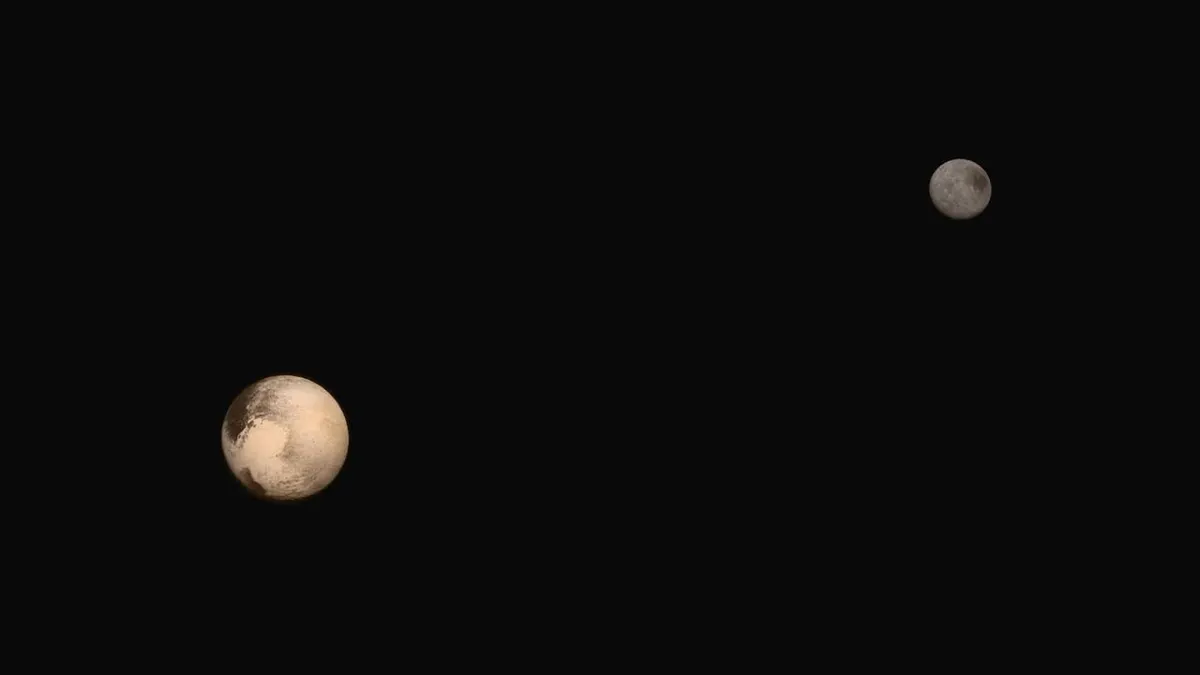
Nine and a half years from Florida to Pluto
NASA's New Horizons launched on January 19, 2006 and flew past Pluto on July 14, 2015, a trip of 9.5 years. NASA's history office describes it as already the fastest spacecraft to leave Earth, and it still needed a boost. A gravity assist from Jupiter on February 28, 2007 cut the total flight time from 14 years to under ten.
It passed Pluto at a range of about 12,500 km. The full account is in the New Horizons page.
Pluto doesn't stay in one place
Pluto takes 248 years to orbit the Sun, on an oval path that carries it as close as 30 astronomical units and as far as 49.3. The fact sheet gives its distance from Earth as 4,284,700,000 km at the closest and 7,528,000,000 km at the farthest. Light needs 3 hours 58 minutes to cross the shortest gap and 6 hours 58 minutes to cross the longest. A trip that starts when Pluto is near is much shorter than one that starts when it is far.
Pluto was discovered in 1930 and is now called a dwarf planet. Why Pluto isn't a planet explains what changed.
Travel time by vehicle
| Vehicle | Speed | Closest | Typical | Farthest |
|---|---|---|---|---|
| Walking | 3 mph | 101,239 years | 139,556 years | 177,872 years |
| Bicycle | 12 mph | 25,310 years | 34,889 years | 44,468 years |
| Car on a highway | 65 mph | 4,673 years | 6,441 years | 8,209 years |
| Passenger jet | 570 mph | 533 years | 735 years | 936 years |
| SR-71 Blackbird, its official speed record | 2,193 mph | 138 years | 191 years | 243 years |
| Voyager 1, about 17 km/s | 38,028 mph | 8.0 years | 11.0 years | 14.0 years |
| Parker Solar Probe at closest approach, 692,000 km/h | 429,989 mph | 258 days | 356 days | 453 days |
| Light | 670,616,629 mph | 3 hours 58 minutes | 5 hours 28 minutes | 6 hours 58 minutes |
How long real spacecraft took
New Horizons needed 9.5 years. Spacecraft rarely fly straight at a target. They follow curved paths timed to launch windows, so the trip is longer than the distance alone suggests.
| Mission | Launched | Arrived | Trip time | What happened |
|---|---|---|---|---|
| New Horizons | January 19, 2006 | July 14, 2015 | 9.5 years | Flew past Pluto |
Why the answer changes
Pluto is 1.8 times farther away at its farthest than at its closest, so every travel time above is 1.8 times longer at the far end. The distance depends on where both planets are in their orbits. The closest figure is the smallest possible gap, and the typical figure is the midpoint between the closest and the farthest.
Try your own speed
Other destinations
 The MoonBy car, 145 days at the closest.
 MarsBy car, 59.5 years at the closest.
 The SunBy car, 160 years at the closest.
 VenusBy car, 41.7 years at the closest.
After Pluto, the spacecraft kept going
New Horizons flew by the Kuiper Belt object Arrokoth on January 1, 2019. NASA says it covers about 300 million miles a year. On October 1, 2024 it passed 60 times Earth's distance from the Sun, twice as far out as Pluto. It has no destination that needs it to slow down, which is why the fast vehicles in the table are the fairer comparison.
One trip, one pass
The flyby itself was brief compared with the trip. The spacecraft spent 9.5 years getting there, and it passed Pluto at a range of about 12,500 km. No spacecraft has orbited Pluto, so everything we know about its surface comes from that single pass.
The numbers in the table
At 65 mph a car would need 4,673 years to reach Pluto at its closest, and a passenger jet 533 years. Light, the fastest comparison, needs 3 hours 58 minutes. You can see how a planet's own year compares in the age calculator, which uses the same orbital data. The world itself is covered in Pluto.
The speed Pluto would demand
Suppose you wanted to reach Pluto in the 76 hours Apollo 11 needed to enter lunar orbit. At the closest distance in the fact sheet, 4,284,700,000 km, that means averaging 56,501,563 km/h, or 35,108,444 mph, for the whole trip. This is by far the largest sum in the planetary list. Stretch the same trip to one year and the average falls to 488,786 km/h (303,718 mph), a figure a spacecraft can reach, which is why real missions take months or years.
Sunlight at Pluto
Sunlight gets weaker with the square of the distance. With Pluto at 39.48 times Earth's distance from the Sun on average, it receives about 0.000642 times as much sunlight as Earth does. Light from the Sun takes 328.4 minutes to get there, against 8.3 minutes to reach Earth. The distances come from the NASA fact sheet and the sums are done here.
A year, a pull and the moons
Pluto takes 90,560 days to go round the Sun, which is 247.94 Earth years. Surface gravity is 0.07 times Earth's, so a 70 kg person would read about 5 kg on a scale there. The fact sheet lists 5 known moons. Try your own numbers in the weight calculator or the age calculator.
How often Earth and Pluto line up
Earth laps Pluto on a regular schedule. Using the orbital periods in the fact sheet, the two planets return to the same relative positions every 367 days, about 12.0 months. That's the rhythm that mission planners work to, although the gap between launch and arrival depends on the route chosen, not on this number alone. It's the same method used on the Mars page, where the pattern gives a launch window roughly every 26 months.
Checking the trip with arithmetic
NASA says New Horizons covers about 300 million miles a year. Divide by the hours in a year and that's 34,223 mph, or 55,077 km/h. At that steady speed the fact sheet's closest distance to Pluto, 4,284,700,000 km, takes 8.9 years, and the average distance takes 12.2 years. The real flight took 9.5 years. The sum lands close because the spacecraft didn't slow down for Pluto, it only needed to arrive.