A planet found by arithmetic and patience
The hunt for Pluto began on paper. From 1905, Percival Lowell searched for a planet beyond Neptune that might explain small wobbles in the orbit of Uranus, and he published his predictions in a 1915 memoir. He died without finding it. On February 18, 1930, Clyde Tombaugh, working at Lowell's observatory in Arizona, spotted a faint dot that moved between two photographic plates, and the discovery was announced on March 13, 1930.
The wobbles that started the search turned out not to exist. Pluto is far too small to tug on Uranus, so the planet had been found for the wrong reason. Tombaugh died in 1997, and some of his ashes are aboard New Horizons, which reached Pluto in 2015.
Pluto keeps shrinking
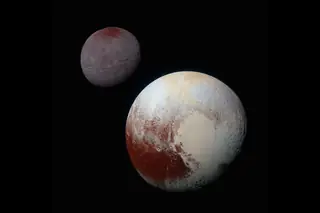
Early estimates of Pluto's size were too large. On June 22, 1978, James Christy found at the U.S. Naval Observatory station in Flagstaff, Arizona that Pluto had a moon, Charon, and Charon's orbit allowed astronomers to weigh the pair for the first time. Pluto turned out to be far lighter than anyone had thought. It's 2,376 km across, about one fifth of Earth's width and smaller than Earth's Moon at 3,475 km. Charon is about half Pluto's size, the largest moon compared with its planet in the solar system, so the pair are often called a double planet.
The discovery that forced a decision
Through the 1990s astronomers began finding other icy bodies beyond Neptune, in the region known as the Kuiper Belt. The decisive one was found by Mike Brown and his team in 2005, an object later named Eris. When its mass was measured in 2007, it came out about 27 percent greater than Pluto's. Either Eris was the tenth planet, or Pluto and Eris were something else. Astronomers faced the prospect of a list of planets that kept growing.
What happened in 2006
On August 24, 2006, at the General Assembly of the International Astronomical Union in Prague, about 424 astronomers still present voted on a definition. To count as a planet, a world must orbit the Sun, be massive enough to be round, and have cleared the neighborhood around its orbit. Pluto passes the first two. It fails the third, because it shares its region with the many icy bodies of the Kuiper Belt. It became a dwarf planet.
Pluto compared
| Measure | Pluto | Mercury | Earth |
|---|---|---|---|
| Diameter (km) | 2,376 | 4,879 | 12,756 |
| Orbit tilt to the planets' plane (degrees) | 17.2 | 7.0 | 0.0 |
| Orbit stretch (eccentricity) | 0.244 | 0.206 | 0.017 |
| Year (Earth years) | 247.9 | 0.24 | 1.0 |
| Moons | 5 | 0 | 1 |
Values from the NASA Planetary Fact Sheet. Mercury is the smallest planet.
An odd orbit
Pluto's orbit is long, oval and tilted, with an eccentricity of 0.24 against Earth's 0.017, and a tilt of 17.2 degrees from the plane of the planets. For about two decades of every 248 years, Pluto is closer to the Sun than Neptune is, most recently from 1979 to 1999. It can't hit Neptune, because Pluto's year is 1.51 times Neptune's. For every three laps Neptune makes, Pluto makes two, and that pattern keeps them apart.
The argument isn't over
Not every astronomer accepts the 2006 definition. Alan Stern, who leads the New Horizons mission, has argued that the "cleared its orbit" test is unclear, because no planet, Earth included, has fully cleared its path of asteroids. The IAU position stands, and the classification is a matter of definition, not discovery. Nothing about Pluto itself changed in 2006.
What New Horizons found
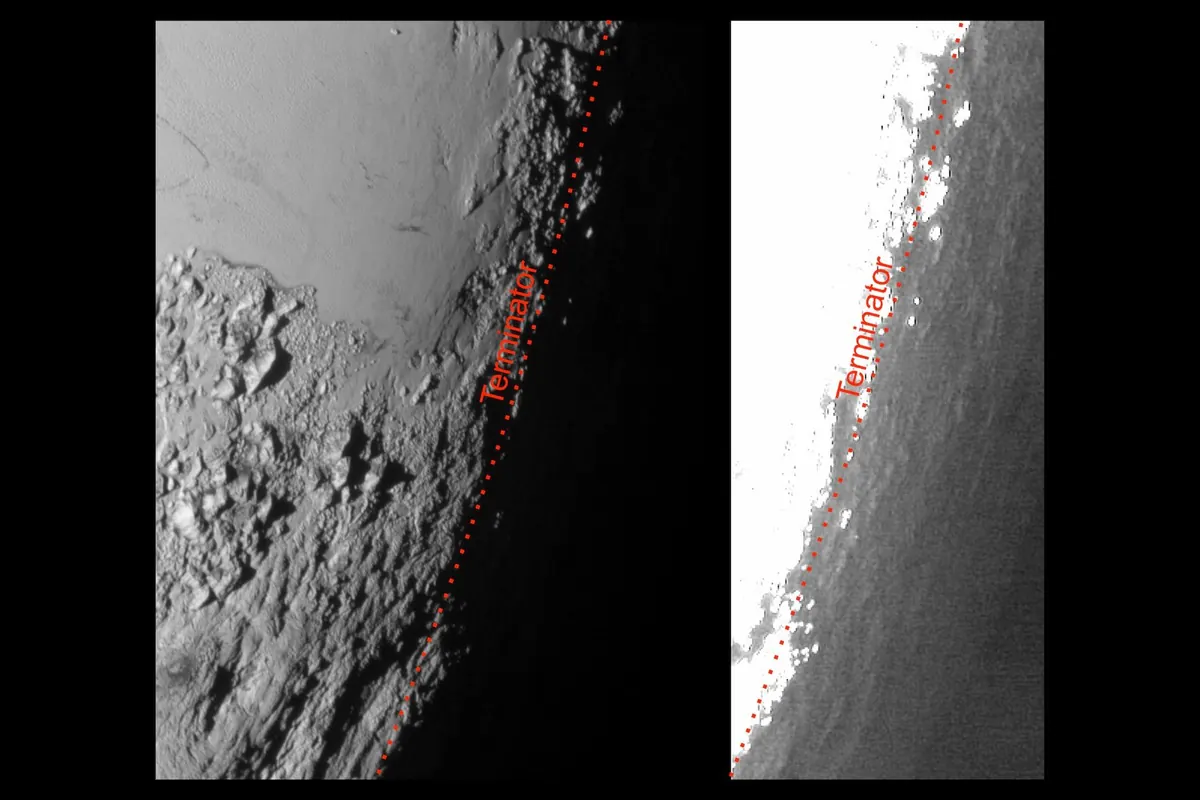
NASA's New Horizons flew past on July 14, 2015, the only spacecraft to visit. It measured Pluto's diameter at 2,377 km (NASA's figure; the fact sheet gives 2,376), and found mountains, valleys, plains, craters and glaciers, a thin atmosphere of nitrogen, methane and carbon monoxide, and a haze that softly lights the night side, as in the picture on this page. Some scientists think there could be an ocean deep inside. The New Horizons page covers the mission, and Pluto's own page the world.
It also changed the argument. Whatever you call it, Pluto is an active, varied world, and not the dull ball of ice that early images suggested. The order of the planets still has eight entries, and Pluto, the best known of the dwarf planets, now sits just beyond them.
A definition, not a discovery
This is the heart of the story. Nobody found out anything new about Pluto in 2006. The change was in the word. Until 2006 the International Astronomical Union had no formal definition of a planet. Once Eris and others turned up, it had to write one down. A definition can be argued over in a way a measurement can't, and the arguing is still going. Seen that way, Pluto lost nothing: it stayed the same world, and is one of the most studied bodies at the edge of the solar system.
What dwarf planets are
Pluto is the best known dwarf planet, but there are others, among them Ceres in the asteroid belt, and Eris, Haumea and Makemake beyond Neptune. The category exists for round worlds that share their orbits with a crowd. The moons page lists Pluto's five moons next to the planets', and the size comparison draws Pluto at its true scale.
The heart of Pluto
The picture that made New Horizons famous showed a pale, heart-shaped region, now named Tombaugh Regio after the man who found Pluto. Part of it's a basin of frozen nitrogen. A surface that smooth means Pluto is geologically active, and young in places, something nobody expected from a world so small and so far from the Sun.
Questions people ask
Why is Pluto not a planet?
In 2006 the International Astronomical Union defined Pluto as a dwarf planet: it orbits the Sun and is round, but it hasn't cleared its orbital neighborhood of other objects.
When did Pluto stop being a planet?
August 24, 2006. It had been the ninth planet since its discovery in 1930.
Is Pluto bigger than the Moon?
No. Pluto is 2,376 km across and the Moon is 3,475 km.
Has a spacecraft visited Pluto?
Yes. NASA's New Horizons flew past Pluto on July 14, 2015.