The race to touch down
Getting down in one piece took years of trying. Ranger 7 sent back close-ups of the Moon in 1964 before its planned impact, but nobody had landed. In 1965 the Soviet Union lost Luna 5, Luna 7 and Luna 8 in crashes caused by a loss of control, an attitude-control failure and a landing-system fault. Luna 9 finally made the first soft landing on February 3, 1966, and sent back the first picture from the surface. Surveyor 1 was the first American landing, on June 2, 1966.
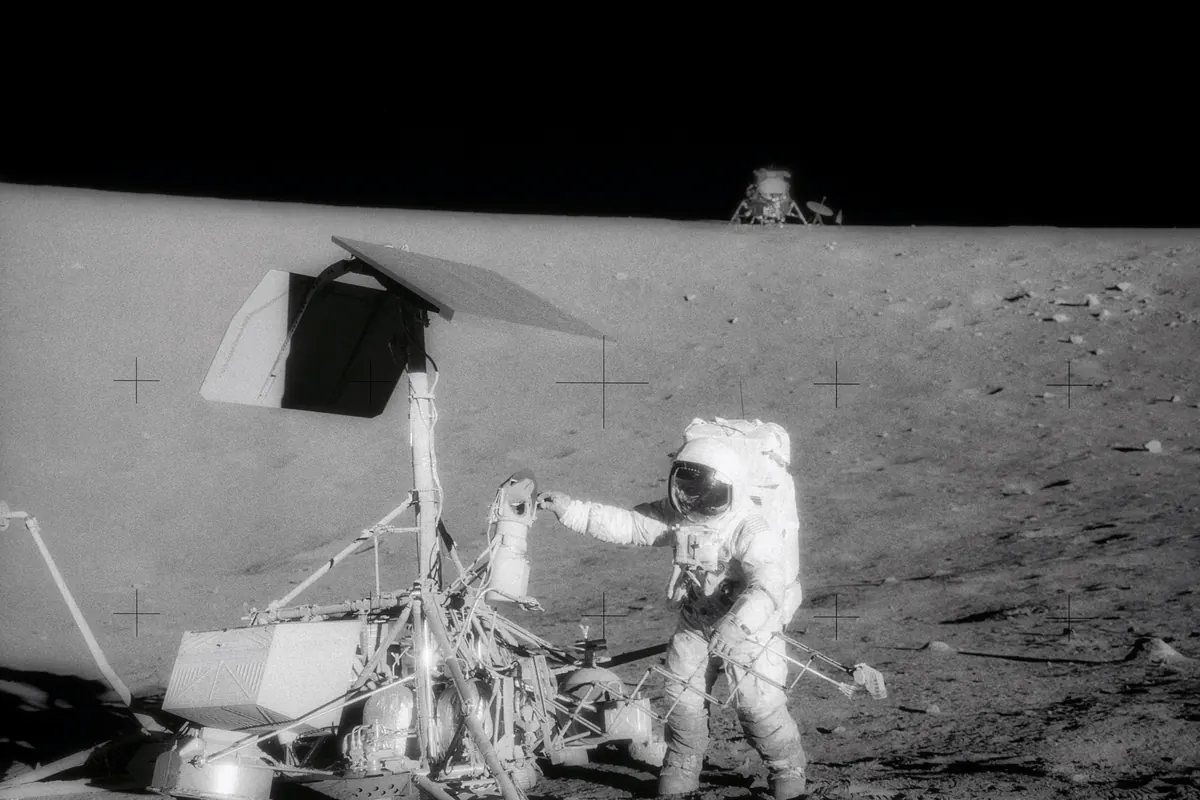
The Surveyors scouted for Apollo. When Apollo 12 landed, its lunar module set down 155 meters from Surveyor 3, which is why the photo above shows the two together.
Apollo, and the robots beside it
The six Apollo landings were the high point. Armstrong and Aldrin spent 21 hours and 36 minutes on the Moon, and Armstrong's walk lasted 2 hours, 31 minutes. Later crews stayed longer. In between, the Soviet Union chose robots. Luna 16 returned about 101 grams of material from Mare Fecunditatis, and Luna 24 returned 170 grams. Lunokhod 1 roved 10.5 kilometers over 322 days. The people who made the Apollo landings are listed on how many people have walked on the Moon.
The 28 soft landings
| Landed (UTC) | Mission | Program | Kind | Where | Mission result |
|---|---|---|---|---|---|
| February 3, 1966 | Luna 9 | Soviet Union / Russia | Robotic lander | 7.68° N, 63.86° W | Success |
| June 2, 1966 | Surveyor 1 | United States | Robotic lander | 2.47° N, 43.34° W | Success |
| December 24, 1966 | Luna 13 | Soviet Union / Russia | Robotic lander | 18.87° N, 62.05° W | Success |
| April 20, 1967 | Surveyor 3 | United States | Robotic lander | 3.02° S, 23.42° W | Success |
| September 11, 1967 | Surveyor 5 | United States | Robotic lander | 1.46° N, 23.19° E | Success |
| November 10, 1967 | Surveyor 6 | United States | Robotic lander | 0.47° N, 1.43° W | Success |
| January 10, 1968 | Surveyor 7 | United States | Robotic lander | 40.98° S, 11.51° W | Success |
| July 20, 1969 | Apollo 11 | United States | Crewed landing | 0.69° N, 23.43° E | Success |
| November 19, 1969 | Apollo 12 | United States | Crewed landing | 3.01° S, 23.42° W | Success |
| September 20, 1970 | Luna 16 | Soviet Union / Russia | Sample return | 0.51° S, 56.36° E | Success |
| November 17, 1970 | Luna 17 / Lunokhod 1 | Soviet Union / Russia | Lander and rover | 38.24° N, 35.00° W | Success |
| February 5, 1971 | Apollo 14 | United States | Crewed landing | 3.65° S, 17.47° W | Success |
| July 30, 1971 | Apollo 15 | United States | Crewed landing | 26.12° N, 3.63° E | Success |
| February 21, 1972 | Luna 20 | Soviet Union / Russia | Sample return | 3.79° N, 56.62° E | Success |
| April 21, 1972 | Apollo 16 | United States | Crewed landing | 8.97° S, 15.50° E | Success |
| December 11, 1972 | Apollo 17 | United States | Crewed landing | 20.19° N, 30.77° E | Success |
| January 15, 1973 | Luna 21 / Lunokhod 2 | Soviet Union / Russia | Lander and rover | 26.00° N, 30.41° E | Success |
| November 6, 1974 | Luna 23 | Soviet Union / Russia | Sample return | 12.67° N, 62.15° E | Failure |
| August 18, 1976 | Luna 24 | Soviet Union / Russia | Sample return | 12.71° N, 62.21° E | Success |
| December 14, 2013 | Chang'e-3 / Yutu | China | Lander and rover | 44.12° N, 19.51° W | Success |
| January 3, 2019 | Chang'e-4 / Yutu-2 | China | Lander and rover | 45.46° S, 177.59° E | Success |
| December 1, 2020 | Chang'e-5 | China | Sample return | 43.06° N, 51.92° W | Success |
| August 23, 2023 | Chandrayaan-3 | India | Lander and rover | 69.37° S, 32.32° E | Success |
| January 19, 2024 | SLIM | Japan | Lander and rover | 13.32° S, 25.25° E | Success |
| February 22, 2024 | IM-1 | United States | Robotic lander | 80.13° S, 1.44° E | Success |
| June 1, 2024 | Chang'e-6 | China | Sample return | 41.64° S, 153.99° W | Success |
| March 2, 2025 | Blue Ghost Mission 1 | United States | Robotic lander | 18.56° N, 61.81° E | Success |
| March 6, 2025 | IM-2 | United States | Lander and rover | 84.79° S, 29.20° W | Partial |
A soft landing means the craft touched down in one piece. Some tipped over or landed damaged (Luna 23, SLIM, IM-1 and IM-2). The last column is the result for the whole mission, not just the touchdown. Sites are the coordinates GCAT lists for each landing.
The 12 that didn't make it
| Date | Mission | Program | What happened |
|---|---|---|---|
| May 12, 1965 | Luna 5 | Soviet Union / Russia | Loss of control caused a crash without surface operations. |
| October 7, 1965 | Luna 7 | Soviet Union / Russia | Attitude-control failure caused a crash without surface operations. |
| December 6, 1965 | Luna 8 | Soviet Union / Russia | Landing-system fault caused a crash without surface operations. |
| September 23, 1966 | Surveyor 2 | United States | Control lost during course correction; no surface operations. |
| July 17, 1967 | Surveyor 4 | United States | Contact lost during descent; no surface operations achieved. |
| July 21, 1969 | Luna 15 | Soviet Union / Russia | Crashed during descent; no sample collected or returned. |
| September 11, 1971 | Luna 18 | Soviet Union / Russia | Crash landing prevented sample collection and return. |
| April 11, 2019 | Beresheet | Israel | Crashed during landing; the primary soft-landing demonstration and surface operation weren't achieved. |
| September 6, 2019 | Chandrayaan-2 | India | Orbiter continues science; Vikram crashed and Pragyan surface operations were precluded. |
| April 25, 2023 | HAKUTO-R Mission 1 | Japan | Crash landing prevented the primary surface delivery and rover operations, despite completion of eight preparatory milestones. |
| August 19, 2023 | Luna 25 | Soviet Union / Russia | Crashed after an orbital maneuver; no surface investigation achieved. |
| June 5, 2025 | HAKUTO-R Mission 2 | Japan | Crash landing prevented surface payload delivery and Tenacious deployment. |
In 1965 three Soviet landers crashed in a row, Luna 5, Luna 7 and Luna 8, before Luna 9 made the first soft landing. The most recent losses came from India, Israel, Japan and the Soviet Union / Russia between 2019 and 2025.
The long gap
After Luna 24 landed in 1976, nothing set down on the Moon for 37 years, until Chang'e-3 in 2013. China's Chang'e-3 made the first soft landing since Luna 24 on December 14, 2013. Chang'e-4 went somewhere no one had: the far side, on January 3, 2019, in Von Karman crater, inside the South Pole-Aitken basin. Its relay satellite, Queqiao, had been placed in a halo orbit around the Earth-Moon L2 point in June 2018. China's Chang'e-5 returned 1,731 grams of samples, and Chang'e-6 collected 1,935.3 grams from the far side, a preliminary figure.
India, Japan and the private landers
India's Chandrayaan-3 landed on August 23, 2023, which made India the fourth country to land on the Moon and the first to land near the southern polar region. ISRO named the site Shiv Shakti. The lander and rover were designed to work for one lunar day, about 14 Earth days, and the Pragyan rover traveled about 103 meters over ten days. Japan's SLIM landed on January 20, 2024 (JST), about 55 meters east of its target. At an altitude of 50 meters it most likely lost thrust from one of its two main engines.
NASA's contract landers followed. Intuitive Machines' Odysseus landed on February 22, 2024 and tipped over. Its instruments worked for seven days. Firefly's Blue Ghost landed on March 2, 2025 in Mare Crisium, within its 100-meter target, and worked for more than 14 days. Intuitive Machines' second lander, on March 6, 2025, came to rest on its side about 820 feet from the intended spot. The countries and companies are compared on countries that have landed on the Moon.
Why the crashes happened
The crash list has some instructive entries. Russia's Luna 15 began its descent on July 21, 1969 after 52 orbits and crashed. Israel's Beresheet crashed in April 2019 after, in SpaceIL's preliminary findings, a command meant to fix an inertial measurement unit problem set off a chain reaction that shut down its main engine. Japan's ispace lost two landers: in April 2023, its software treated an altitude jump over a crater rim as an error and discarded it, and in June 2025, its laser rangefinder hardware failed. Russia's Luna 25 crashed on August 19, 2023, its first attempt since 1976. The failures are told in full on Moon missions that failed.
When the landings happened
Counting soft landings by decade gives 1960s: 9, 1970s: 10, 2010s: 2 and 2020s: 7. The 1960s and 1970s hold the first wave, and the later decades hold a small number. Since the start of 2024, five landings have been made, from Japan, two American companies and China. That's more than the two made in the 43 years from 1977 to 2019.
The robot drivers
Two Soviet rovers set the pace for driving on another world. Luna 17 touched down on November 17, 1970 and released Lunokhod 1. Lunokhod 2 followed on Luna 21 in January 1973, and NASA's remeasurement from orbit puts its traverse at about 39 kilometers. It was the longest planetary rover traverse until Opportunity passed it on Mars. The Mars rovers page has that story.
Driving with people aboard
Crewed driving began with Apollo 15. The Lunar Roving Vehicle made its debut on July 31, 1971, with David Scott at the controls, and NASA says the Apollo 15 crew covered 17.5 miles in all. Apollo 17 launched on December 7, 1972, the first night launch of an American crewed flight, and landed four days later.
The first five
The first five soft landings, in order, were Luna 9 (1966), Surveyor 1 (1966), Luna 13 (1966), Surveyor 3 (1967) and Surveyor 5 (1967). Every one was robotic, and every one came within a span of a few years.
The highest latitude
The landing closest to a pole was IM-2, at 84.79° S, 29.20° W. The coordinates are the ones GCAT lists for each landing, matched to the ledger.
Soft landings by program
Of the 28 soft landings, the totals by program are the United States 14, the Soviet Union / Russia 8, China 4, India 1 and Japan 1. The countries page tells the story of each.
The crashes by program
The 12 landers that crashed or were lost on descent break down as the Soviet Union / Russia 6, the United States 2, Japan 2, Israel 1 and India 1.