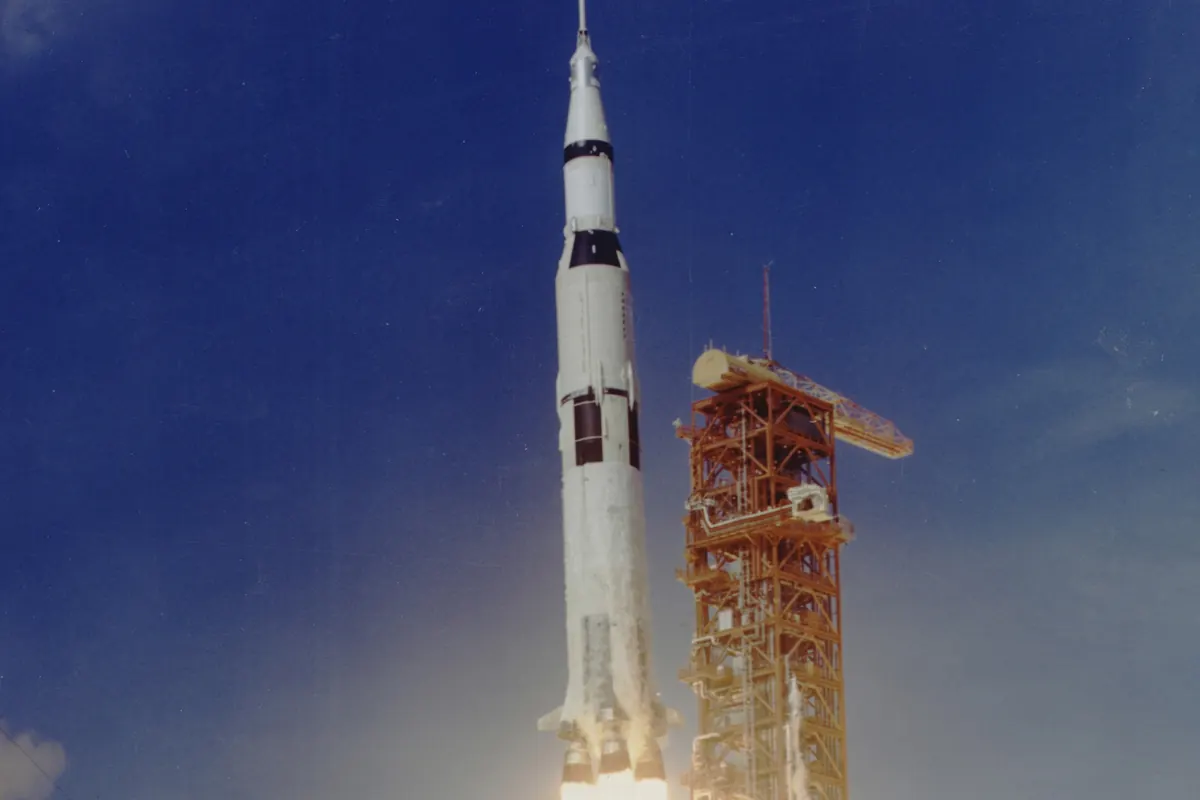
What it cost
NASA's history office puts the cost of Project Apollo at $25.4 billion, about $95 billion in 1990 dollars. Apollo 18, 19 and 20 were cancelled because of budget limits, so six landings was the total.
The fire
The program's worst day came before any crew had flown. On January 27, 1967, Gus Grissom, Ed White and Roger Chaffee died when fire swept through their command module during a preflight test. Apollo 1 never flew, which is why the table starts with Apollo 7.
All 11 crewed flights
| Mission | Launched | Crew | Length | What it did |
|---|---|---|---|---|
| Apollo 7 | October 11, 1968 | Wally Schirra, Donn F. Eisele, Walter Cunningham | 10 d 20 h 9 min | Earth orbit test |
| Apollo 8 | December 21, 1968 | Frank Borman, James Lovell, William Anders | 6 d 3 h 0 min | Flew to the Moon, no landing |
| Apollo 9 | March 3, 1969 | James McDivitt, David Scott, Rusty Schweickart | 10 d 1 h 0 min | Earth orbit test |
| Apollo 10 | May 18, 1969 | Thomas P. Stafford, John Young, Eugene Cernan | 8 d 0 h 3 min | Flew to the Moon, no landing |
| Apollo 11 | July 16, 1969 | Neil Armstrong, Michael Collins, Buzz Aldrin | 8 d 3 h 18 min | Landed on the Moon |
| Apollo 12 | November 14, 1969 | Pete Conrad, Richard F. Gordon Jr., Alan Bean | 10 d 4 h 36 min | Landed on the Moon |
| Apollo 13 | April 11, 1970 | James Lovell, Jack Swigert, Fred Haise | 5 d 22 h 54 min | Flew to the Moon, no landing |
| Apollo 14 | January 31, 1971 | Alan Shepard, Stuart Roosa, Edgar Mitchell | 9 d 0 h 1 min | Landed on the Moon |
| Apollo 15 | July 26, 1971 | David Scott, Alfred Worden, James Irwin | 12 d 7 h 11 min | Landed on the Moon |
| Apollo 16 | April 16, 1972 | John Young, Ken Mattingly, Charles Duke | 11 d 1 h 51 min | Landed on the Moon |
| Apollo 17 | December 7, 1972 | Eugene Cernan, Ronald Evans, Harrison Schmitt | 12 d 13 h 51 min | Landed on the Moon |
Apollo 1 never flew; its crew died in a fire during a pad test in January 1967. Apollo 7 and 9 tested the spacecraft in Earth orbit. Crews are listed as commander, command module pilot and lunar module pilot.
The 6 landings
| Mission | Landed | Site | Hours outside | Distance (km) | Rock (kg) |
|---|---|---|---|---|---|
| Apollo 11 | July 20, 1969 | Mare Tranquilitatis | 2.53 | 0.25 | 21.55 |
| Apollo 12 | November 19, 1969 | Oceanus Procellarum | 7.75 | 1.35 | 34.35 |
| Apollo 14 | February 5, 1971 | Fra Mauro | 9.38 | 3.45 | 42.28 |
| Apollo 15 | July 30, 1971 | Hadley Rille | 19.13 | 27.9 | 77.31 |
| Apollo 16 | April 20, 1972 | Descartes | 20.23 | 27 | 95.71 |
| Apollo 17 | December 11, 1972 | Taurus-Littrow | 22.07 | 35 | 110.52 |
Apollo 15, 16 and 17 carried a lunar rover and stayed three days. Between them they returned 74% of all the rock and covered 89.9 km of the 95.0 km total.
From the first to the last
Apollo 11's crew spent 2.53 hours outside and covered 0.25 km. Apollo 17's spent 22.07 hours outside and covered 35 km. In three years, moonwalks went from one short outing to three long drives.
Before the first landing
Four crewed flights came before the first landing. Apollo 7 tested the spacecraft in Earth orbit. Apollo 8's crew became the first humans to orbit the Moon, on December 24, 1968. Apollo 9 tested the lunar module in Earth orbit. Apollo 10 flew to the Moon and didn't land. The crews are in the table above.
Scouting the sites
Robots picked the landing sites. The five Lunar Orbiters, flown between August 1966 and August 1967, returned 3,062 images, and NASA says the first three imaged 20 potential Apollo landing sites. One of them, Site 2, became the Apollo 11 landing site.
The scare
Apollo 13 is the mission people remember for not landing. An oxygen tank in the service module failed about 56 hours into the flight. The crew came home safely, and the ledger grades the mission partial.
Landing by landing
The landings grew steadily more ambitious. Apollo 11 had the shortest time outside, 2.53 hours, and Apollo 17 the longest, 22.07 hours. The most rock came back on Apollo 17, 110.52 kilograms from Taurus-Littrow, and the least on Apollo 11, 21.55 kilograms from Mare Tranquilitatis.
The longer stays
The last three landings were a different kind of mission. Apollo 15, 16 and 17 carried a rover, which let the crews cover more ground and bring back more rock. In all, six landings returned 382 kilograms and covered 95 kilometers on the surface. The twelve who made the walks are on how many people have walked on the Moon, and the sites are on every Moon landing.
The landings one by one
Apollo 11 landed at Mare Tranquilitatis (0.674 N, 23.473 E) on July 20, 1969, with the command module Columbia in orbit and the lunar module Eagle on the surface. Neil Armstrong and Buzz Aldrin went down and spent 2.53 hours outside, with Michael Collins alone in orbit. They covered 0.25 kilometers and returned 21.55 kilograms of rock.
Apollo 12 landed at Oceanus Procellarum (3.013 S, 23.422 W) on November 19, 1969, with the command module Yankee Clipper in orbit and the lunar module Intrepid on the surface. Pete Conrad and Alan Bean went down and spent 7.75 hours outside, with Richard F. Gordon Jr. alone in orbit. They covered 1.35 kilometers and returned 34.35 kilograms of rock.
Apollo 14 landed at Fra Mauro (3.646 S, 17.472 W) on February 5, 1971, with the command module Kitty Hawk in orbit and the lunar module Antares on the surface. Alan Shepard and Edgar Mitchell went down and spent 9.38 hours outside, with Stuart Roosa alone in orbit. They covered 3.45 kilometers and returned 42.28 kilograms of rock.
Apollo 15 landed at Hadley Rille (26.132 N, 3.633 E) on July 30, 1971, with the command module Endeavour in orbit and the lunar module Falcon on the surface. David Scott and James Irwin went down and spent 19.13 hours outside, with Alfred Worden alone in orbit. They covered 27.9 kilometers and returned 77.31 kilograms of rock.
Apollo 16 landed at Descartes (8.973 S, 15.501 E) on April 20, 1972, with the command module Casper in orbit and the lunar module Orion on the surface. John Young and Charles Duke went down and spent 20.23 hours outside, with Ken Mattingly alone in orbit. They covered 27 kilometers and returned 95.71 kilograms of rock.
Apollo 17 landed at Taurus-Littrow (20.191 N, 30.772 E) on December 11, 1972, with the command module America in orbit and the lunar module Challenger on the surface. Eugene Cernan and Harrison Schmitt went down and spent 22.07 hours outside, with Ronald Evans alone in orbit. They covered 35 kilometers and returned 110.52 kilograms of rock.
Rock per hour
Divide the rock by the time outside and the landings separate. Apollo 11 brought home the most for each hour on the surface, at 8.5 kilograms an hour, and Apollo 15 the least, at 4.0.
Riding on the Moon
The Lunar Roving Vehicle made its debut on July 31, 1971, driven by David Scott on Apollo 15. NASA says that crew covered 17.5 miles. Apollo 17 launched on December 7, 1972, the first night launch of an American crewed flight. The vehicle was used on each of the last three landings.
Averages
Across the 6 landings, the crews spent 13.5 hours outside on average, covered 15.8 kilometers and returned 63.6 kilograms of rock. The averages hide a wide spread, because the first landing and the last were very different missions. The Moon's weaker pull is part of why the walks could be so long, and you can see how your own weight would change on the weight calculator.
Short flights and long ones
The shortest crewed Apollo flight in the table was Apollo 13, at 5 days 22 hours 54 minutes. The longest was Apollo 17, at 12 days 13 hours 51 minutes.
Who commanded the landings
The six landing missions were commanded by Neil Armstrong, Pete Conrad, Alan Shepard, David Scott, John Young and Eugene Cernan. The command module pilots, who stayed in orbit, are named in the table.