The first planet ever weighed
The history of planetary density begins with a piece of laboratory equipment. In 1798 Henry Cavendish used a twisting wire and two pairs of lead balls to measure how strongly masses attract each other. He expressed the result as a density: the Earth, he found, is about 5.448 times as dense as water. Modern measurements put it at 5.51, so he was close. It was the first time anyone could say what a whole planet is made of on average, and it showed that Earth is much denser than the rocks at its surface, which means something heavy sits inside.
Density of every planet
| World | Density (kg/m3) | Times water | Times Earth |
|---|---|---|---|
| Mercury | 5,429 | 5.43 | 0.98 |
| Venus | 5,243 | 5.24 | 0.95 |
| Earth | 5,514 | 5.51 | 1.00 |
| Mars | 3,934 | 3.93 | 0.71 |
| Jupiter | 1,326 | 1.33 | 0.24 |
| Saturn | 687 | 0.69 | 0.12 |
| Uranus | 1,270 | 1.27 | 0.23 |
| Neptune | 1,638 | 1.64 | 0.30 |
| Pluto | 1,850 | 1.85 | 0.34 |
Water has a density of about 1,000 kg per cubic meter. Values from the NASA Planetary Fact Sheet.
How density is worked out
Density is mass divided by volume, so you need both. The size comes from the planet's angular width and its distance. The mass comes from gravity: the orbit of a moon, or of a passing spacecraft, depends on the planet's mass, so a planet with moons is easy to weigh and one without, like Mercury and Venus, is harder. Divide one by the other and you have a clue to what the planet is made of, and astronomers use the same logic on planets around other stars. Exoplanet sizes shows how.
Rock and metal are heavy
The four rocky planets are the densest. Earth leads, with Mercury second, which NASA ties to its large metal core. NASA gives the core a radius of about 2,074 kilometers, roughly 85 percent of the planet's radius, and says it's partly molten. Mercury is much smaller than Earth, yet its density is almost the same. That tells you how much of it's metal.
Gas is light
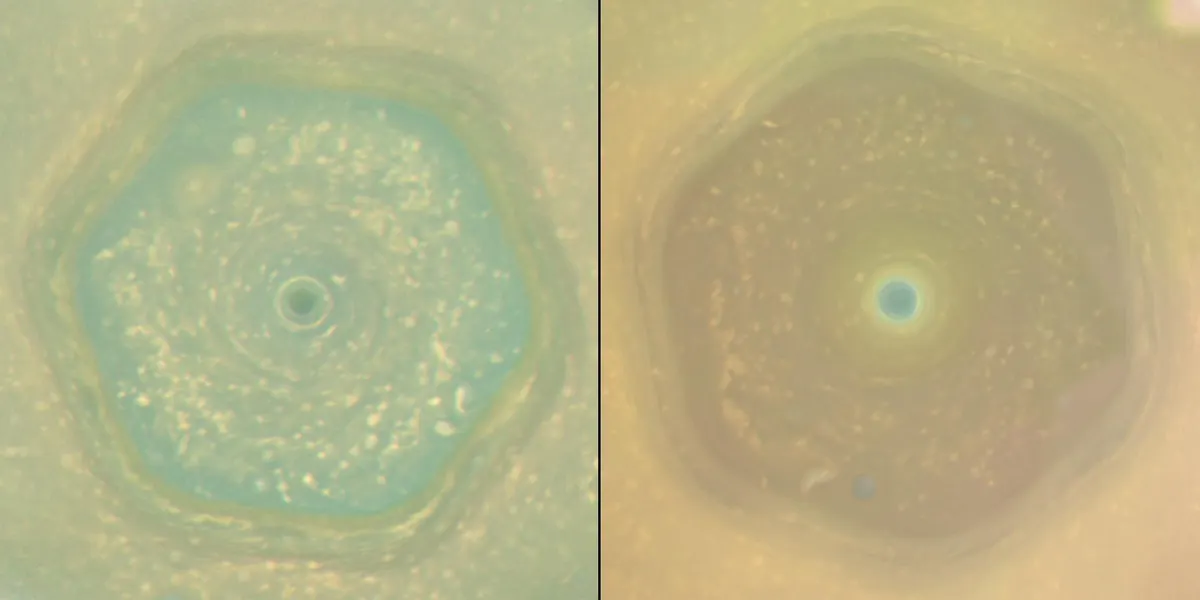
Jupiter and Saturn are made mostly of hydrogen and helium. Their huge size and low density mean they have far more volume than mass. Saturn, at 687 kg per cubic meter, is the only planet less dense than water, as NASA puts it, and it would float if you could find a bathtub big enough. Jupiter, at 1,326, is nearly as dense as the Sun, which averages 1,408. Uranus (1,270) and Neptune (1,638) hold more water, ammonia and methane ices and rock, so both are far denser than Saturn, and Neptune is denser than Jupiter as well.
Pluto in the middle
Pluto's density, 1,850 kg per cubic meter, is nearly twice that of water and sits between the giants and the rocky planets. It's a mix of rock and ice. When New Horizons measured Pluto's size in 2015, it found Pluto slightly larger than some earlier estimates, which put its density slightly lower.
Why density matters
Density is a clue to what a planet is made of. It's how scientists tell a big ball of gas from a ball of rock before any spacecraft arrives. Combined with gravity, it explains why a planet much bigger than Earth can have almost the same pull on its surface. NASA's Juno spacecraft has since shown that Jupiter's core is larger than expected and not solid, so even the best-studied giant is still revealing its insides. The Earths-in-Jupiter page uses the same numbers from the other side.
Squeezed by their own weight
The densities in the table are averages, and the inside of a planet isn't uniform. Earth's 5,514 kg per cubic meter averages light surface rock with a much denser metal core, and compression adds more as the weight above presses down. Mars has 3,934, noticeably lower than Earth, even though both are rocky, because Mars is smaller and has less weight pressing on its interior. Venus, at 5,243, almost matches Earth, which is one reason it's called a twin.
What Juno found inside Jupiter
A giant planet's density is a trade between light gas on the outside and a heavier core deep inside, and nobody can drill in to check. NASA's Juno spacecraft has mapped Jupiter's gravity field to find out. Its data suggest the core is larger than expected and not solid, which means that even the best-studied giant has an interior that remains uncertain. The gravity page shows the surface effect of this, and the Juno page follows the mission.
Using density to read other worlds
The same arithmetic is what lets astronomers tell, from far away, what planets around other stars are made of. If a planet's mass and width are both known, the density sorts it into rock, water or gas. The exoplanets hub applies that to the distant worlds, with the same logic as the table here.
The Moon is lighter than Earth
Earth's Moon has a density of 3,340 kg per cubic meter, about 61 percent of Earth's. That gap is one of the clues behind the leading idea of the Moon's origin: a collision threw out mostly the lighter outer rock of the young Earth, and not much of the dense iron core, which stayed behind. A single number like density can point to a whole history, and the same comparison works for any world with a known mass and size. The moons hub carries the density story for the big moons, too.
Questions people ask
Which planet is the densest?
Earth, at 5,514 kg per cubic meter. Mercury is second at 5,429.
Which planet is the least dense?
Saturn, at 687 kg per cubic meter, less than water.
Would Saturn float on water?
Its average density is below that of water, so a big enough ocean would hold it up. No such ocean exists, and Saturn is a ball of gas, so this is only a way to picture how light it is.
Why are the giant planets so light?
They're made mostly of hydrogen and helium, the lightest elements, rather than rock and metal.
Keep exploring
 How many Earths fit in Jupiter and the Sun?Volume and mass of every planet and the Sun compared with Earth.
 Gravity on each planetSurface gravity on every world, and what you would weigh.
 Planet sizes comparedEvery planet drawn to scale, with diameters next to Earth.
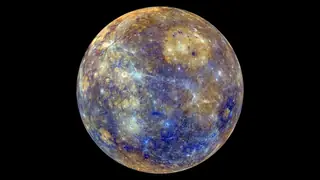 MercuryRocky planet, 0.39 AU from the Sun.