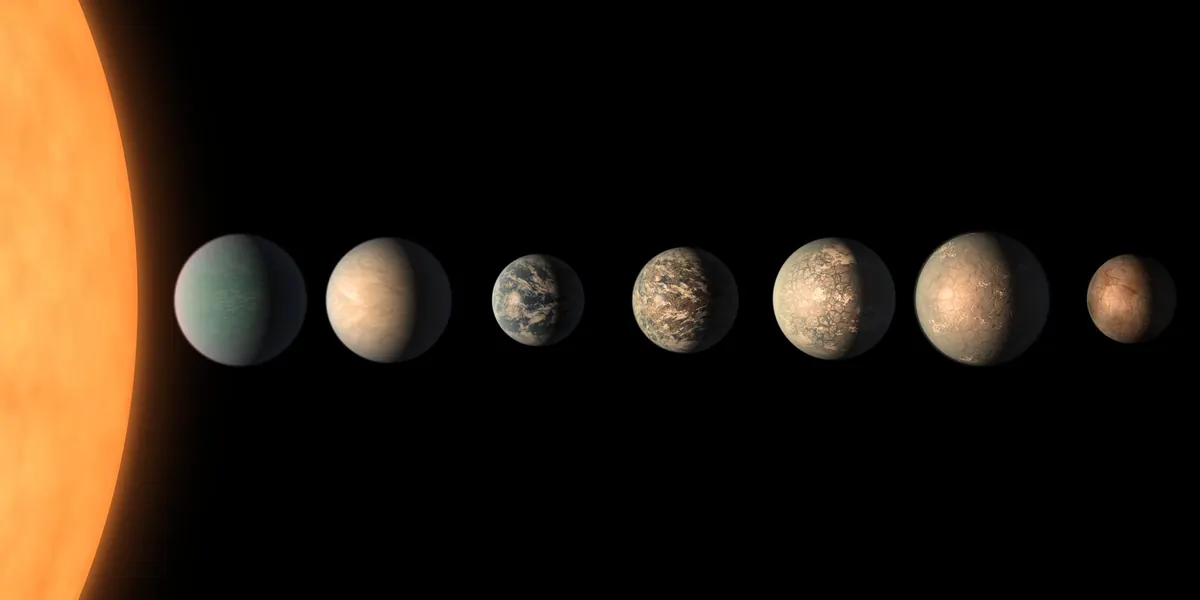
22% of the stars with planets in the archive have more than one. That isn't a clean measure of how common families are. A single-planet star usually just means we have found one planet so far. Every family in the table below was found by teams that kept looking after the first detection.
Most systems have one planet we know of
The table counts the planets known in each system. A system with one listed planet may have more that are too small, too far out or too tilted for current methods to catch. The solar system, with eight planets, ties the record for the largest known family.
| Known planets | Systems | Share of systems |
|---|---|---|
| 1 | 3,778 | 77.9% |
| 2 | 720 | 14.9% |
| 3 | 223 | 4.6% |
| 4 | 83 | 1.7% |
| 5 | 29 | 0.6% |
| 6 | 12 | 0.2% |
| 7 | 1 | 0.0% |
| 8 | 1 | 0.0% |
What a family tells you
When several planets transit the same star, their orbits have to lie in nearly the same plane, like a flat disk. That's how the solar system looks, and Kepler showed such flat families are common. Studies of the Kepler systems, including the California-Kepler Survey, found that neighbors in a system tend to be similar in size and evenly spaced, a pattern astronomers call peas in a pod.
Compact systems turned out to be normal. Kepler-11 has 6 planets, and 5 of them orbit closer to their star than Mercury does to the Sun at 0.39 AU. Nothing like that exists in the solar system, and it was one of the early surprises from the Kepler telescope.
The biggest families
Systems with six or more confirmed planets. The archive lists the Kepler-90 system under the name KOI-351, with one planet carrying the Kepler-90 name.
| Star | Planets | Distance (light years) | Star temperature | Found by | First listed |
|---|---|---|---|---|---|
| KOI-351 (Kepler-90) | 8 | 2,767 | 6,080 K | Transit | 2013 |
| TRAPPIST-1 | 7 | 41 | 2,566 K | Transit | 2016 |
| HD 10180 | 6 | 127 | 5,911 K | Radial Velocity | 2010 |
| HD 110067 | 6 | 105 | 5,266 K | Transit | 2023 |
| HD 191939 | 6 | 175 | 5,348 K | Radial Velocity, Transit | 2020 |
| HD 219134 | 6 | 21 | 4,699 K | Radial Velocity | 2015 |
| HD 34445 | 6 | 150 | 5,879 K | Radial Velocity | 2009 |
| HIP 41378 | 6 | 347 | 6,290 K | Radial Velocity, Transit | 2016 |
| K2-138 | 6 | 661 | 5,356 K | Transit | 2017 |
| Kepler-11 | 6 | 2,108 | 5,663 K | Transit | 2010 |
| Kepler-20 | 6 | 922 | 5,495 K | Radial Velocity, Transit | 2011 |
| Kepler-80 | 6 | 1,205 | 4,540 K | Transit | 2012 |
| TOI-1136 | 6 | 276 | 5,770 K | Transit | 2022 |
| TOI-178 | 6 | 204 | 4,316 K | Transit | 2021 |
Kepler-90: the eight-planet star
The archive lists the Kepler-90 family under its Kepler Object of Interest number, KOI-351. Seven planets were in the catalog by 2013. On December 14, 2017 NASA and Google announced an eighth, Kepler-90 i, found by a neural network trained to pick weak transit signals out of Kepler's light curves. That tied the system with the solar system for the most planets around one star. It's 2,767 light years away.
The resemblance to our own system is partial. The inner planets are small and the outer two are large, as in the solar system, but all eight orbit within 0.97 AU of the star, closer in than Earth. Compare that with the planets on the order of the planets page, where Neptune alone orbits about 30 times farther from the Sun than Earth does.
The families we don't see
Imagine an alien astronomer watching the solar system from a random direction. A planet only crosses the Sun if the viewer sits nearly in its orbital plane, and the chance is roughly the Sun's radius divided by the planet's distance. That comes to about 1.2% for Mercury, 0.47% for Earth and 0.02% for Neptune. Because the planets lie almost in one plane, a viewer who sees a distant planet transit will usually see the closer ones too. That's how Kepler caught whole systems at once.
It also means every count in the table is a lower bound. For each family we can see, there are many we can't, because their orbits are tilted away from us. Of the 14 systems with six or more planets, 11 include at least one transit planet and 3 were found by radial velocity alone. The closest of them, HD 219134, is 21 light years away.
TRAPPIST-1
TRAPPIST-1 is a small, cool star. The TRAPPIST telescope in Chile found three of its planets in 2016, and on February 22, 2017 NASA announced seven, after the Spitzer Space Telescope and ground telescopes found more. NASA said three of them, e, f and g, lie in the habitable zone, a record for planets around one star at the time.
That search was led by Michaël Gillon of the University of Liège, using the TRAPPIST telescope at La Silla. The star is only about 9% of the Sun's mass and about 2,566 K at the surface, so the planets sit close in. The outermost, h, orbits in 18.8 days.
The periods are close to simple ratios. Each planet takes about 1.6, 1.7, 1.5, 1.5, 1.3 and 1.5 times as long as the one inside it, which is what a chain of orbital resonances looks like. Such chains are fragile, so they suggest the planets formed farther out and moved in together. Planets this close are likely tidally locked, with one side always facing the star.
Webb has looked at TRAPPIST-1 b and c, the two innermost planets, in 2023. It found no sign of a thick atmosphere on either. The inner planets of a cool star may have lost their air early, and whether the temperate planets e, f and g kept theirs is still open. See the JWST page for the telescope.
NASA's three temperate planets are e, f and g. The archive puts their sunlight at 0.65, 0.37 and 0.25 times what Earth gets. Planets e and f fall inside the range used on the habitable zone page, and g falls just outside it, so the archive's wording is more cautious than the original announcement. All of this depends on the star's light being measured correctly, and the planets' atmospheres, if any, are unknown.
All seven orbit within 0.06 AU of their star, far inside Mercury's orbit around the Sun at 0.39 AU. The planets are all close to Earth in size.
| Planet | Orbit (days) | Distance from star (AU) | Radius (Earth radii) | Sunlight (Earth = 1) | Year listed |
|---|---|---|---|---|---|
| TRAPPIST-1 b | 1.51 | 0.012 | 1.12 | 4.15 | 2016 |
| TRAPPIST-1 c | 2.42 | 0.016 | 1.1 | 2.21 | 2016 |
| TRAPPIST-1 d | 4.05 | 0.022 | 0.79 | 1.11 | 2016 |
| TRAPPIST-1 e | 6.1 | 0.029 | 0.92 | 0.65 | 2017 |
| TRAPPIST-1 f | 9.21 | 0.038 | 1.04 | 0.37 | 2017 |
| TRAPPIST-1 g | 12.35 | 0.047 | 1.13 | 0.25 | 2017 |
| TRAPPIST-1 h | 18.77 | 0.062 | 0.76 | 0.14 | 2017 |
More resonant chains
TRAPPIST-1 isn't alone. 12 systems in the archive have exactly six planets, and a few, such as TOI-178 and HD 110067 found by TESS, are described in the literature as chains in resonance. Most families are far less tidy. In the archive, 126 systems have four or more planets, and only 14 have six or more.
Which stars host these systems? The breakdown by star type shows where planets turn up most.