One idea, two telescopes
Both missions use the transit method. When a planet crosses the face of its star, the star dims for a few hours. For an Earth-sized planet in front of a Sun-like star the dip is only about 0.0084% of the star's light. Nothing on the ground can measure that reliably through a shifting atmosphere, so the work had to go to space.
William Borucki of NASA's Ames Research Center was the principal investigator for Kepler, which launched on March 7, 2009. It stared at one fixed field of about 150,000 stars in the northern constellations Cygnus, Lyra and Draco and measured their brightness again and again. It never looked anywhere else during its main mission, which let it build up repeat dips for each star.
The wheels that broke
A telescope that stares has to hold perfectly still. Kepler steered with four reaction wheels, spinning flywheels that turn a spacecraft without using fuel. The first failed on July 14, 2012 and the second on May 11, 2013. With only two working it could no longer hold its aim on the original field, and the primary mission was over.
Engineers found a way to keep it working. If the spacecraft points along its own orbit, sunlight pushes evenly on its panels and acts as a stand-in for the missing wheel. NASA approved the new mission, called K2, on May 16, 2014. The roll stays steady for up to about 85 days at a time, and K2 could only look at fields near the ecliptic, the path the Sun traces across the sky, so it worked in short campaigns, one field after another. The archive credits K2 with 550 planets.
How their catches compare
The table shows why the two telescopes find different things. Kepler stared at one distant patch, and its median planet is 2,504 light years away and 2.1 Earth radii across. TESS sweeps the whole sky and picks bright stars close to us, and its median planet is 374 light years away and 3.1 Earth radii across. 45% of Kepler's planets are smaller than twice Earth's radius, which is the first hint that small planets are the norm and the solar system's arrangement isn't.
Closer, brighter stars matter because other telescopes can then study the planets. Webb, the infrared observatory described on the JWST page, needs a bright host star to read a planet's atmosphere, so TESS planets are the ones it targets. Many Kepler planets are too far and faint for that. For how size groups break down, see exoplanet sizes.
| Telescope | Planets | Share of all | First year | Latest year | Median radius (Earth radii) | Share smaller than 2 Earth radii | Median distance (light years) |
|---|---|---|---|---|---|---|---|
| Kepler | 2,787 | 43.2% | 2009 | 2026 | 2.1 | 45% | 2,504 |
| K2 | 550 | 8.5% | 2014 | 2026 | 2.3 | 39% | 674 |
| TESS | 1,012 | 15.7% | 2018 | 2026 | 3.1 | 19% | 374 |
Kepler and K2 by year
The chart shows tall bars in 2014, 2016 and 2021, and none of them is a year when Kepler saw more than usual. The telescope stopped taking its main data in 2013. The bars are years when scientists published planets in batches. In 2014 Kepler's name is on 784 planets in the archive, including the 715 that NASA announced on February 26 of that year, verified because stars with several candidate planets are very likely to be real planetary systems. In 2016 it's on 1,276, driven by the 1,284 planets that NASA announced on May 10 as validated by a statistical method. In 2021 it's on 311, most of them from a neural network, ExoMiner, that scored old candidates. The year-by-year page follows these spikes in the whole archive.
It also matters what Kepler actually delivered: the first confirmed rocky planet outside the solar system, Kepler-10 b, and systems with many planets such as Kepler-90, covered in multi-planet systems. The mission is credited with 2,787 planets in the archive.
TESS: the nearby sky
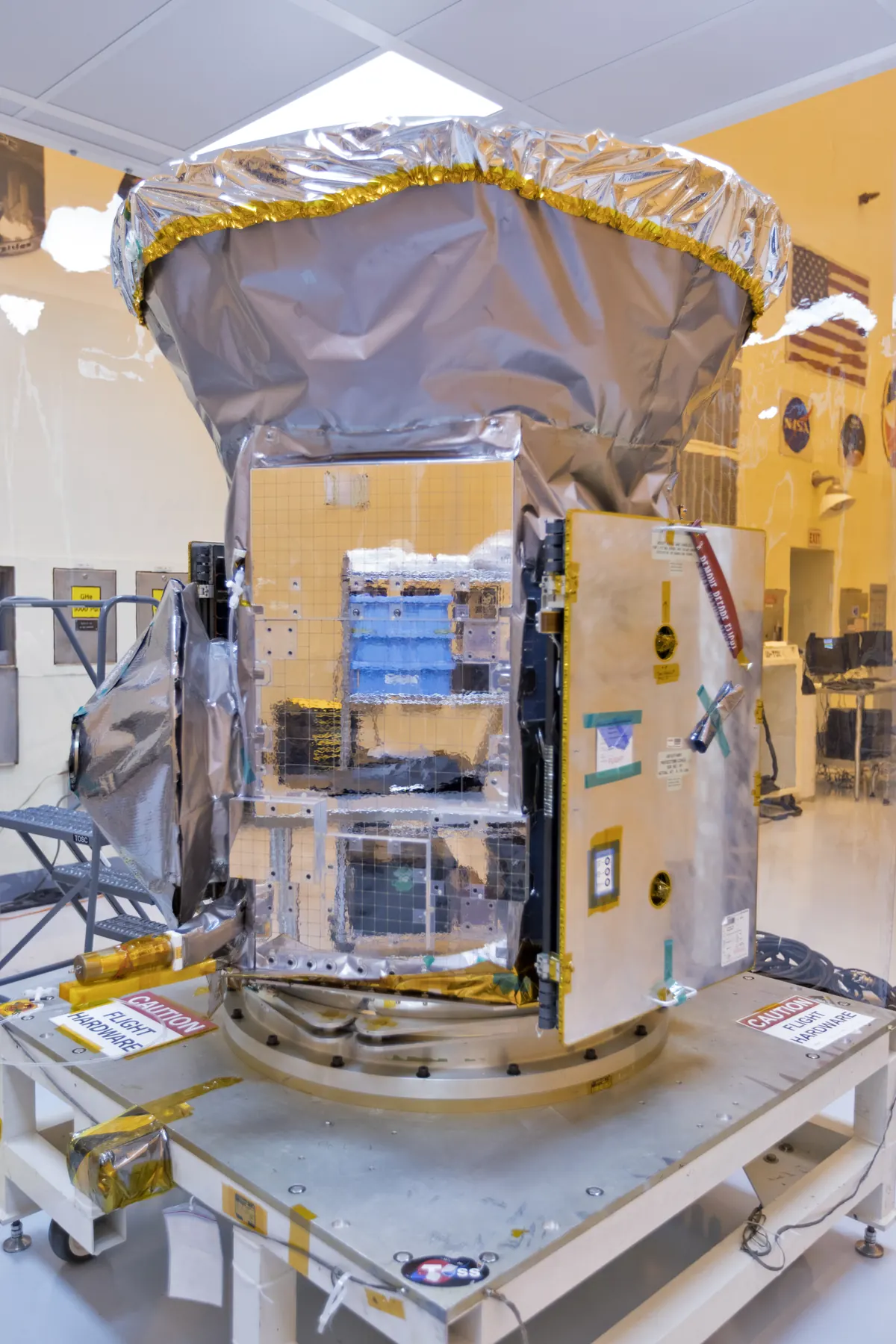
TESS launched on April 18, 2018 on a Falcon 9 from Cape Canaveral, in a mission led by MIT. It carries four wide-field cameras and reads a strip of sky about 27 days at a time, called a sector, before moving on. Its orbit around Earth is a long ellipse that makes two loops for every orbit of the Moon, which keeps the orbit stable for years. The first two years covered about 85% of the sky, south first and then north. Two extended missions followed.
The first TESS planets were announced in September 2018: Pi Mensae c, a super-Earth, and LHS 3844 b, a rocky world that circles its star in under a day. The archive credits TESS with 1,012 confirmed planets as of October 15, 2026, and the count has risen most years. 178 were credited in 2024, the best full year, and 273 already in 2026.
TESS finds a candidate first and calls it a TESS Object of Interest. Each one then needs follow-up before it counts as a planet. The archive lists 4,820 such candidates still waiting, more than four times as many as confirmed TESS planets, and 1,977 Kepler candidates have never been resolved either. Some will be eclipsing stars or background blends. That's why candidate lists aren't planet counts, as the main count page explains.
What each telescope can't see
Transit surveys are blind to most planets. A planet only transits if its orbit is edge-on to us, and a telescope has to catch at least a couple of dips to prove a period. TESS watches most of the sky for only about a month, so it favors short orbits: its median planet circles its star in 5.7 days, against 11.5 for Kepler, which watched one field for four years. An Earth twin would transit once a year, giving Kepler only three or four dips in its main mission, too few for a clean confirmation.
The archive shows the problem. Kepler-452 b, announced in 2015 as an Earth cousin on a 385-day orbit around a Sun-like star, is flagged controversial in the archive. A 2018 reanalysis (Mullally and colleagues) found that its signal couldn't be shown to be a planet with the statistical confidence claimed in 2015, so it's best treated as a candidate. The habitable zone page leaves it out for that reason.
What comes next
TESS is still working, and the archive credits it with more planets in 2026 so far than in any earlier year. The telescope that extends the transit approach to Earth twins is ESA's PLATO, designed to watch many bright Sun-like stars for years. Neither mission can replace the other: Kepler showed what's typical, and TESS supplies the nearby targets that Webb and the large ground telescopes can actually study.