Where the letters came from
The letters O, B, A, F, G, K and M belong to the Harvard classification, which Annie Jump Cannon reordered and simplified so that stars run from hottest to coolest. Our Sun is class G2, with a surface near 5,800 K. The usual rhyme for remembering the order is "Oh, Be A Fine Girl, Kiss Me." Sources draw the class edges a few hundred kelvin apart, so a star near a boundary can land in different classes depending on the table. The cut-offs on this page are fixed in the table above.
Sorting stars by temperature
The archive lists a temperature for the stars of 95% of the planets, so we sort by that. M stars are the coolest and reddest, then K, G like the Sun, F and finally A and hotter stars. The temperature ranges are the usual ones for each class.
| Star class | Star temperature | Planets | Share | Median radius (Earth radii) | Median orbit (days) | Hot Jupiters |
|---|---|---|---|---|---|---|
| M | under 3,700 K | 447 | 7.3% | 1.9 | 6.3 | 4.5% |
| K | 3,700 to 5,200 K | 1,743 | 28.4% | 2.6 | 10.8 | 7.4% |
| G | 5,200 to 6,000 K | 2,780 | 45.2% | 2.8 | 11.7 | 10.4% |
| F | 6,000 to 7,500 K | 1,123 | 18.3% | 3.5 | 10.3 | 22.0% |
| A and hotter | over 7,500 K | 51 | 0.8% | 13.3 | 13.1 | 27.5% |
The most common stars have the fewest known planets
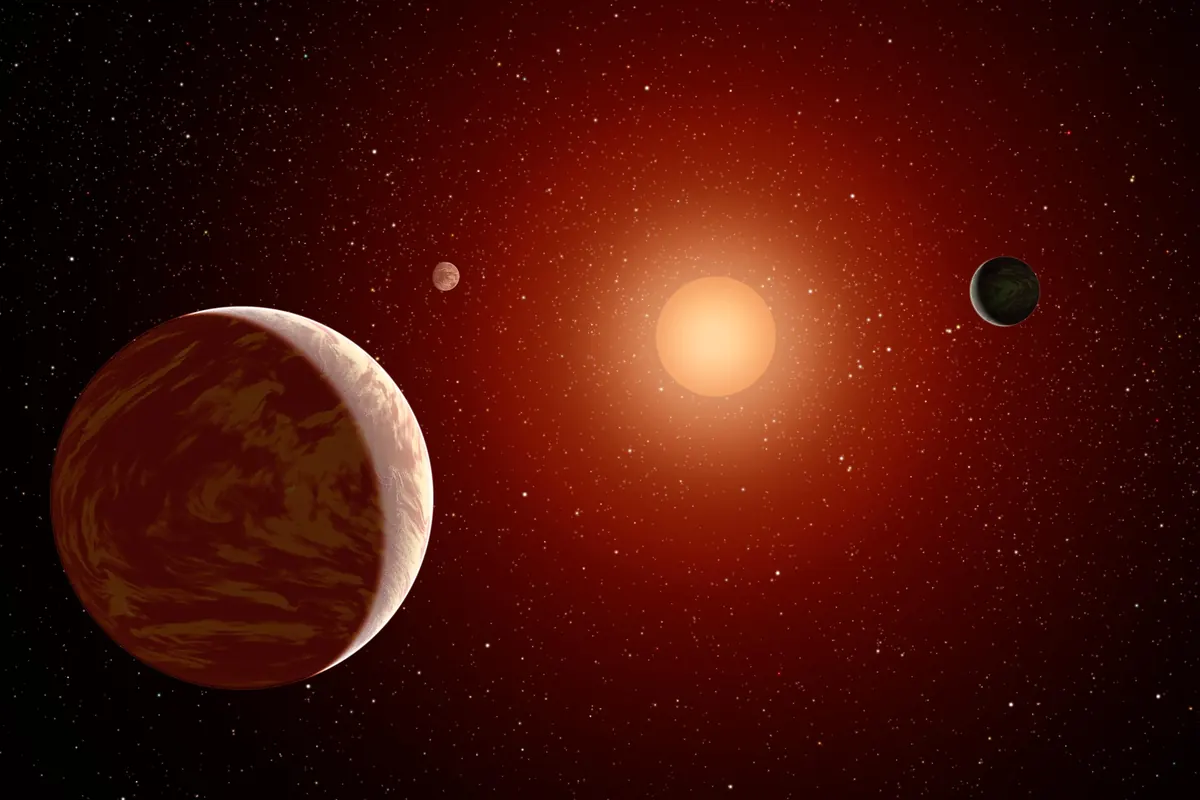
Red dwarfs make up most of the stars near the Sun. Some estimates put them at about three quarters of the Milky Way's stars, and Proxima Centauri, the nearest star to the Sun, is one. Yet only 7% of the planets with a known star temperature orbit M stars, compared with 45% for G stars. That isn't because red dwarfs lack planets. Telescopes were slower to find them. Red dwarfs are faint, and early surveys had to choose brighter stars.
The planets we do know there are often small and close in. Faint stars give weak signals, but a small star lets a small planet cause a big wobble or a deep dip. Newer surveys that aim at cool stars, such as TESS, have started to change the balance.
Heavier stars, richer stars
Giant planets are found more often around stars with more elements heavier than helium, a pattern known as the planet-metallicity correlation and reported in the late 1990s and firmly established in 2005. The material for planet-building cores is thought to be easier to find in such stars. The effect is weaker for small planets, which turn up around stars with a wide range of heavy-element content.
The hottest stars are a special case. Radial velocity struggles with fast-spinning A and F stars because rotation blurs the spectral lines astronomers measure. Transit surveys can still find planets there, which is how KELT-9 b was found around a star of 9,270 K. The archive lists only 51 planets around stars hotter than 7,500 K. Compare their planets with the hottest worlds on the most extreme exoplanets page.
Planets per host star
The archive lists 308 M stars with planets, 1,279 K stars, 2,041 G stars and 882 F stars. Divide planets by host stars and the average is 1.45 planets per M star, 1.36 per K star, 1.36 per G star and 1.27 per F star. M stars host the most planets each because small stars with several planets are easy to follow up once the first is found, and TRAPPIST-1 alone adds seven to the M column. Among the multi-planet systems it's one of the most striking.
ESA's PLATO mission is designed to find Earth-sized planets around Sun-like stars, so the G and F rows are the ones it should change most.
Temperature is a stand-in for mass. The median host star in the archive weighs 0.35 solar masses in the M group, 0.77 in K, 0.98 in G and 1.2 in F. Hot Jupiters make up 4.5% of the planets around M stars and 10.4% around G stars. Giant planets close in around the smallest stars are rare, and the planets that cool stars do host are mostly small ones.
Why the pattern isn't the whole story
Which stars have the most known planets depends on which stars astronomers looked at, not only on where planets form. 77% of the Kepler planets with a star temperature orbit G or K stars, while 16% of TESS's planets orbit M stars, against 1% for Kepler. Each telescope looked at a different set of stars, and the totals follow its choices.
The counts also say something about what the telescopes chose. Kepler targeted Sun-like dwarfs, so its planets mostly belong to G and K stars. TESS chose bright, nearby stars and ranked cool dwarfs highly, so M stars are a larger share of its catch. The Kepler and TESS page describes how each mission picked its targets.
What the medians say
Read down the median columns. The typical planet is 1.9 Earth radii across around M stars and 3.5 around F stars, and the share of hot Jupiters rises from 4.5% to 22.0% over the same range. These describe the planets found so far, and detection favors the same kinds of planets in every group, so they aren't a verdict on how planets form.
The counts above are planets. By stars, 2,041 G stars host at least one confirmed planet, against 308 M stars.
The coolest host star in the archive is WISE J033605.05-014350.4, at 415 K. Stars that cool are barely above the limit for fusing hydrogen, and they shine mostly in the infrared. Planets there are difficult to see with visible-light telescopes and are one reason infrared instruments matter so much.
What the red dwarf numbers mean for habitability
The 308 M stars with planets matter more than their share suggests, because the nearest candidate Earth-sized planets orbit them. The habitable zone page lists them. Red dwarfs also flare, and their planets are likely tidally locked, so whether these systems can hold on to atmospheres is one of the field's main open questions.