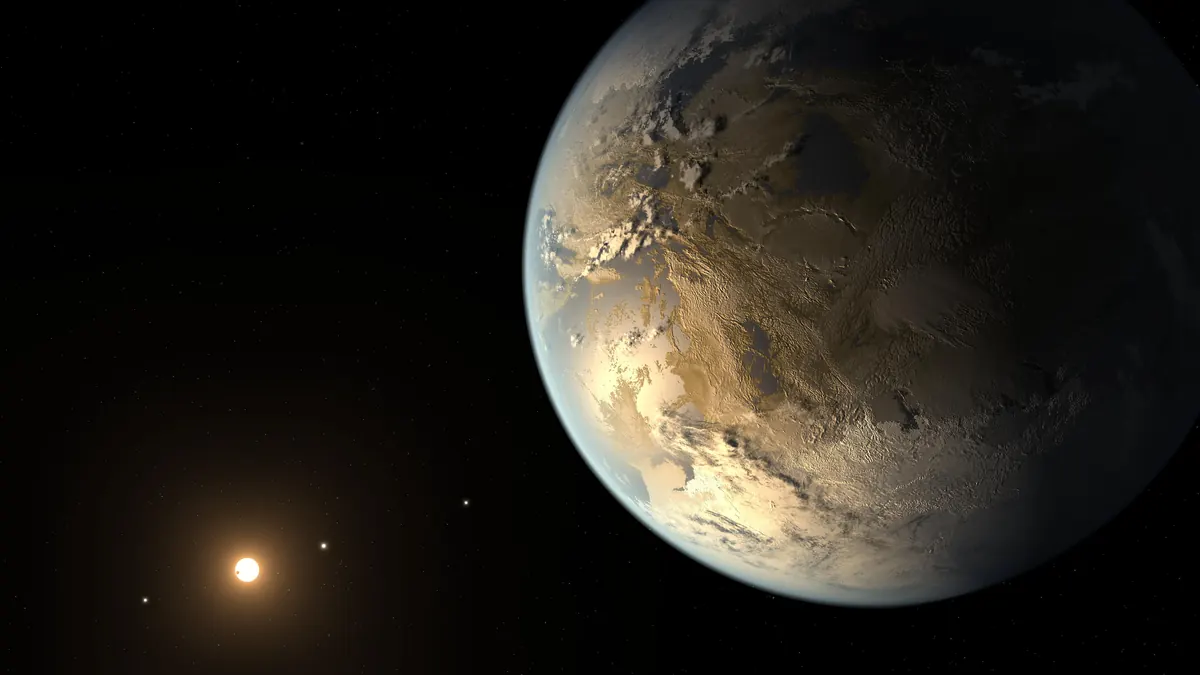
Where the idea comes from
The habitable zone is the band around a star where a planet with an Earth-like atmosphere could keep liquid water on its surface. The modern version comes from a 1993 paper by James Kasting and colleagues, who built a climate model for stars of different brightness. In 2013 Ravi Kopparapu and colleagues revised the edges with better treatments of water and carbon dioxide, and those are the limits this page uses.
The inner edge is where a planet would lose its water to a runaway greenhouse effect, the way Venus probably did. The outer edge is where carbon dioxide can no longer keep a planet warm. The test uses starlight received, expressed in units of what Earth gets, because one number works for every star. A planet at 1 gets Earth's share. At 0.64 Proxima Centauri b gets about two thirds of it.
How we counted
We count a planet if its radius is between 0.8 and 1.6 times Earth's, and the starlight it receives is between 0.32 and 1.78 times what Earth gets. The size range picks planets that could be rocky, since the odds of a planet being mostly rock fall past about 1.6 Earth radii. The sunlight range comes from the limits for a Sun-like star: the "recent Venus" edge, where Venus was probably still dry, and the "early Mars" edge, where Mars once could have been warm enough for liquid water.
Planets whose existence the archive flags as controversial are left out. For stars cooler or hotter than the Sun, the true edges of the zone shift, so this is a screening test and not a verdict.
The list
All 28 planets, nearest first. The sunlight column is in units of the sunlight Earth receives, and the temperature is the archive's calculated equilibrium temperature, which ignores any atmosphere.
| Planet | Radius (Earth radii) | Sunlight (Earth = 1) | Equilibrium temperature (K) | Star temperature | Distance (light years) | Mass known |
|---|---|---|---|---|---|---|
| Proxima Cen b | 1.02 | 0.64 | 218 | 2,900 K | 4 | no |
| Ross 128 b | 1.11 | 1.38 | 301 | 3,192 K | 11 | no |
| GJ 1061 c | 1.19 | 1.4 | 304 | 2,953 K | 12 | yes |
| GJ 1061 d | 1.16 | 0.6 | 242 | 2,953 K | 12 | yes |
| Teegarden's Star b | 1.05 | 1.08 | 277 | 3,034 K | 12 | no |
| Teegarden's Star c | 1.02 | 0.35 | 209 | 3,034 K | 12 | no |
| GJ 1002 b | 1.03 | 0.67 | 231 | 3,024 K | 16 | no |
| GJ 273 b | 1.51 | 1.06 | 292 | 3,382 K | 19 | no |
| GJ 3378 b | 1.32 | 0.91 | 272 | 3,340 K | 25 | no |
| Wolf 1069 b | 1.08 | 0.65 | 250 | 3,158 K | 31 | no |
| L 98-59 f | 1.48 | 1.1 | 285 | 3,415 K | 35 | no |
| Gliese 12 b | 0.93 | 1.62 | 315 | 3,328 K | 40 | yes |
| TRAPPIST-1 e | 0.92 | 0.65 | 250 | 2,566 K | 41 | yes |
| TRAPPIST-1 f | 1.04 | 0.37 | 218 | 2,566 K | 41 | yes |
| TOI-700 d | 1.15 | 0.85 | 269 | 3,459 K | 102 | no |
| TOI-700 e | 0.92 | 1.27 | 273 | 3,459 K | 102 | no |
| LP 890-9 c | 1.37 | 0.91 | 272 | 2,850 K | 106 | yes |
| TOI-715 b | 1.55 | 0.67 | 234 | 3,075 K | 138 | no |
| K2-3 d | 1.46 | 1.44 | 305 | 3,844 K | 144 | yes |
| K2-72 e | 1.29 | 1.2 | 286 | 3,360 K | 217 | no |
| Kepler-1649 c | 1.06 | 0.75 | 234 | 3,240 K | 301 | no |
| Kepler-1512 b | 1.18 | 1.6 | 322 | 4,372 K | 528 | no |
| Kepler-296 e | 1.53 | 1.41 | 337 | 3,740 K | 545 | no |
| Kepler-438 b | 1.12 | 1.4 | 288 | 3,748 K | 639 | no |
| Kepler-1652 b | 1.6 | 0.81 | 268 | 3,638 K | 822 | no |
| Kepler-1229 b | 1.4 | 0.52 | 212 | 3,784 K | 866 | no |
| Kepler-62 f | 1.41 | 0.5 | 208 | 4,925 K | 981 | yes |
| Kepler-442 b | 1.34 | 0.66 | 241 | 4,402 K | 1,194 | no |
Why almost every entry orbits a red dwarf
Look at the star temperatures in the list. 21 of the 28 planets orbit M dwarfs, 7 orbit K stars, and none orbits a Sun-like G star. This isn't a statement about where habitable planets exist. A red dwarf's zone is close in, so a planet there orbits in days or weeks, transits often and tugs hard on its small star. That makes it much easier to find than a planet on a one-year orbit around a Sun-like star, which transits once a year and needs several years to confirm.
The Earth-sized planets found by the Kepler telescope around Sun-like stars were the ones people hoped for. Kepler-186 f, announced in 2014, was called the first Earth-sized planet in the habitable zone of another star. Kepler-452 b, announced in 2015, orbits a Sun-like star every 385 days. The archive flags both as controversial and this page leaves both out. See the Kepler and TESS page for why long orbits are hard.
The trouble with red dwarfs
A planet close to a red dwarf is likely to be tidally locked, with one side always facing the star. Red dwarfs are also flare stars. Proxima Centauri can brighten a hundredfold in hours, and its ultraviolet and X-ray output at Proxima b could strip an atmosphere. The first billion years or so, while the star settles down, may be the harshest. Climate models disagree on whether thick air or deep oceans could survive these conditions, which is why every planet in the table is a question.
The TRAPPIST-1 system shows the stakes. Webb looked at TRAPPIST-1 b and c in 2023 and found no sign of a thick atmosphere on either. Two planets in the list, TRAPPIST-1 e and f, sit farther out, and they're among the best-known targets. See the multi-planet systems page for the full system and the JWST page for the telescope.
How fragile the count is
Change the rules slightly and the number moves. That shows how uncertain the idea of a habitable zone is. It isn't sloppy counting.
| Test | Planets |
|---|---|
| Our test: 0.8 to 1.6 Earth radii, 0.32 to 1.78 times Earth's sunlight | 28 |
| Narrower sunlight range: 0.35 to 1.04 times Earth's | 16 |
| Smaller planets allowed: 0.5 to 1.6 Earth radii | 30 |
Why 28 is a screening number
The test checks two things we can measure, size and starlight, and it ignores the rest. Earth gets the same sunlight as a planet at 1.0 in the table, but with no greenhouse effect its equilibrium temperature would be about 255 K, well below freezing. Its actual surface averages about 288 K because of the atmosphere. The equilibrium temperature column in the list assumes no atmosphere and depends on the reflectivity each paper assumed, so treat it as a rough guide to heat, not a forecast of weather.
Only 8 of the 28 planets have a measured mass or minimum mass, and without a mass the rocky guess rests on radius alone. Nearly all lack a known atmosphere. None is known to be habitable, and none has shown signs of life. The nearest, Proxima Cen b, is 4.2 light years away. Compare the stars with the nearest exoplanets list.
The next steps need telescopes that can read an atmosphere. Webb can do that for a few planets around cool stars. NASA's proposed Habitable Worlds Observatory is designed to look for Earth-like planets around Sun-like stars. For our own planet's heat, see the temperature of each planet page.
What we know and what we don't
Measured: the planet's size and the sunlight it gets. Inferred: whether it's rocky, from its size. Unknown for most of these planets: the mass, whether there's an atmosphere, how thick it is, and whether there's any water.
Questions people ask
Is there life on any of these planets?
Nobody has detected life on any of them. The habitable zone only says a planet gets about the right amount of starlight for liquid water on a rocky surface, if it has the right atmosphere.
How many Earth-like planets are known?
It depends on the definition. With the test used here, 28 confirmed planets are about Earth-sized and receive between 0.32 and 1.78 times the sunlight Earth does. With a narrower sunlight range the count is 16.
Why do so many of these orbit small red stars?
21 of the 28 orbit stars cooler than 3,700 K. A small, cool star makes a small planet easier to detect, and a planet has to sit close to such a star to stay warm, which makes its transits and wobble bigger.