The year the world passed 300
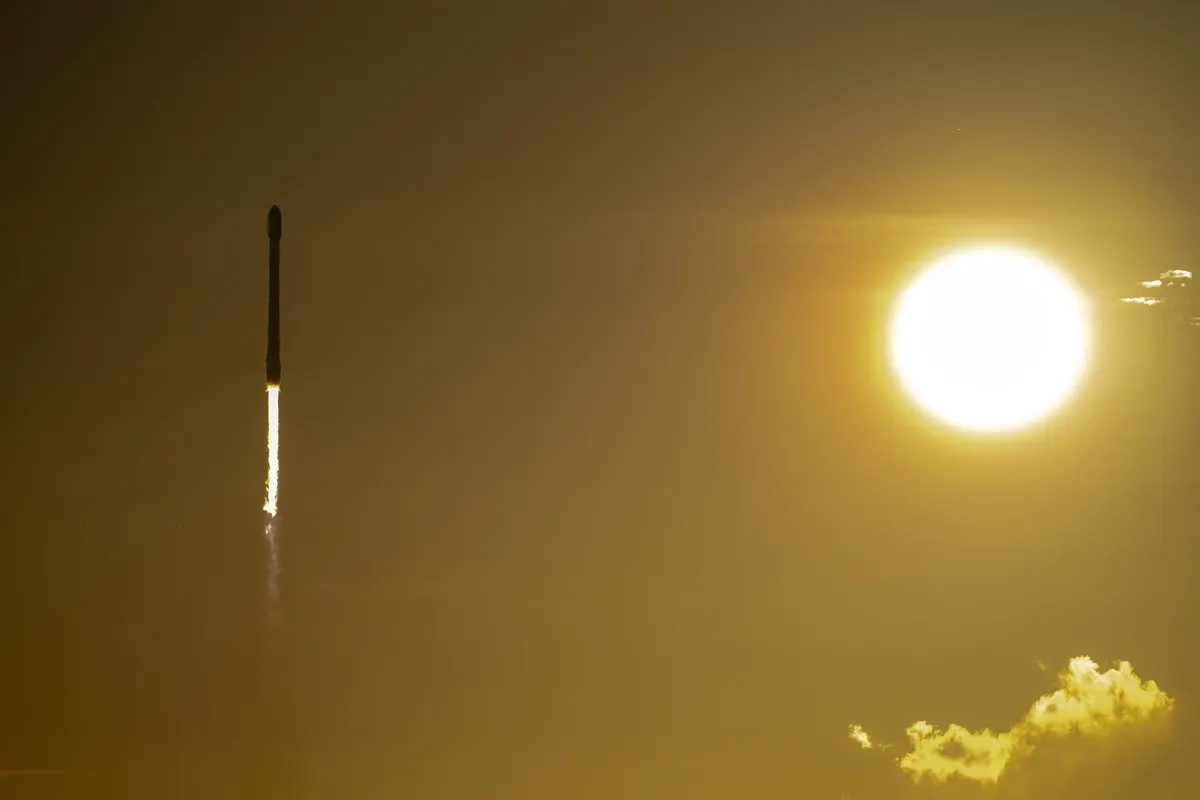
329 launches in 2025 is 65 more than in 2024, the biggest one-year jump in the history of the launch log. The United States launched 181 times and China 92. SpaceX flew 170, 52%: 165 Falcon 9s and 5 Starship flights. Starlink took 127 of those launches and carried 3,207 satellites. The satellites launched across the whole year number 4,605, and the count of payloads in orbit rose to 17,304 by the end of December.
4,605 payloads were carried into orbit. 11 launches failed. 5 Starship test flights are included in the total.
Launches by month
By country
The biggest change from 2024 was the United States, up 36 to 181 launches.
By launch site
By rocket
Launches in every year since 1957.
The year before is on the 2024 launch page.
The landmark flights
New Glenn. Blue Origin's heavy rocket flew for the first time on January 16, 2025. Its second stage reached orbit, but the first stage failed to land. On November 13, 2025 it launched NASA's twin ESCAPADE spacecraft toward Mars, and this time the first stage landed on a drone ship, according to Wikipedia. See the Mars mission count for where ESCAPADE stands.
Landers. Our mission ledgers list 5 Moon and Mars missions that launched in 2025: 1 success, 1 partial, 2 failure, 1 still pending. Firefly's Blue Ghost launched on January 15, 2025 and landed on March 2, 2025, a full success. ispace's second lander launched on the same rocket and crashed. Intuitive Machines' IM-2 launched on February 27, 2025 and landed on March 6, 2025, but tipped over. The list of Moon landings records each result.
Science and people. The NASA and Indian space agency radar satellite NISAR launched on July 30, 2025, and a private Axiom Mission 4 crew flew to the space station on June 25, 2025.
Chinese rockets try to land. Zhuque-3 reached orbit on its first flight on December 3, 2025, but Wikipedia says its first stage crashed in a landing burn anomaly. The Long March 12A flew on December 23, 2025 and its booster failed to land. China's 92 launches were its most in a year. See the China page.
Eleven failures
Five of the failures were first flights of a rocket or version: Starship V2, Spectrum, Eris Block 1, Zoljanah and HANBIT-NANO. Starship V2 failed on January 16 and March 6. Germany's Spectrum failed on March 30 and Australia's Eris on July 29. Firefly's Alpha failed on April 29, India's PSLV on May 18, China's Zhuque-2E on August 15 and Ceres-1 on November 10, Iran's Zoljanah on September 18, Japan's H3 on December 22 and South Korea's Hanbit-Nano on December 23. 97% of launches succeeded.
Rockets and launch sites
Falcon 9 flew 165 of the 329 launches (50%), ahead of Electron with 18 and Chang Zheng 3B with 13. By site, Cape Canaveral had 82, Vandenberg 64, Jiuquan 33 and Kennedy Space Center 27. Twelve countries launched at least once in all, counting the launching country the way GCAT does. The launches put 4,605 satellites into orbit, an average of 14 per launch. 3,207 of them, 70%, were Starlink satellites. The rest, 1,398, came from every other operator in the world put together.
New rockets and shifting shares
GCAT logs eleven rocket types flying for the first time in 2025: New Glenn 7x2 (January 16), Starship V2 (January 16), Chang Zheng 8A (February 11), Spectrum (March 30), Eris Block 1 (July 29), Vulcan Centaur VC4S (August 13), Zoljanah (September 18), H3-24W (October 26), Zhuque-3 (December 3), HANBIT-NANO (December 23), Chang Zheng 12A (December 23). Five of them failed on that first flight. Some are new versions of a rocket that already existed, which GCAT lists under a new name. Against 2024, the biggest gain was the United States, up 36 to 181, and the biggest fall was Iran, down 3 to 1.
The shape of the year
February was the quietest full month with 20 launches and December the busiest with 40. By quarter the counts run 68, 80, 84 and 97, so 29% of the year's launches came in the final three months.
Where the year ranks
Among the 70 years in the log, 2025 ranks 1st for the number of launches. No earlier year in the log had as many. The log holds 7,433 launches in all, an average of 106 a year, so 2025 was at 3.1 times the long-run average.
The December rush
December had 40 launches, one every 18.6 hours on average. The Florida page has the East Coast history. Wikipedia lists 330 launches for 2025 against our 329, and 13 failures against 11. Next: 2026, which is still under way.