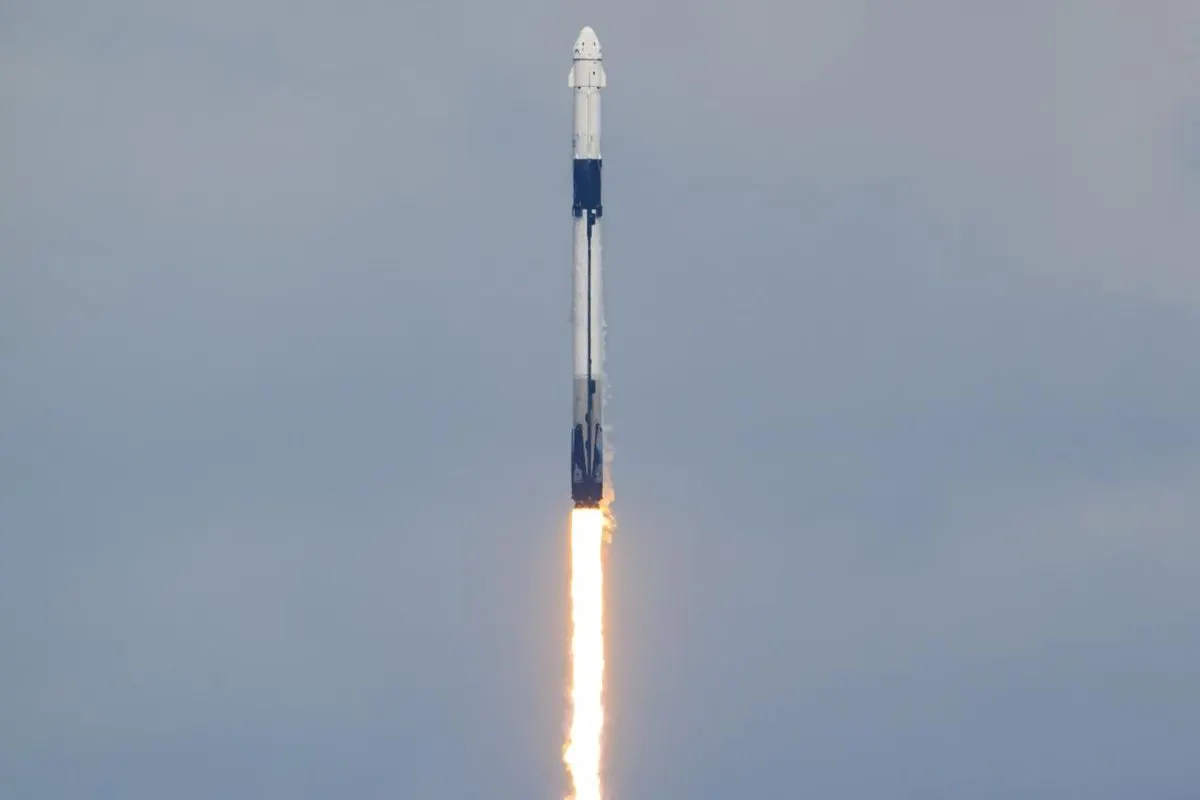
The year more than half was SpaceX
264 launches is 41 more than the record set in 2023. The United States flew 145 and China 69. SpaceX flew 138 of them, 52%: 132 Falcon 9s, 2 Falcon Heavies and 4 Starship flights. It was the first year of the eight on this site in which one company launched more than half of the world's rockets. It was also the most reliable. 258 of 264 launches reached orbit, 97.7%, with only six failures.
2,898 payloads were carried into orbit. 6 launches failed. 4 Starship test flights are included in the total.
Launches by month
By country
The biggest change from 2023 was the United States, up 36 to 145 launches.
By launch site
By rocket
Launches in every year since 1957.
The landmark flights
A crowded Moon. Our mission ledgers list 8 Moon and Mars missions that launched in 2024: 6 success, 2 failure. Astrobotic's Peregrine launched on January 8, 2024 on the first Vulcan Centaur and never reached the Moon after a propellant leak. Japan's SLIM landed on January 19, 2024 but ended up inverted. Intuitive Machines' Odysseus launched on February 15, 2024, landed on February 22, 2024 and tipped over. China's Chang'e-6 launched on May 3, 2024 and returned the first samples from the far side on June 25, 2024. See the Moon mission count.
Ariane 6. Europe's new rocket flew on July 9, 2024. GCAT scores the launch a success. Wikipedia calls it a partial failure, because the second stage failed to relight and couldn't be deorbited, which meant the re-entry test payloads weren't deployed. Both are defensible readings of the same flight.
Starship. The fifth flight, on October 13, 2024, brought the Super Heavy booster back, the first recovery of a Starship booster. It was one of 4 Starship flights that year, and none was logged as a failure.
People and probes. Boeing's Starliner flew its first crewed test on June 5, 2024. SpaceX's Polaris Dawn launched on September 10, 2024, and a spacewalk on September 12, 2024 lasted 26 minutes. NASA's Europa Clipper left on a Falcon Heavy on October 14, 2024; the Europa page explains where it is going.
Six failures
Japan's Kairos failed on its first flight on March 13 and again on December 18. North Korea's new rocket failed on May 27, a Hyperbola-1 on July 10 and a Lijian-1 on December 27. The sixth was a Falcon 9 on July 12, which ended a run of 325 straight successes for the rocket, according to Wikipedia.
Rockets and launch sites
Falcon 9 flew 132 of the 264 launches (50%), ahead of Electron with 14 and Soyuz-2-1A with 8. By site, Cape Canaveral had 67, Vandenberg 46, Kennedy Space Center 26 and Jiuquan 21. Ten countries launched at least once in all, counting the launching country the way GCAT does. The launches put 2,898 satellites into orbit, an average of 11 per launch. 1,982 of them, 68%, were Starlink satellites. The rest, 916, came from every other operator in the world put together.
New rockets and shifting shares
GCAT logs ten rocket types flying for the first time in 2024: Vulcan Centaur VC2S (January 8), Yinli-1 (January 11), Kairos (March 13), Angara A5/Orion (April 11), Chang Zheng 6C (May 7), NK Kerolox LV (May 27), Ariane 62 (July 9), Zhuque-2E (November 27), Chang Zheng 12 (November 30), Chang Zheng 5B/YZ-2 (December 16). Two of them failed on that first flight. Some are new versions of a rocket that already existed, which GCAT lists under a new name. Against 2023, the biggest gain was the United States, up 36 to 145, and the biggest fall was India, down 2 to 5.
The shape of the year
July was the quietest full month with 13 launches and November the busiest with 30. By quarter the counts run 63, 64, 57 and 80, so 30% of the year's launches came in the final three months.
Where the year ranks
Among the 70 years in the log, 2024 ranks 2nd for the number of launches. No earlier year in the log had as many. The log holds 7,433 launches in all, an average of 106 a year, so 2024 was at 2.5 times the long-run average.
Where the launches happened
November and December each had 30 launches. Wikipedia lists 261 launches for 2024 against our 264, a gap of the kind you get when trackers make different calls on test flights and partial failures. The Vandenberg page shows the California site's rise. Next: 2025.