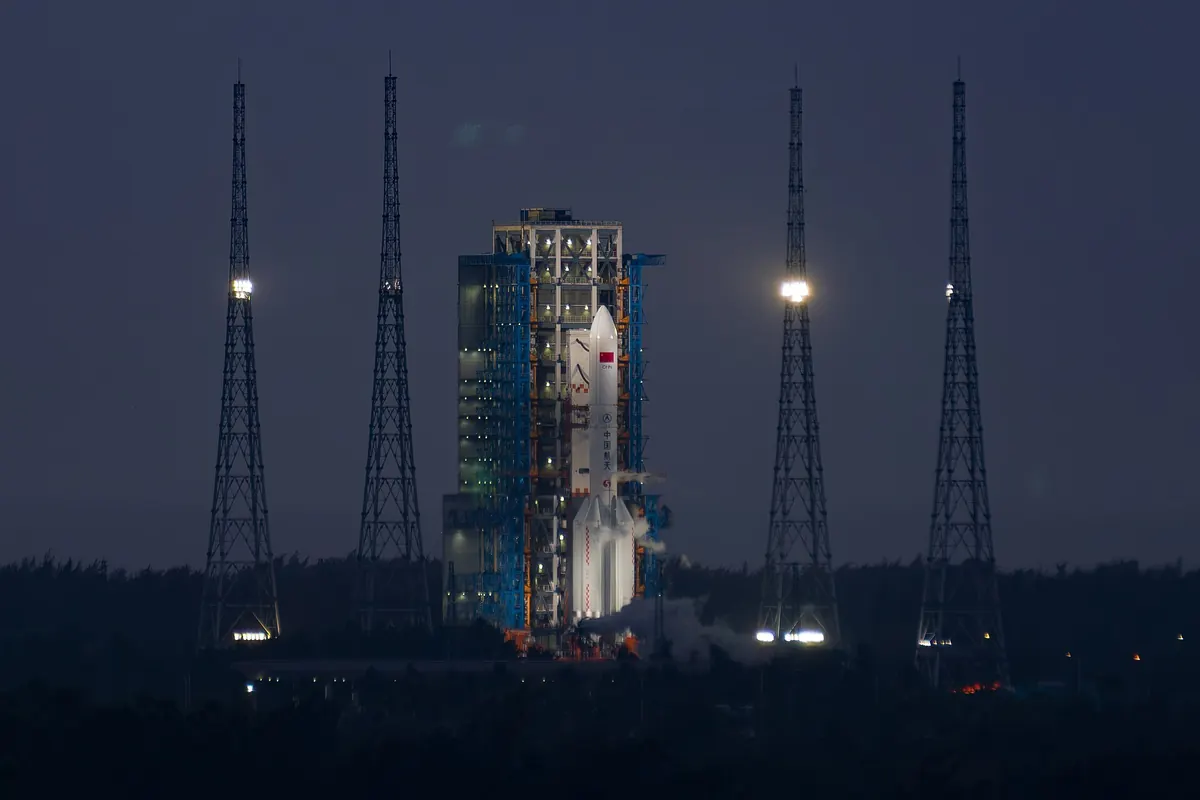
Four old spaceports and a growing crowd of new sites
China has made 808 orbital launch attempts since April 24, 1970, and 767 succeeded. That first launch was DFH-1, the satellite that broadcast a song, on a Long March 1 from Jiuquan. In 2025 there were 92, 90 of them successful.
Four traditional spaceports carry most of the history: Jiuquan with 299, Xichang with 242, Taiyuan with 161 and Wenchang with 51. Newer sites on the Hainan coast and out at sea add more.
Launches per year
Launches by month in 2025
Pads and launch complexes
The busiest pads over the last five years.
Which rockets
Rockets launched in 2024 and 2025.
Jiuquan, the oldest
Jiuquan was founded in 1958, the oldest of China's four spaceports, and the launch site for Shenzhou crewed flights since 2003. It leads the table with 299 attempts, and LC43/94 there's the busiest pad in the recent pad table with 69 launches.
The first Chinese satellite left from here in 1970. The first flights of two commercial rockets, Ceres-1 and Kinetica-1, left from here as well, and both are covered below.
Xichang, aimed at geostationary orbit
Xichang has been operating since 1984, and its first launch was a Long March 3 on January 29, 1984. At Xichang most launches go to geostationary transfer orbit, and Chang'e 1 flew from there on October 24, 2007. In the recent pad table, Xichang's LC3 has 46 launches and LC2 has 38.
The site also has the grimmest entry in the log. On February 15, 1996, a Long March 3B carrying Intelsat 708 crashed about 1,200 meters from the pad. Six deaths were officially reported, though other estimates dispute that figure.
Taiyuan, Wenchang and the sea launches
Taiyuan was founded in March 1966 and fully operating in 1968, in Shanxi at about 1,500 meters. It launches mainly weather, Earth-resource and scientific satellites into sun-synchronous orbit, and its first was Fengyun 1A on September 6, 1988. Its LC9 pad has 31 launches in the recent pad table. Its sea-launch arm, DongFang Spaceport, with its home port at Haiyang, first launched on June 5, 2019, with a Long March 11 in the Yellow Sea, which helps explain why GCAT has 20 launches from the Yellow Sea.
Wenchang is on Hainan at about 19 degrees north. Its first launch was on June 25, 2016, with a Long March 7, and Long March 5 flights began on November 3, 2016. It launched the three Tiangong modules (Tianhe on April 29, 2021), Chang'e 5 (November 23, 2020) and Chang'e 6 (May 3, 2024); the Moon missions are on the Moon landings by country page. A separate commercial site operates alongside it, and GCAT lists 24 launches under Hainan CLS.
Heavy rockets and commercial ones
The Long March 5 is the heavy lifter. It first flew on November 3, 2016. On July 2, 2017, a core stage engine fault that lost the Shijian-18 payload. It went on to launch Tianwen-1 on July 23, 2020, Chang'e 5 on November 23, 2020, and the Tiangong modules Tianhe, Wentian and Mengtian on April 29, 2021, July 24, 2022 and October 31, 2022. The CZ-5B version can lift about 25,000 kg to low Earth orbit.
The commercial names in the table are newer and much smaller. Lijian-1, also called Kinetica-1, is built by CAS Space and first flew on July 27, 2022 from Jiuquan. It failed on December 27, 2024 because of third stage instability. Gushenxing 1, also called Ceres-1, is Galactic Energy's rocket. It first flew on November 7, 2020 from Jiuquan, and its first sea launch was on September 5, 2023, as the Ceres-1S variant from a converted barge off Haiyang in the Yellow Sea. It lifts about 400 kg to low Earth orbit, against 25,000 for the CZ-5B.
How fast the cadence changed
China flew 22 times in 2016 and 18 in 2017. Then came 39 in 2018, more than double the year before. The pace kept climbing: 34 in 2019, 56 in 2021 and 92 in 2025.
In December 2025 alone China flew 16 launches, in a month when the whole world flew 40.
A busier year
China's 2025 total was 28% of the world's 329. The recent rocket table shows Long March 3B and 6A at 23 each, and newer names like Lijian-1 with 14 and Gushenxing 1 with 12.
2026 has 72 through October 16, 2026, against 62 at the same point in 2025. The fleet the rockets are building is on the China satellites page. For the biggest launch coast, see Florida, and for the oldest, Russia.