The next ten greatest elongations
| Date | Angle from the Sun | Sky | Height at twilight, 40 N | Height at twilight, 30 S |
|---|---|---|---|---|
| November 20, 2026 | 19.6 degrees | Morning, west of the Sun | 10 degrees | 1 degrees |
| February 3, 2027 | 18.3 degrees | Evening, east of the Sun | 8 degrees | 2 degrees |
| March 17, 2027 | 27.6 degrees | Morning, west of the Sun | 2 degrees | 17 degrees |
| May 28, 2027 | 22.9 degrees | Evening, east of the Sun | 12 degrees | 8 degrees |
| July 15, 2027 | 20.7 degrees | Morning, west of the Sun | 5 degrees | 7 degrees |
| September 24, 2027 | 26.3 degrees | Evening, east of the Sun | 1 degrees | 16 degrees |
| November 4, 2027 | 18.8 degrees | Morning, west of the Sun | 9 degrees | -1 degrees |
| January 17, 2028 | 18.8 degrees | Evening, east of the Sun | 8 degrees | 4 degrees |
| February 27, 2028 | 26.9 degrees | Morning, west of the Sun | 4 degrees | 15 degrees |
| May 9, 2028 | 21.4 degrees | Evening, east of the Sun | 12 degrees | 4 degrees |
Heights are for local solar time, 45 minutes after sunset for an evening elongation and 45 minutes before sunrise for a morning one, at 40 degrees north and 30 degrees south. The higher the planet, the easier it's to see over the horizon haze.
What greatest elongation means
Mercury orbits so close to the Sun that it's hard to see at all. It's only visible for a few weeks around greatest elongation, low in the twilight sky, and it does this about six times a year. Greatest elongation is when it appears farthest from the Sun in our sky. It's a good time to look because the planet is as high as it gets at twilight, although it isn't always the brightest moment. In this list the angle runs from 18.3 degrees (February 3, 2027) to 27.6 degrees (March 17, 2027).
The best appearance in this list
From 40 degrees north the highest Mercury gets at twilight in this list is 12 degrees, at the elongation on May 28, 2027. From 30 degrees south it's 17 degrees, on March 17, 2027. Which ones are best depends on the angle the ecliptic makes with the horizon at sunset or sunrise, which changes with the season and your latitude.
The planet most people never see
Mercury is bright enough to see but it never strays far from the Sun. Its greatest elongation, the angle at which it stands farthest from the Sun in our sky, runs from 18.3 to 27.6 degrees in the list above. That means it sets within a couple of hours of the Sun, and you look for it low in the twilight, in the west after sunset or the east before sunrise. The next greatest elongation is on November 20, 2026, 19.6 degrees west of the Sun.
Mercury goes round the Sun in 88 days, and Earth's own motion stretches the repeat of its appearances to 116 days. That gives roughly three evening and three morning elongations a year, which is why the table has so many dates.
Why some elongations are much better than others
The same elongation angle can be easy or hopeless. What matters is how steeply the ecliptic, the path of the Sun and planets, climbs from the horizon at sunset or sunrise. When the angle is steep, the planet is higher at the end of twilight. In the Northern Hemisphere that means evening elongations in spring and morning elongations in autumn. In the Southern Hemisphere it's the reverse.
The table gives the height at twilight for 40 degrees north and 30 degrees south. Mercury's orbit is also the most oval of the major planets, with an eccentricity of 0.206, so the angle at elongation varies from about 18 to 28 degrees depending on where Mercury is in its orbit.
The first transit seen
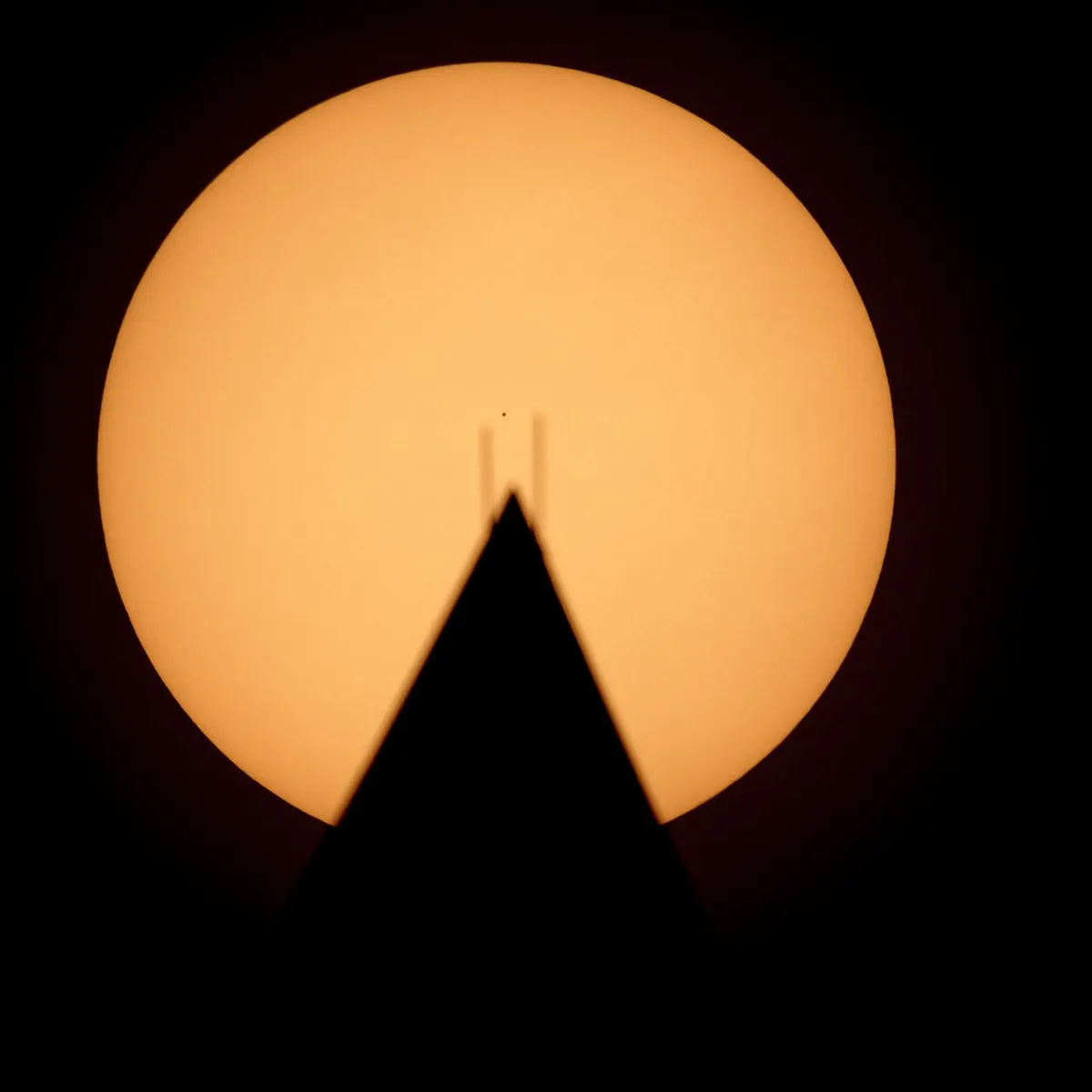
Mercury also crosses the face of the Sun, though rarely. Johannes Kepler predicted that a transit would occur in 1631, and on November 7, 1631 Pierre Gassendi, in Paris, watched it as a tiny black dot on an image of the Sun. It was far smaller than anyone had expected, which taught astronomers that Mercury was a small planet.
The most recent transit was on November 11, 2019, and the next is in 2032. Transits need a safe solar filter, because looking at the Sun through unprotected optics can blind you. The NASA solar eclipse safety rules apply in full, and are on the next solar eclipse page.
A spacecraft on its way
Few planets are harder to reach than Mercury, because a spacecraft has to shed a huge amount of speed to be captured by it. The European and Japanese BepiColombo mission, launched toward Mercury, has used planetary flybys to do it. As of ESA's timeline, last updated in July 2026, the spacecraft was due to enter orbit around Mercury on November 21, 2026. Dates for a mission like this can slip, so check ESA's page before you plan around it.
How to find it
Choose an elongation where the table shows the planet more than about 10 degrees high at twilight from your latitude, and find a clear horizon in the right direction. Start looking about 30 minutes after sunset (or before sunrise), and use binoculars to find it and then see it with the naked eye. It looks like a bright, steady star-like point that doesn't twinkle much.
Venus is the easier target, and it often helps to find Mercury: when they are both in the twilight, Venus acts as a signpost. Compare the dates on the Venus elongation page, and for the outer planets see planet oppositions.
The best of the next ten
Of the next ten greatest elongations, 5 are in the evening sky and 5 in the morning. From 40 degrees north, the highest twilight view is 12 degrees on May 28, 2027. From 30 degrees south, it's 17 degrees on March 17, 2027.
That height is the reason to mark one of those dates and plan around it. A Mercury evening that looks fine on paper but sits 5 degrees up behind a tree line will be a miss, so scout the horizon in daylight.
The reason Mercury stays so close to the Sun is simple geometry. It orbits at 57.9 million kilometers from the Sun on NASA's fact sheet, against 149.6 million for Earth, so from here it can never wander far from our star.
 Planet oppositionsWhen Mars, Jupiter and the outer planets are closest.
 Venus elongationThe other inner planet.
 Sky calendarEvery sky page.
Questions people ask
When is Mercury at greatest elongation next?
November 20, 2026, 19.6 degrees west of the Sun.
Is Mercury a morning or evening object after that?
After the elongation on November 20, 2026 it's in the morning sky.
How far from the Sun can Mercury get?
In this list between 18.3 and 27.6 degrees.
What does greatest elongation mean?
It's when an inner planet appears farthest from the Sun in the sky, which is a good time to look for it at twilight.