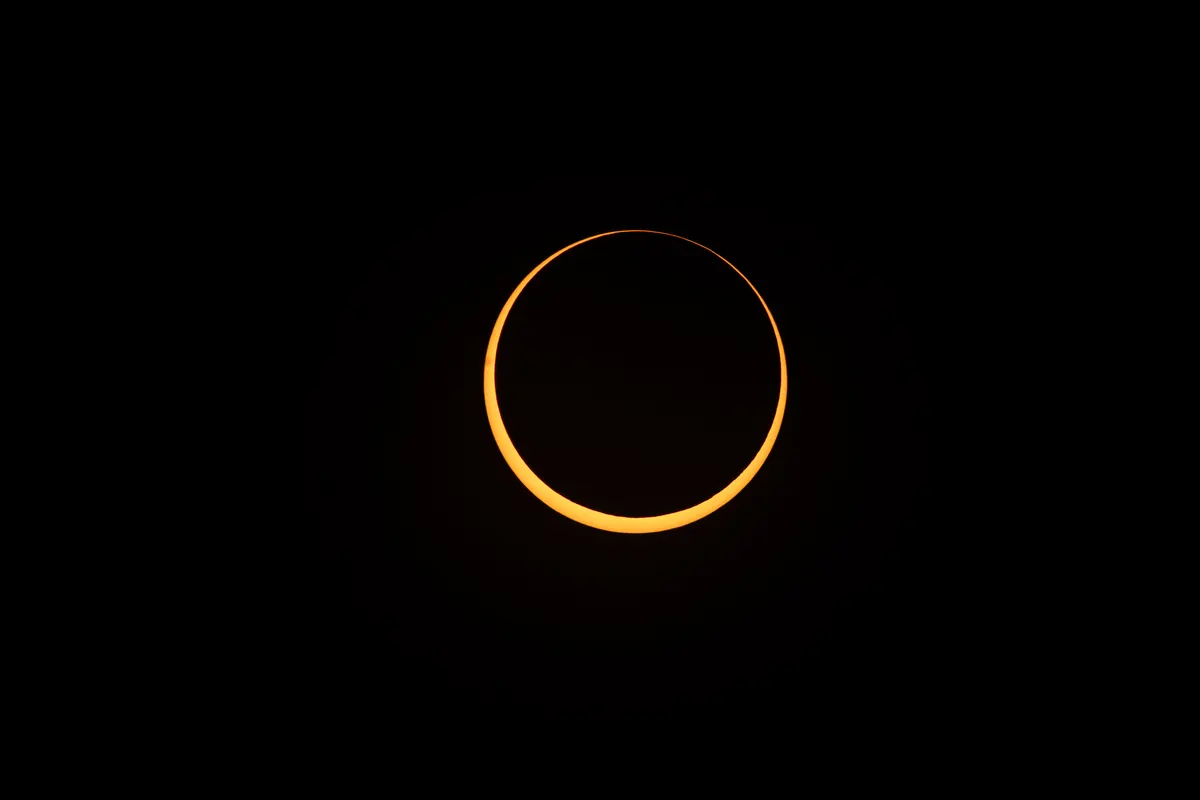
The next eclipse in detail
On February 6, 2027 the Moon's shadow touches Earth at 15:59 UTC. The eclipse is an annular one, with a magnitude of 0.9281. Magnitude is the share of the Sun's width the Moon covers at the middle of the eclipse: 1 or more means the Sun is fully covered, and less than 1 leaves a ring.
Greatest eclipse happens at 31S 48W, where the Sun is 73 degrees above the horizon. The path there's 282 km wide, and the longest annularity or totality on it lasts 7m 51s. It crosses Chile, Argentina, Uruguay, Brazil, Côte d'Ivoire, Ghana, Togo, Benin and Nigeria.
The next eight solar eclipses
| Date | Type | Greatest eclipse | Magnitude | Longest totality or annularity | Path width | Where the path crosses |
|---|---|---|---|---|---|---|
| February 6, 2027 | Annular | 15:59 UTC | 0.928 | 7m 51s | 282 km | Chile, Argentina, Uruguay, Brazil, Côte d'Ivoire, Ghana, Togo, Benin and Nigeria |
| August 2, 2027 | Total | 10:06 UTC | 1.079 | 6m 23s | 258 km | Morocco, Spain, Algeria, Tunisia, Libya, Egypt, Sudan, Saudi Arabia, Yemen and Somalia |
| January 26, 2028 | Annular | 15:07 UTC | 0.921 | 10m 27s | 323 km | Ecuador, Peru, Brazil, Colombia, Suriname, French Guiana, Portugal, Spain and Morocco |
| July 22, 2028 | Total | 02:55 UTC | 1.056 | 5m 10s | 230 km | Australia and New Zealand |
| January 14, 2029 | Partial | 17:12 UTC | 0.871 | n/a | n/a | Partial only |
| June 12, 2029 | Partial | 04:04 UTC | 0.458 | n/a | n/a | Partial only |
| July 11, 2029 | Partial | 15:36 UTC | 0.230 | n/a | n/a | Partial only |
| December 5, 2029 | Partial | 15:02 UTC | 0.891 | n/a | n/a | Partial only |
Partial eclipses have no central path, so they have no path width or countries. A hybrid eclipse is annular in places and total in others.
The next total solar eclipse
The next total solar eclipse is on August 2, 2027. Totality lasts up to 6m 23s on a path 258 km wide, crossing Morocco, Spain, Algeria, Tunisia, Libya, Egypt, Sudan, Saudi Arabia, Yemen and Somalia.
Eye safety
Only the short total phase of a total eclipse is safe to look at without a filter. An annular or partial eclipse never covers the Sun fully, so you need certified eclipse glasses or a solar filter for all of it. NASA's eclipse safety page (opens in a new tab) explains what to use.
Where the last one left off
The most recent solar eclipse before this page's data date, October 19, 2026, was a total eclipse on August 12, 2026, with up to 2 minutes 18 seconds of totality or annularity. NASA's catalog has at least 2 solar eclipses in every year of this century, so there's rarely a long wait for one. A total eclipse you can actually reach is another matter.
Most of the world sees a partial eclipse
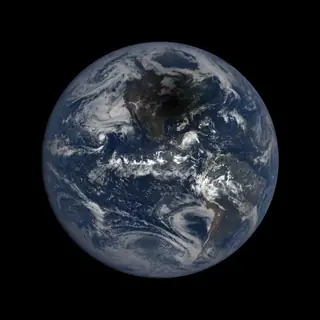
The Moon's shadow on Earth has two parts. The small dark core, the umbra, makes the total or ring phase and covers a strip only 4 to 781 kilometers wide in NASA's catalog. The much larger, fainter outer shadow, the penumbra, covers thousands of kilometers and gives a partial eclipse, where the Moon takes only a bite out of the Sun. Most people who see an eclipse of the Sun see a partial one.
A partial eclipse takes a bite out of the Sun without turning day to night, and the uncovered part is as dangerous to look at as ever. NASA says you can view an eclipse without protection only when the Moon completely obscures the Sun's bright face, so a partial or annular eclipse always needs eclipse glasses.
The next one that matters
The next eclipse of any type is the annular eclipse on February 6, 2027. It crosses Chile, Argentina, Uruguay, Brazil, Côte d'Ivoire, Ghana, Togo, Benin and Nigeria. The next total or hybrid eclipse is on August 2, 2027, with up to 6 minutes 23 seconds of totality on a path 258 kilometers wide across Morocco, Spain, Algeria, Tunisia, Libya, Egypt, Sudan, Saudi Arabia, Yemen and Somalia. At the point of greatest eclipse the Sun stands 82 degrees above the horizon, and a high Sun is easier to see, because it clears hills and haze.
For comparison, totality at its longest lasted 2 minutes 40 seconds in 2017 and 4 minutes 28 seconds in 2024. The next total or hybrid eclipse offers 1.4 times the 2024 maximum, which is why people plan trips years ahead. The total eclipse list covers every one to 2050.
Planning around the time
The times in the table are in UTC, so add or subtract your time zone before you plan. Start with first contact, when the Moon first touches the Sun, because the partial phase builds for a long time. For the 2024 eclipse, NASA said the partial phase would last about 70 to 80 minutes at most locations. Be set up with glasses, a clear view of the sky and a back-up plan well before.
The Sun's height matters as much as the clock. For a total eclipse the center line gives the longest wait in the dark, and a low Sun can be blocked by a hill or the cloud bank on the horizon. Cloud on the day will beat any plan, which is why serious eclipse chasers watch the forecast and keep a second site within reach.
Kit and safety
You need very little, but it has to be the right kit. NASA says safe solar viewers are thousands of times darker than ordinary sunglasses and ought to comply with the ISO 12312-2 standard. If a pair is scratched or damaged, don't use it. If you want to photograph the eclipse, solar filters must be attached to the front of any telescope, binoculars or camera lens. Never use eclipse glasses with optics.
A paper pinhole is a safe, cheap alternative: poke a small hole in card, stand with the Sun behind you, and watch the projected image on the ground. Never look at the Sun through the hole. The full guidance is on NASA's eclipse safety page, and the eclipse seasons page explains why eclipses bunch up in some months and are missing in others.
Partial eclipses are the commonest single type. Of the 224 solar eclipses in 2001 to 2100, 77 are partial everywhere on Earth and never reach a central path at all, which is one more reason a ring or a total eclipse deserves a trip.
 Total solar eclipsesEvery total eclipse through 2050, with the countries on each path.
 Annular solar eclipsesThe ring of fire eclipses, with the countries on each path.
 Next lunar eclipseWhen the Moon next passes through Earth's shadow.
 Solar vs lunar eclipseHow the two kinds differ.
Questions people ask
When is the next solar eclipse?
The next solar eclipse is an annular eclipse on February 6, 2027.
When is the next total solar eclipse?
The next total solar eclipse is on August 2, 2027, with up to 6m 23s of totality.
How many solar eclipses are there each year?
In NASA's catalog for 2001 to 2100 every year has between 2 and 4 solar eclipses. See how often eclipses happen for the counts.
Is it safe to look at a solar eclipse?
Only during the total phase of a total eclipse. At every other time, including annular and partial eclipses, use certified eclipse glasses or a solar filter.