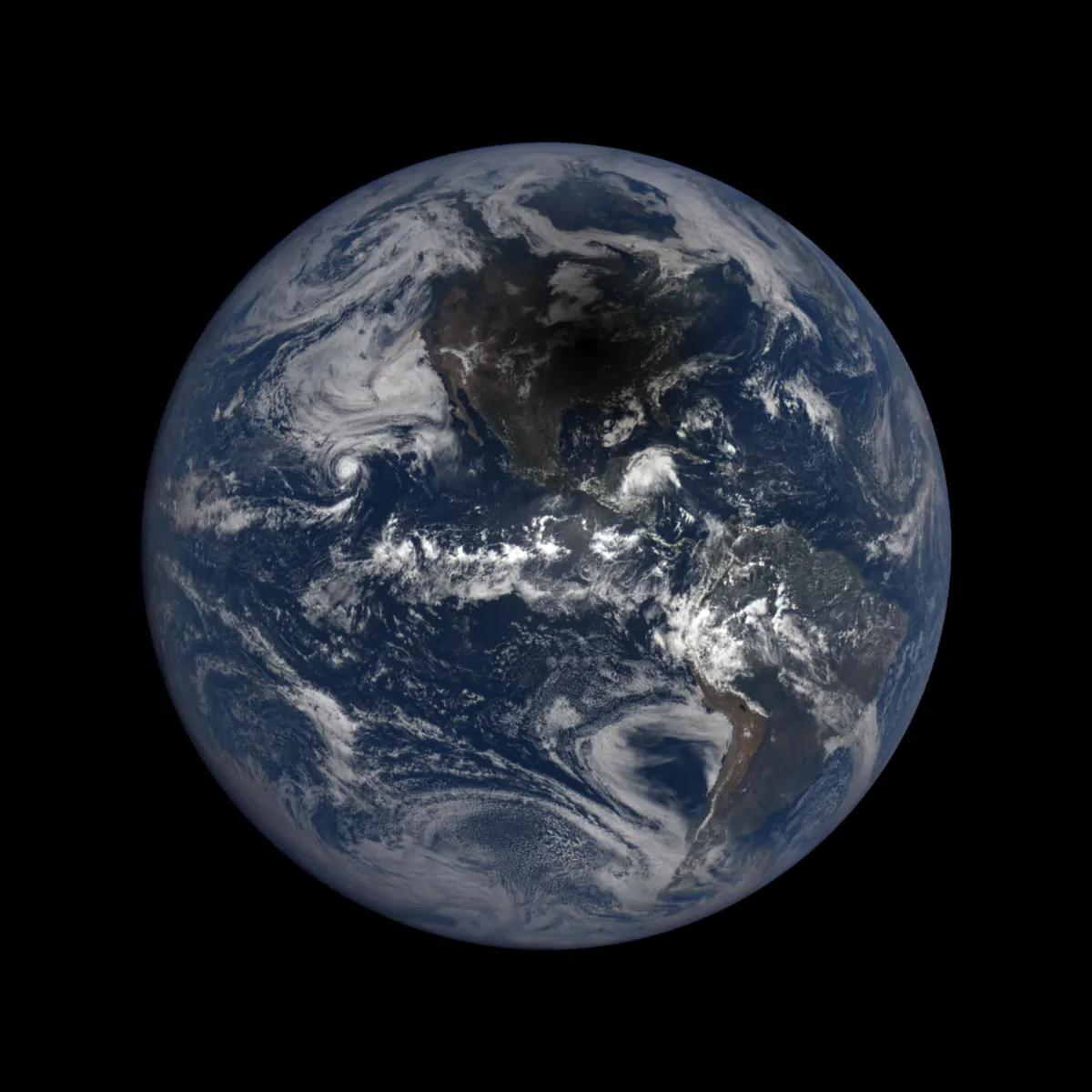
The two kinds side by side
| Solar eclipse | Lunar eclipse | |
|---|---|---|
| What blocks the light | The Moon passes between the Sun and Earth | Earth passes between the Sun and the Moon |
| Moon phase | New Moon | Full Moon |
| Who sees it | A narrow path for the total or ring phase, a wider area for a partial eclipse | Everyone on the night side of Earth where the Moon is up |
| Longest total phase, 2001 to 2100 | 6m 39s, on July 22, 2009 | 103 min, on July 27, 2018 |
| Number in 2001 to 2100 | 224 | 228 |
| Safe to look at? | Only during totality. Otherwise you need eclipse glasses. | Yes, with your eyes, binoculars or a telescope |
Why solar eclipses feel rarer
The catalog lists 224 solar eclipses and 228 lunar eclipses in the century, so there are about as many of each. A solar eclipse feels rarer because you have to be in the right place: only 147 of the 224 reach the Sun fully covered or ringed, and their paths are between 10 and 781 km wide on a planet 12,742 km across. The Moon's shadow is small. Earth's shadow is large, so a lunar eclipse covers the whole night side.
Why they don't happen every month
The Moon's orbit is tilted by about five degrees compared with Earth's orbit around the Sun, so most months the Moon passes above or below the Sun or the shadow. Eclipses only happen when a new or full Moon falls close to one of the two points where the orbits cross. Eclipse seasons explains the timing.
The same line-up, from opposite ends
A solar and a lunar eclipse use the same three bodies lined up in nearly a straight line. In a solar eclipse the Moon is in the middle, and its shadow touches Earth. In a lunar eclipse Earth is in the middle, and its shadow touches the Moon. The Moon is only about a quarter of Earth's width, so its shadow on the ground is small. Earth's shadow at the Moon's distance is more than two and a half times as wide as the Moon, and the Moon spends a long time inside it.
That geometry explains almost everything in the table above: why a solar eclipse is seen from a narrow strip, why a lunar eclipse is seen from half the planet and why a lunar eclipse lasts far longer. In this century the longest totality of the Moon is about 15 times the longest totality of the Sun.
What each one gave to science
Lunar eclipses told the Greeks about the shape of Earth. Aristotle argued that the curved shadow on the Moon, which is always round whichever way the Moon is placed, could only come from a round Earth.
Solar eclipses have a history of discovery of their own. During the total eclipse of August 18, 1868, the French astronomer Pierre Janssen, watching from Guntur, India, saw a bright yellow line in the Sun's prominences that didn't match any known element. Norman Lockyer found the same line in England that October, and the new element was named helium after the Greek word for the Sun. It wasn't found on Earth until 1881.
The eclipse of May 29, 1919 did something bigger. Teams organized by Arthur Eddington and Frank Dyson photographed stars near the eclipsed Sun from Principe and Sobral, and their measurements supported Einstein's prediction that gravity bends light. The total solar eclipse page tells more of that story.
How the odds compare
In 2001 to 2100 there are 224 solar eclipses, of which 68 are total, 72 annular, 7 hybrid and 77 partial. There are 228 lunar eclipses, of which 85 are total, 57 partial and 86 penumbral. That means 37 percent of lunar eclipses are total, while only 30 percent of solar ones are.
The picture changes if you look at the whole planet. Every person who can see the Moon sees a lunar eclipse, but only people inside a path a few hundred kilometers wide see the totality of a solar one. So the typical person gets a lunar eclipse far more often, while the occasional solar totality is the rarer event.
Watching them safely
The two kinds need different care. NASA says you can look at a total solar eclipse with the naked eye only during the brief time when the Moon completely covers the Sun. Before and after totality, and during any partial or annular eclipse, you need solar eclipse glasses that meet the ISO 12312-2 standard.
A lunar eclipse needs none. You can watch with your eyes, binoculars or a telescope. That makes it a good first sky event for children, and a good way to learn the pattern before a more demanding solar eclipse trip.
Which to plan for
The next of each type is on the next solar eclipse and next lunar eclipse pages, with times for the next year or so. A solar eclipse trip needs a flight, a hotel and a plan B for cloud. A lunar eclipse needs a clear night and a warm coat, and you can do it from your own garden.
The clock tells the story
The two kinds also differ in how long the whole event takes. A solar eclipse from first contact to last lasts a few hours at most, and for the total eclipse of 2024 NASA gave the partial phase before totality as about 70 to 80 minutes at most locations. A lunar eclipse takes far longer. In this century the longest one spends 6 hours 14 minutes in the outer shadow, and the longest totality is 1 hour 43 minutes, on July 27, 2018.
That's why a lunar eclipse suits a relaxed evening, with time to go indoors for tea, and a solar eclipse suits a plan with every minute accounted for. Watch the first and you won't miss much if you glance away. Watch the second and the few minutes of totality are the whole point.
 Next solar eclipseThe next one, with times and path.
 Next lunar eclipseThe next one, with phase times.
 How often eclipses happenThe counts for the century.
Questions people ask
What's the difference between a solar and a lunar eclipse?
A solar eclipse is the Moon passing in front of the Sun, at new Moon. A lunar eclipse is the Moon passing through Earth's shadow, at full Moon.
Which lasts longer, a solar or lunar eclipse?
A lunar eclipse. Totality in a lunar eclipse can last up to 103 min this century, against 6m 39s for a solar eclipse.
Can everyone see a lunar eclipse?
Everyone where the Moon is above the horizon can, which is roughly half the planet.
Why is there not an eclipse every month?
The Moon's orbit is tilted, so most months the Moon misses the Sun and Earth's shadow.