The next eight lunar eclipses
| Date | Type | Greatest eclipse | Umbral magnitude | Totality | Moon overhead at |
|---|---|---|---|---|---|
| February 20, 2027 | Penumbral | 23:12 UTC | -0.057 | none | 10N 15E |
| July 18, 2027 | Penumbral | 16:02 UTC | -1.068 | none | 22S 121E |
| August 17, 2027 | Penumbral | 07:13 UTC | -0.525 | none | 12S 108W |
| January 12, 2028 | Partial | 04:12 UTC | 0.066 | none | 23N 61W |
| July 6, 2028 | Partial | 18:19 UTC | 0.389 | none | 23S 86E |
| December 31, 2028 | Total | 16:51 UTC | 1.246 | 71 min | 23N 108E |
| June 26, 2029 | Total | 03:22 UTC | 1.844 | 102 min | 23S 50W |
| December 20, 2029 | Total | 22:41 UTC | 1.117 | 54 min | 23N 19E |
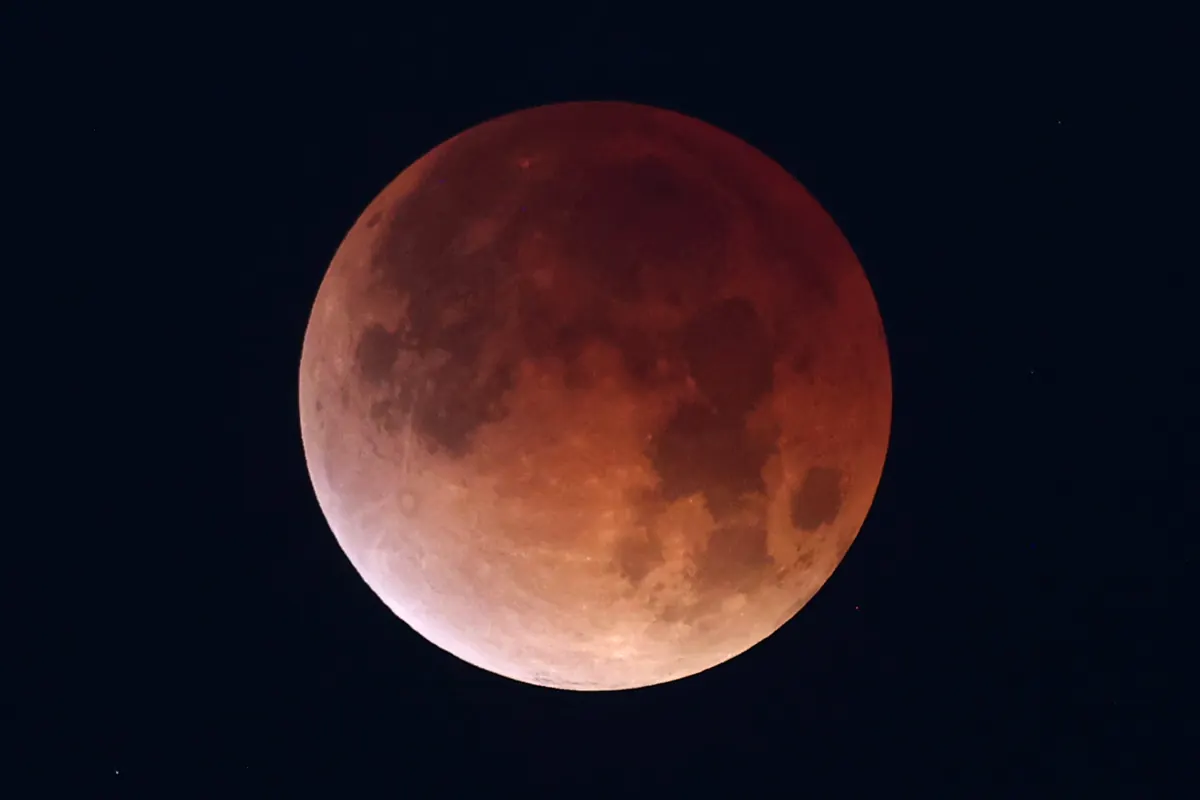
A penumbral eclipse only dims the Moon slightly and is hard to notice. A partial eclipse takes a dark bite out of it, and in a total eclipse the Moon turns red or brown. Umbral magnitude is how far into the dark core of Earth's shadow the Moon goes: 1 or more is total.
Timing of January 12, 2028
This is the next partial or total lunar eclipse. Greatest eclipse is at 04:12 UTC, and the Moon is 0.07 of the way into the umbra at that moment.
| Phase | Starts | Ends |
|---|---|---|
| Penumbral eclipse | 02:07 UTC | 06:18 UTC |
| Partial eclipse | 03:44 UTC | 04:40 UTC |
Who can see it
A lunar eclipse is visible from every place where the Moon is above the horizon, which is about half of Earth. At greatest eclipse the Moon is directly overhead at 23N 61W. Here is how high it stands at greatest eclipse from eight big cities.
| City | Moon height | Moon |
|---|---|---|
| London | 35 degrees | Above the horizon |
| New York | 69 degrees | Above the horizon |
| Los Angeles | 38 degrees | Above the horizon |
| Sao Paulo | 41 degrees | Above the horizon |
| Cairo | 8 degrees | Above the horizon |
| Delhi | -26 degrees | Below the horizon |
| Beijing | -28 degrees | Below the horizon |
| Sydney | -60 degrees | Below the horizon |
Times are in UTC. Add your own time zone offset to get local time. The Moon needs to be well above the horizon to clear trees and buildings.
The next few, and which ones count
The next three lunar eclipses after October 19, 2026 are penumbral on February 20, 2027, penumbral on July 18, 2027 and penumbral on August 17, 2027. A penumbral eclipse is the weakest kind. The Moon passes only through the pale outer part of Earth's shadow, and the dimming is so slight that most people looking up would miss it. The eclipses before it in the list are all penumbral, so the first one you can really see is on January 12, 2028, 450 days after the data date.
The next total lunar eclipse is on December 31, 2028. The page on total lunar eclipses lists every one to 2060, with totality length and Saros number.
The stages of an eclipse
A lunar eclipse starts quietly. First the Moon enters the penumbra, and nothing seems to happen for the best part of an hour. Then the dark umbra reaches the Moon's edge, and a dark bite appears on one side. This partial phase grows until the Moon is wholly inside the umbra, which is the start of totality. At mid-eclipse the Moon is at its deepest in the shadow, and then the whole sequence runs in reverse.
For the eclipse on January 12, 2028, the one to plan for, greatest eclipse is at 04:12 UTC. The dark bite lasts about 56 minutes, inside 4 hours 11 minutes of shading from the outer shadow. The table above gives the start and end of each phase.
Reading the times
All the times on this page are in Coordinated Universal Time. To get your local time, add or subtract your offset, remembering that clocks may be on daylight saving. A lunar eclipse happens at one moment for the whole world, so everyone with the Moon above their horizon sees the same stage at the same instant. Only the Moon's height and the time of night differ.
That's a big difference from a solar eclipse, where the time depends on where you stand. It also means a lunar eclipse can be a better target for families and groups, because it's easy to spread over a whole evening. The eclipse of January 12, 2028 puts the Moon overhead at 23N 61W, so places near there get the best view and places far away may see the Moon low or not at all.
When the Moon is low
The Moon's height matters more than the eclipse's depth. A Moon on the horizon is hidden behind trees, buildings and hills, and a total eclipse at that angle can be harder to enjoy than a smaller partial one with the Moon high in the sky. The table of cities usually shows the Moon below the horizon for some of them at greatest eclipse, even though those places may catch the start or the end.
If the Moon is low, find an open view toward the right compass direction before the night. A phone compass is good enough, and a free planetarium app can show the Moon's path. The usual rule applies to any sky event: go to the darkest place that's easy to reach, and let your eyes adjust for a few minutes.
What to bring
Dress for a night outdoors, because the long penumbral and partial phases are quiet and chilly. Binoculars add a lot. A pair with a 50 mm front lens shows the shadow's curved edge, and during totality they show more stars around the red Moon, because the sky darkens when the bright light is gone. A camera on a tripod does the rest.
No eye protection is needed, since lunar eclipses are safe to look at. If you want to learn more about how the Moon and Sun line up, the eclipse seasons page shows why lunar eclipses usually come within a few weeks of a solar one.
The year after
If clouds spoil the eclipse on January 12, 2028, there's a second chance within about a year: partial on July 6, 2028 and total on December 31, 2028. Lunar eclipses come in the same seasons as solar ones, so the eclipse seasons page tells you when each of these falls.
Across the eight eclipses in the table, 3 are total, 2 are partial and 3 are penumbral. That mix is typical, and it's a good reason to read the type before you set an alarm for the middle of the night.
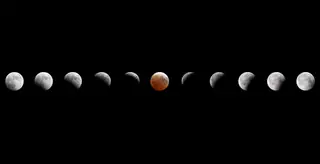 Total lunar eclipsesEvery total lunar eclipse through 2060.
 Solar vs lunar eclipseHow the two kinds differ.
 Next solar eclipseThe next eclipse of the Sun.
Questions people ask
When is the next lunar eclipse?
The next lunar eclipse is a penumbral lunar eclipse on February 20, 2027.
When is the next total lunar eclipse?
The next total lunar eclipse is on December 31, 2028, with 71 min of totality.
Is a lunar eclipse safe to look at?
Yes. A lunar eclipse is only the Moon in Earth's shadow, so you can watch it with your eyes, binoculars or a telescope.
Why does the Moon turn red in a total lunar eclipse?
Sunlight bent by Earth's atmosphere still reaches the Moon, and the atmosphere filters out the blue, leaving red light.