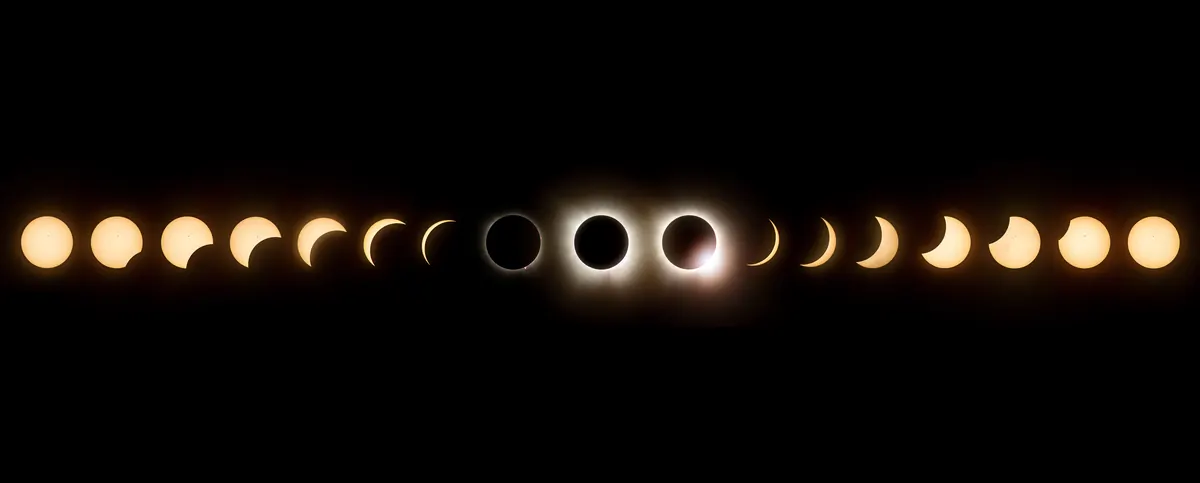
Eclipses per year
The most common year has 4 eclipses (62 years of the 100). 62 years have 4, 26 years have 5, 10 years have 6, 2 years have 7. Solar eclipses alone: 82 years have 2, 12 years have 3, 6 years have 4.
What kinds of eclipse they are
| Type | Number | Share |
|---|---|---|
| Total | 68 | 30% |
| Annular | 72 | 32% |
| Hybrid | 7 | 3% |
| Partial | 77 | 34% |
| Type | Number | Share |
|---|---|---|
| Total | 85 | 37% |
| Partial | 57 | 25% |
| Penumbral | 86 | 38% |
Total solar eclipses are uncommon on Earth as a whole, and rarer still at any one place, because the Moon's shadow on the ground is so small. In this century a total or hybrid eclipse happens somewhere on Earth every 1.3 years on average (490 days).
Why they come around again
Eclipses repeat in families called Saros series. A Saros is 6,585.3 days, 18 years, 11 days and about 8 hours, after which the Sun, Moon and Earth line up in almost the same way again. The extra third of a day moves each repeat a third of the way round the world. NASA's catalog gives the Saros number of every eclipse, and this century's 224 solar eclipses belong to 43 different series.
The cycle the Babylonians found
The Saros rests on a coincidence of three lunar cycles. After 223 lunar months, or 6,585.3211 days, the Sun, Moon and Earth return to almost the same arrangement. It works because three different lunar cycles, the phase cycle, the distance cycle and the node cycle, all come very close to a whole number of days at that interval.
The idea is old. Babylonian astronomers kept eclipse records for centuries, and the Antikythera mechanism, the ancient Greek geared device built between the late third and early first century BCE, had a spiral dial of four turns that was used to predict eclipses. The name Saros was applied to the cycle by Edmond Halley in 1686.
The extra third of a day
A Saros isn't a whole number of days, and the leftover eight hours matters. In that time Earth turns through about 116 degrees of longitude, so the repeat of a solar eclipse falls that far to the west of the one before. After three Saros cycles the geometry returns to nearly the same longitude, though the new eclipse has also moved north or south slightly.
That's why a family of eclipses wanders across the globe and why a given place gets a total eclipse so seldom. A single Saros series in the catalog, number 136, has 71 members that run for about 1,262 years. The longest eclipses page shows how the 1973 and 2027 eclipses, both from that family, compare.
What the century count looks like
In NASA's catalog, 2001 to 2100 has 224 solar and 228 lunar eclipses. They belong to 43 separate solar Saros series and 43 lunar ones, since each series visits the Sun or Moon only once every 18 years or so. The busiest years hold 7 eclipses (2038, 2094), and the quietest hold 4.
Not every solar eclipse is a spectacle. About a third are partial, and only some are total or hybrid. The mean gap between total or hybrid eclipses in this century is 1.3 years, but the gaps in the data run from 176 days to 857 days, so a long drought or a close pair can come at any time.
Counting by place, not by planet
The global count hides what matters to an individual. The shadow of a total eclipse covers a thin strip, so a given spot on Earth sees a total solar eclipse only about once every 375 years on average, according to NASA's eclipse pages. Some places have gone far longer, and some have had two in a few years. The total solar eclipse list shows where the next ones cross.
A lunar eclipse is much easier. Every lunar eclipse is visible from the whole night side of Earth, so over a few years most people get at least one chance to see an eclipsed Moon. The catch is that a penumbral one is almost invisible, and only the total and the deep partial ones really change the Moon's look.
Reading the next ones
The two best ways to use this page are to look for the big years and to note the family names. For the next specific dates, the pages on the next solar eclipse and the next lunar eclipse list them with times. If you want to know why they bunch together in two seasons a year, read about eclipse seasons. Those two factors, the season and the Saros, together explain nearly everything in the calendar.
A century at a glance
The busiest year for solar eclipses alone has 4, and 6 years reach that (2011, 2029, 2047, 2065, 2076 and 2094). In 82 of the 100 years there are only two solar eclipses. Of the 228 lunar eclipses, 86 are penumbral, the faintest kind, which is 38 percent of the total.
That share is one reason lunar eclipses are less famous than they might be. More than a third of them are too subtle for most people to notice, and the dramatic ones, the total eclipses, are on the total lunar eclipse page.
Averaged out, each of the 43 solar series contributes 5.2 eclipses to the century, which fits one return every 18 years or so. A quiet year can still hold a spectacular eclipse, because the count says nothing about how good the eclipses are.
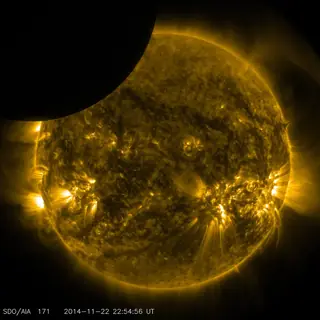 Eclipse seasonsWhy eclipses cluster in two seasons a year.
 Next solar eclipseThe next one, with times.
 Next lunar eclipseWhen the Moon next passes through the shadow.
Questions people ask
How many eclipses are there in a year?
Between 4 and 7 solar and lunar eclipses combined in this century, most often 4.
How many solar eclipses are there each year?
Between 2 and 4, according to NASA's catalog for 2001 to 2100.
How often is there a total solar eclipse?
A total or hybrid solar eclipse happens somewhere on Earth about every 1.3 years on average in this century.
What's a Saros cycle?
A Saros is about 18 years and 11 days. After one, an eclipse repeats in almost the same geometry, a third of the way round the world.