A slow start
The archive has 2 planets under 1992, the two pulsar planets that Aleksander Wolszczan and Dale Frail reported from the Arecibo radio telescope, and 1 under 1994, a third planet around the same pulsar. The next entry is 51 Pegasi b in 1995, the first planet around a Sun-like star. The story of those years is on the first exoplanets page.
After that the count grows in small steps. In 1996 the archive records 6 new planets, and 5 of them came from one observatory, Lick in California, where astronomers had spent years building the precision to measure a star's wobble. The total passed 100 in 2003 and 500 in 2011. Those years were slow because almost the only way to find a planet at scale was a spectrograph on a large telescope, used on a clear night, one star at a time.
Survey telescopes join in
The mid-2000s changed the method as well as the pace. The first planet found by watching for transits, OGLE-TR-56 b, was spotted by the Optical Gravitational Lensing Experiment in 2002 and confirmed by a velocity measurement in early 2003. By the end of the decade, ground-based surveys such as SuperWASP and HATNet were watching wide patches of sky night after night. Transit planets found by something other than Kepler, K2 or TESS rose from 16 in 2007 to 34 in 2010 and 36 in 2012.
Microlensing adds a thin but steady stream of planets found when a foreground star briefly magnifies a distant one. The first appears in 2004, and the yearly count has been in double figures since 2016, reaching 51 in 2022.
The yearly count
The bars show the year the archive records for each discovery. Early years are tiny. The big steps come when a telescope or a team publishes hundreds of planets at once.
The Kepler lumps
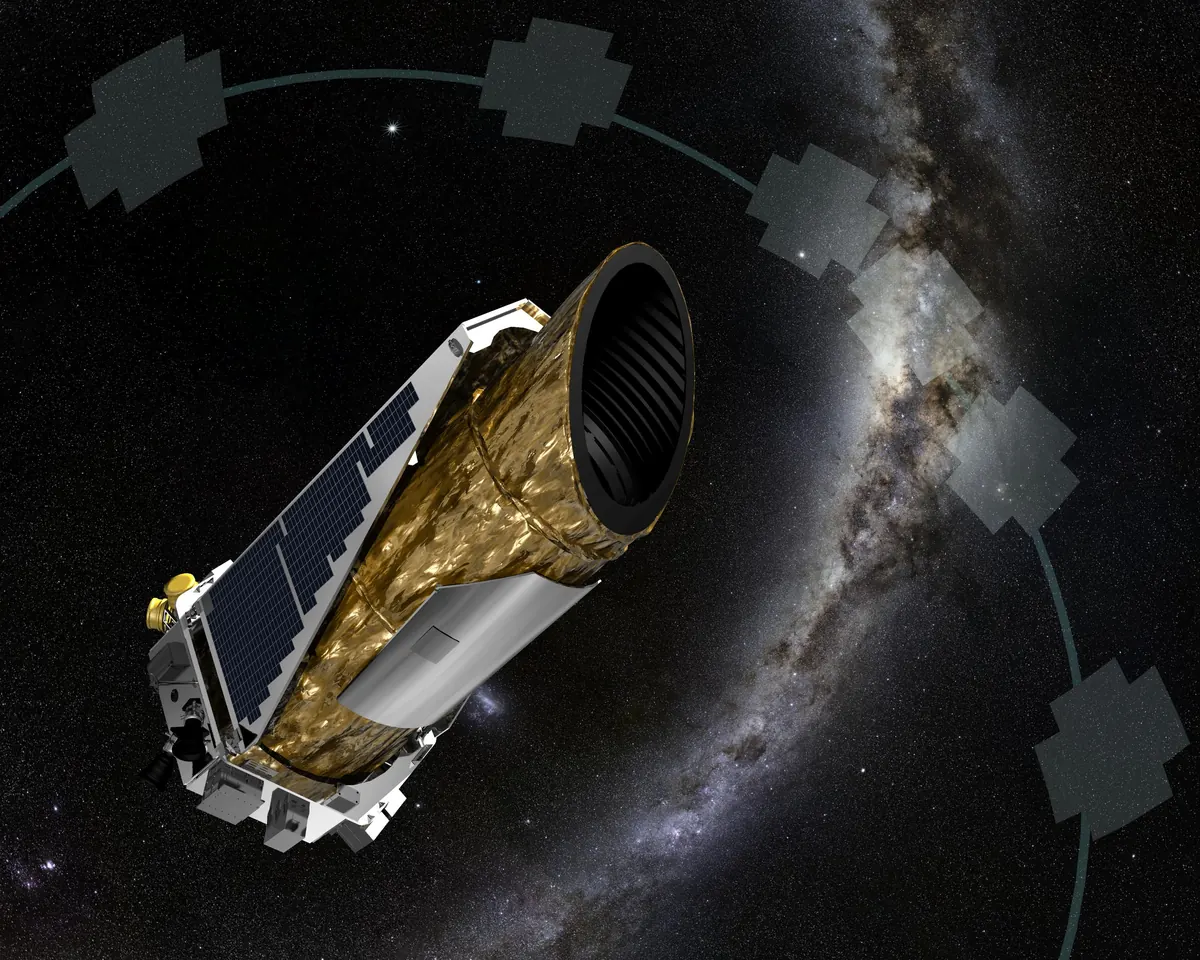
Kepler began releasing planets in 2010 and the archive records 54 under 2011. Those are still modest. The huge numbers come later, and they belong to the dates of analyses, not to Kepler's observing. The telescope stopped collecting its main data in 2013, yet 784 planets are listed under 2014, 1,276 under 2016 and 311 under 2021.
Each spike is a method. In 2014 NASA announced 715 planets verified together because stars with several candidates are almost always real systems. In 2016 a statistical analysis validated 1,284 more, by showing that false alarms couldn't explain them. In 2021 a neural network scored Kepler's remaining candidates. A planet is counted when a paper confirms it, so one paper can add a year's worth of discoveries. Read the Kepler and TESS page for the mission behind them.
Why 2016 stands out
1,276 of the 1,504 planets listed under 2016 came from Kepler, and 103 more from its K2 mission. NASA announced on May 10 of that year that Kepler's team had validated 1,284 new planets in one release, so a single paper added more planets than most whole years. 2016 isn't a record for telescope time. It's a record for paperwork finally catching up with data.
Year by year
For each year the table gives the number of planets, the method that found the most of them and the telescope or observatory behind the most.
| Year | Planets | Top method | Top facility (planets) |
|---|---|---|---|
| 1992 | 2 | Pulsar Timing (100%) | Arecibo Observatory (2) |
| 1994 | 1 | Pulsar Timing (100%) | Arecibo Observatory (1) |
| 1995 | 1 | Radial Velocity (100%) | Haute-Provence Observatory (1) |
| 1996 | 6 | Radial Velocity (100%) | Lick Observatory (5) |
| 1997 | 1 | Radial Velocity (100%) | Fred Lawrence Whipple Observatory (1) |
| 1998 | 6 | Radial Velocity (100%) | W. M. Keck Observatory (3) |
| 1999 | 13 | Radial Velocity (100%) | La Silla Observatory (5) |
| 2000 | 16 | Radial Velocity (100%) | Multiple Observatories (6) |
| 2001 | 12 | Radial Velocity (100%) | W. M. Keck Observatory (4) |
| 2002 | 29 | Radial Velocity (97%) | W. M. Keck Observatory (8) |
| 2003 | 22 | Radial Velocity (95%) | La Silla Observatory (13) |
| 2004 | 27 | Radial Velocity (67%) | W. M. Keck Observatory (7) |
| 2005 | 36 | Radial Velocity (92%) | W. M. Keck Observatory (13) |
| 2006 | 32 | Radial Velocity (66%) | W. M. Keck Observatory (8) |
| 2007 | 52 | Radial Velocity (65%) | La Silla Observatory (11) |
| 2008 | 62 | Radial Velocity (58%) | La Silla Observatory (15) |
| 2009 | 87 | Radial Velocity (76%) | La Silla Observatory (21) |
| 2010 | 93 | Transit (49%) | La Silla Observatory (19) |
| 2011 | 141 | Transit (57%) | Kepler (54) |
| 2012 | 144 | Transit (65%) | Kepler (59) |
| 2013 | 128 | Transit (62%) | Kepler (73) |
| 2014 | 872 | Transit (93%) | Kepler (784) |
| 2015 | 155 | Transit (64%) | Kepler (46) |
| 2016 | 1,504 | Transit (95%) | Kepler (1,276) |
| 2017 | 152 | Transit (57%) | K2 (44) |
| 2018 | 308 | Transit (79%) | K2 (191) |
| 2019 | 194 | Transit (55%) | K2 (38) |
| 2020 | 234 | Transit (70%) | Transiting Exoplanet Survey Satellite (68) |
| 2021 | 564 | Transit (81%) | Kepler (311) |
| 2022 | 367 | Transit (52%) | Transiting Exoplanet Survey Satellite (112) |
| 2023 | 323 | Transit (70%) | Transiting Exoplanet Survey Satellite (140) |
| 2024 | 260 | Transit (72%) | Transiting Exoplanet Survey Satellite (178) |
| 2025 | 246 | Transit (59%) | Transiting Exoplanet Survey Satellite (129) |
| 2026 | 361 | Transit (77%) | Transiting Exoplanet Survey Satellite (273) |
The TESS years
After 2016 the yearly total settles at a few hundred, and the steady supplier is TESS. It's credited with 32 planets in 2019, its first full year, and 129 in 2025. In 2025 that was 52% of all planets listed. K2 lifted 2018 to 308, with 191 of them credited to it.
The partial year is already large. As of October 15, 2026, 361 planets are listed under 2026, 273 of them from TESS, the highest total since 2022. Part of that's timing. Papers arrive in clusters, and a count for a year that isn't over can move a lot between updates.
The methods that don't come in batches
Radial velocity has kept a steady pace beside the transit surveys. Since 2015 it has added between 29 and 115 planets a year, with its best year, 2022, at 115. Nothing in that line looks like the Kepler spikes, because each planet needs its own long series of spectra before a team can publish.
Direct imaging has added 62 planets since 2015, a few each year, and microlensing adds up to a few dozen. Imaging is limited by how few young, nearby stars there are to look at. Microlensing is limited by luck: events are watched as they happen, and the telescopes that watch for them have to stare at the crowded center of the galaxy. The methods page explains why each method has its own pace.
A year's count can change after the fact. The archive adds planets as papers are published and sometimes revises a discovery year, so older rows can shift by a planet or two between updates.
How to read the bars
The year is when the discovery was published, not when the light reached a telescope. That makes the chart a record of announcements, and it explains why the Kepler bars look nothing like Kepler's observing schedule. It also means no single year says how fast the field is moving. A better guide is the running total on the main count page: the archive held 911 planets at the end of 2013 and 3,442 three years later.
Five-year blocks are fairer than single years. The archive lists 435 in 2007 to 2011, 2,803 in 2012 to 2016, 1,452 in 2017 to 2021, 1,557 in 2022 to 2026, the last block running to October 15, 2026. Spikes average out, and what remains is a field that now adds hundreds of planets every year, a pace nobody expected when the first two pulsar planets were announced.