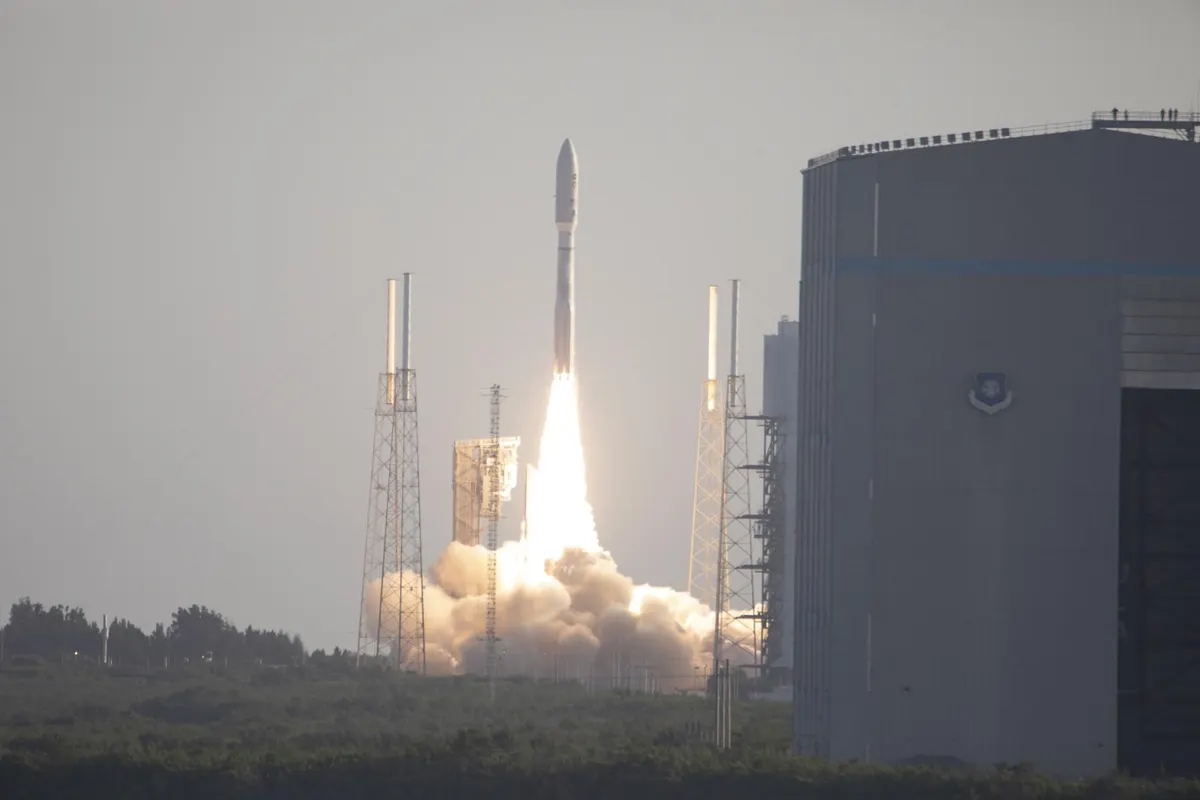
A pandemic year that still grew
The world launched 115 times in 2020, 13 more than in 2019, in a year when airports shut and factories closed. China led with 40 launches to the United States' 37. It was also the least reliable of the eight years on this site: 10 launches failed, so 91% succeeded. The pandemic did change plans. On March 12, 2020 ESA and Roscosmos announced that the ExoMars rover wouldn't fly until 2022. But the launch windows that planets set couldn't be moved, and 2020 became a year of three Mars launches, a Moon sample return, the first American crew launch from American soil in nine years and the finished BeiDou navigation network.
1,291 payloads were carried into orbit. 10 launches failed. 0 Starship test flights are included in the total.
Launches by month
By country
The biggest change from 2019 was the United States, up 16 to 37 launches.
By launch site
By rocket
Launches in every year since 1957.
The landmark flights
Crew launches return to Florida. NASA and SpaceX launched Robert Behnken and Douglas Hurley on May 30, 2020. The first operational flight, Crew-1, followed on November 15, Florida time, with four astronauts. SpaceX flew 25 launches in all, 22% of the world total, and 14 of them were Starlink flights that carried 833 satellites, up from 120 in 2019.
Three launches to Mars. Our mission ledgers list 5 Moon and Mars missions that launched in 2020: 5 success. The United Arab Emirates' Emirates Mars Mission launched on July 19, 2020, China's Tianwen-1 on July 23, 2020 and NASA's Mars 2020 with its Ingenuity helicopter on July 30, 2020. They flew within two weeks because Earth and Mars line up for an efficient trip only about every 26 months. Every one of them worked. The Mars mission count shows how rare that streak is, and the light travel time calculator turns the distance into minutes.
The Moon, with a return ticket. China's Chang'e-5 launched on November 23, 2020 and returned 1.7 kilograms of lunar material on December 16, 2020, the first sample return from the Moon in 44 years, counting from the Soviet Luna 24 in 1976.
BeiDou is complete. The last BeiDou-3 satellite launched on June 23, 2020, finishing a constellation of 30: 24 in medium Earth orbit, 3 in inclined geosynchronous orbit and 3 in geostationary orbit. The GPS page compares the three navigation systems.
Iran. The Qased rocket flew for the first time on April 22, 2020 and put Iran's first military satellite, Noor-1, into orbit. It was one of Iran's 2 launches that year. The other, a Simorgh on February 9, failed.
Ten failures
Five of the 10 failures were new rockets or new versions flying for the first time in GCAT's log: Chang Zheng 7A, LauncherOne, Kuaizhou-11, Astra Rocket 3.1 and Astra Rocket 3.2. China lost a Long March 7A on March 16, a Long March 3B on April 9, a Kuaizhou-11 on July 10 and a Kuaizhou-1A on September 12. In the United States, Virgin Orbit's LauncherOne failed on May 25, and Astra's rocket failed on September 12 and again on December 15. Rocket Lab's Electron lost one of its 7 launches on July 4. Europe's Vega failed on November 17. The success rate of 91% compares with 95% in 2019 and 96% in 2022. Young rockets fail more often, and 2020 had many of them.
Rockets and launch sites
Falcon 9 flew 25 of the 115 launches (22%), ahead of Chang Zheng 3B with 8 and Soyuz-2-1B with 8. By site, Cape Canaveral had 20, Xichang 13, Jiuquan 13 and Kennedy Space Center 10. Nine countries launched at least once in all, counting the launching country the way GCAT does. The launches put 1,291 satellites into orbit, an average of 11 per launch. 833 of them, 65%, were Starlink satellites. The rest, 458, came from every other operator in the world put together.
New rockets and shifting shares
GCAT logs ten rocket types flying for the first time in 2020: Chang Zheng 7A (March 16), Qased (April 22), Chang Zheng 5B (May 5), LauncherOne (May 25), Kuaizhou-11 (July 10), Astra Rocket 3.1 (September 12), Gushenxing 1 (November 7), CE-5 SSQ (December 3), Astra Rocket 3.2 (December 15), Chang Zheng 8 (December 22). Five of them failed on that first flight. Some are new versions of a rocket that already existed, which GCAT lists under a new name. Against 2019, the biggest gain was the United States, up 16 to 37, and the biggest fall was Russia, down 10 to 12.
The shape of the year
April was the quietest full month with 5 launches and December the busiest with 17. By quarter the counts run 24, 21, 31 and 39, so 34% of the year's launches came in the final three months.
Who was ahead?
By GCAT's rule China led, 40 to 37. But 7 of the year's launches were Rocket Lab Electrons flown from New Zealand, and GCAT credits them to that country. Add them to the American company that built the rocket and the United States has 44, ahead of China. Both answers are fair; they answer different questions. The Rocket Lab page has the detail.
The busiest month was December with 17 launches, more than any month of 2019. The next page, 2021 covers the year that broke a record from 1967.