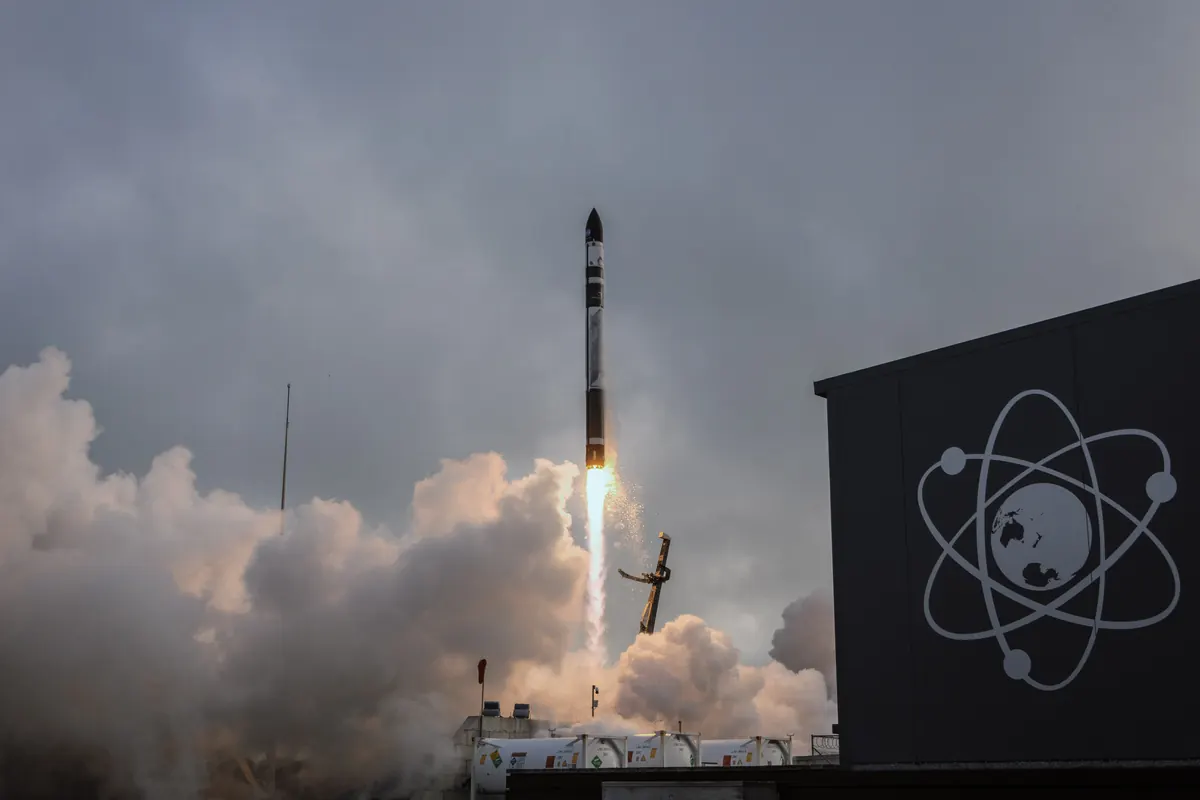
An American company that GCAT counts as New Zealand
Rocket Lab has made 88 orbital launch attempts since May 25, 2017, and 84 succeeded. Of those, 84 flew from Mahia in New Zealand, and GCAT credits them to New Zealand. The other four left from Wallops in Virginia, and those count for the United States.
That's why New Zealand appears in the country table on the launches-per-year page, with 17 launches in 2025.
Launches per year
Launches by month in 2025
Pads and launch complexes
The busiest pads over the last five years.
Which rockets
Rockets launched in 2024 and 2025.
A rough first flight
The company was founded in 2006 by Peter Beck in Auckland. Its first launch pad, Launch Complex 1A, opened September 26, 2016. The first launch, on May 25, 2017, ended in failure. The rocket reached about 224 km before telemetry was lost and the rocket was destroyed.
The first flight to reach orbit, Still Testing, was on January 21, 2018, and it carried three CubeSats. GCAT logs 4 failures in all, on May 25, 2017, July 4, 2020, May 15, 2021 and September 19, 2023.
More pads and a bigger rocket
A second Mahia pad, Launch Complex 1B, flew for the first time on February 28, 2022. Wallops Launch Complex 2 had its first Electron launch on January 24, 2023. In the recent pad table, 1B has 41 launches, 1A has 25 and the Wallops pad has 4.
The suborbital HASTE variant first flew June 18, 2023, and suborbital flights aren't in this count. Neutron's pad, Launch Complex 3 at Wallops, opened August 28, 2025.
From Auckland to Long Beach
Rocket Lab's headquarters are in Long Beach, California. The company moved there in 2020 from Huntington Beach. The company began trading on Nasdaq on August 25, 2021, through a merger with the SPAC Vector Acquisition Corporation. It also builds spacecraft: Photon is a satellite bus based on Electron's kick stage that first flew in August 2020, and NASA selected Rocket Lab in February 2020 to launch CAPSTONE.
The Mahia site is the one that counts for New Zealand. Launch Complex 1 is near Ahuriri Point at the southern tip of the Mahia Peninsula in Hawke's Bay on New Zealand's North Island. New Zealand's first orbital space launch took place from Launch Complex 1 on January 21, 2018.
The rocket
Electron stands 18 meters tall. It has nine Rutherford engines on the first stage and one vacuum version on the second, with almost all engine parts 3D printed. Its payload was 225 kg to low Earth orbit at first, raised to 300 kg in August 2020.
On recovery, Flight 16, Return to Sender, was the first to recover a first stage, with a splashdown in the Pacific Ocean, and a helicopter catch was tried on Flight 26 before Rocket Lab went back to ocean landings. Rocket Lab's own tally is 97 Electron flights as of September 26, 2026 (the 97th Electron mission, per its press release), including the suborbital HASTE flights. Subtract the suborbital flights and the orbital total matches GCAT's 88.
Reliability and the national table
84 of 88 launches succeeded, 95.5%. The four failures came in 2017, 2020, 2021 and 2023, and none has appeared in the log since the one on September 19, 2023. The yearly series from 2019 to 2025 reads 6, 7, 6, 9, 9, 14, 18.
In 2025 New Zealand's 17 launches matched Russia's 17. The countries on this site's launches per year page are listed by the country of the rocket.
Month by month
The monthly table for 2025 runs from 0 launches in the quietest months to 4 in June, with a total of 18. A rocket that small is flown from a launch pad every few weeks and not every few days.
For scale, Ceres-1, a commercial rocket on the China page, lifts about 400 kg to low Earth orbit against Electron's 300 kg.
A growing customer list
Launches have risen from 6 in 2019 to 18 in 2025, and 2026 has 15 through October 16, 2026, against 13 at the same point in 2025. All of them were Electron.
Customers come from several countries. Synspective, for example, operates radar (SAR) imaging satellites named StriX and launches them on Rocket Lab's Electron. See the Japan page for that fleet. The much larger SpaceX totals show the other end of the market.