The record from 1967 falls
146 launches broke a record that was 54 years old. The old high was 141 in 1967, at the peak of the Cold War, and no year had come close since. China flew 56 of them, up from 40 in 2020, and the United States 45. 135 reached orbit. Behind the headline were 31 SpaceX launches, a new Chinese space station core, the first orbital flight with no professional astronauts and the launch of the James Webb Space Telescope on Christmas Day. There was also a Russian missile test that sent the crew of the space station to shelter.
1,856 payloads were carried into orbit. 11 launches failed. 0 Starship test flights are included in the total.
Launches by month
By country
The biggest change from 2020 was China, up 16 to 56 launches.
By launch site
By rocket
Launches in every year since 1957.
The following year is on the 2022 launch page.
The landmark flights
China builds a station. The Tianhe core module launched on April 29, 2021, the first piece of the Tiangong station. Two weeks later, on May 14, 2021, China's Zhurong rover landed on Mars. See the list of Mars rovers for the countries that have done it.
Russia adds a module. The Nauka laboratory launched on July 21, 2021 for the Russian side of the International Space Station. Russia flew 16 launches in all, and the Russia page has the history.
Civilians in orbit. Inspiration4 launched on a Falcon 9 on the evening of September 15, Florida time, which is September 16 in UTC. Its four crew were private citizens, the first all-civilian crew in orbit.
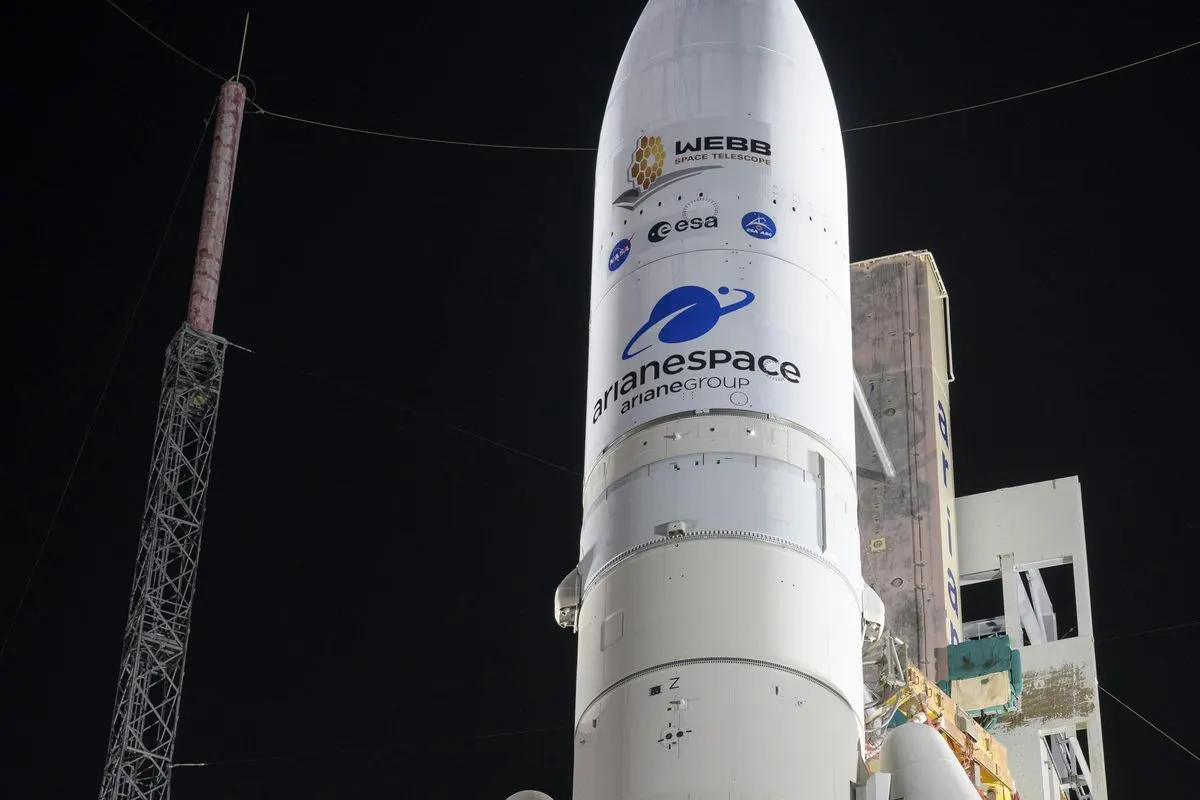
Webb. The James Webb Space Telescope launched on an Ariane 5 from Kourou on December 25, 2021. Ariane 5 flies from French Guiana, which is why GCAT credits 15 launches to France that year. See the Webb page for what it has found. A month earlier, on November 24, 2021, NASA's DART spacecraft launched to test whether a crash can change an asteroid's path.
A debris emergency
On November 15, 2021 Russia destroyed its retired Kosmos 1408 satellite with a missile. The cloud counts more than 1,500 trackable pieces, according to Wikipedia's account, and the crew of the space station took shelter in their return spacecraft while it passed. The test came nearly three years after India's, covered on the 2019 page.
Eleven failures
11 launches failed in 2021, 92% success. Four were first flights: Astra's Rocket 3.3 on August 28, Firefly's Alpha on September 3, South Korea's Nuri on October 21, which reached orbit on its second flight in 2022, and Russia's Angara A5 with a new upper stage called Persei on December 27. China lost Hyperbola-1 twice, on February 1 and August 3, and a Kuaizhou-1A on December 15. Iran's Simorgh failed on June 12 and again on December 30. Electron failed on May 15 and India's GSLV on August 12.
Rockets and launch sites
Falcon 9 flew 31 of the 146 launches (21%), ahead of Soyuz-2-1B with 13 and Chang Zheng 3B with 11. By site, Jiuquan had 22, Cape Canaveral 19, Xichang 16 and Baikonur 14. Nine countries launched at least once in all, counting the launching country the way GCAT does. The launches put 1,856 satellites into orbit, an average of 13 per launch. 989 of them, 53%, were Starlink satellites. The rest, 867, came from every other operator in the world put together.
New rockets and shifting shares
GCAT logs five rocket types flying for the first time in 2021: Proton-M (July 21), Astra Rocket 3.3 (August 28), Firefly Alpha (September 3), Nuri (October 21), Angara A5/Persei (December 27). Four of them failed on that first flight. Some are new versions of a rocket that already existed, which GCAT lists under a new name. Against 2020, the biggest gain was China, up 16 to 56.
The shape of the year
January was the quietest full month with 7 launches and December the busiest with 23. By quarter the counts run 27, 35, 34 and 50, so 34% of the year's launches came in the final three months.
Where the year ranks
Among the 70 years in the log, 2021 ranks 6th for the number of launches. No earlier year in the log had as many. The log holds 7,433 launches in all, an average of 106 a year, so 2021 was at 1.4 times the long-run average.
How the year was counted
The United States' 45 excludes 6 Electron launches credited to New Zealand; other lists add them. Starlink flew 19 launches and 989 satellites, 61% of SpaceX's flights. December had 23 launches, the busiest month so far. The record didn't slow the climb. See 2022.