Claims that came first and didn't stand
Several astronomers announced planets before 1992, and none of those announcements settled the question. One, around the pulsar PSR B1829-10, had to be retracted after errors were found in the calculations. Another came in 1988, when Bruce Campbell and colleagues reported a planet with a roughly 2.7-year orbit around the star Gamma Cephei. In 1992 Gordon Walker and colleagues argued that the signal came from the star's own variability. The planet was finally confirmed in 2002, by Artie Hatzes and colleagues, and published in 2003.
That history is why the pulsar planets of 1992 count as the first confirmed ones. They were measured, checked and not retracted, which is the standard the archive still applies.
The pulsar planets
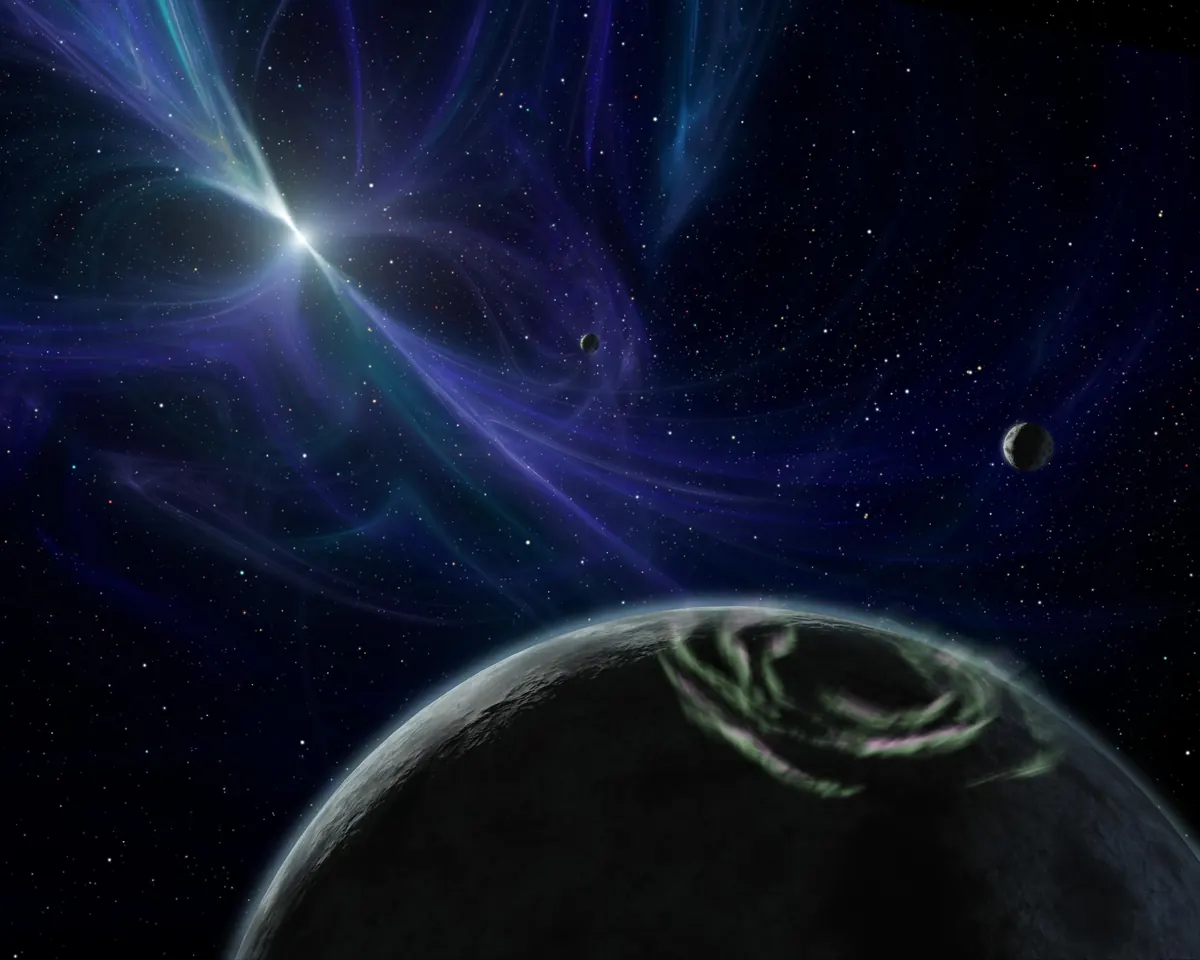
In 1992 Aleksander Wolszczan and Dale Frail reported planets around PSR B1257+12, a pulsar: the dense, fast-spinning remnant of a star that exploded. They used the Arecibo radio telescope in Puerto Rico and found the planets from tiny shifts in the timing of the pulsar's radio pulses. Two planets were published in 1992, and a third, innermost one in 1994. The archive puts the system at about 1,957 light years from us.
Wolszczan had discovered the pulsar itself on February 9, 1990, also with Arecibo. It spins every 6.2 milliseconds, so the timing of its pulses is extremely regular, and a planet's pull shows up as a repeating drift against that clock. The archive lists the two planets from 1992 at about 4.3 and 3.9 Earth masses. The innermost, announced in 1994, is far lighter at about 0.02 Earth masses. All three weigh far less than any other entry in the table.
These planets orbit the dead core of a star, so they're very different places from the worlds around ordinary stars like the one in the next find.
51 Pegasi b
In October 1995 Michel Mayor and Didier Queloz reported a planet around 51 Pegasi, a star much like the Sun about 50 light years away. They found it from the star's wobble. It has at least about 0.61 Jupiter masses and circles its star every 4.2 days. Mercury takes 88 days to circle the Sun.
They announced 51 Pegasi b on October 6, 1995. They used the ELODIE spectrograph on a telescope at the Observatoire de Haute-Provence in France, and the planet showed up as a back-and-forth shift of about 59 meters per second, roughly 212 kilometers per hour, in the star's velocity. That's a motion no one could see by eye, but the spectrograph could read it as a tiny shift in the starlight's color. Within a week a team at Lick Observatory in California confirmed it.
A gas giant that heavy, on an orbit that short, didn't fit what was known about how planets form. Giants were expected to take shape far from their stars and stay there. It also tugs its star about five times harder than Jupiter tugs the Sun, which is part of why it was the first to be caught. The finding pushed theorists toward the idea of orbital migration, and hot Jupiters, as planets like this became known, proved to be a whole class. The exoplanet sizes page counts how many of those are now known.
Every planet found around an ordinary star by the end of 1996 lies within 69 light years of us. That's no coincidence. A spectrograph needs plenty of light to measure a star's motion to a few meters per second, so the first searches could only work on bright, nearby stars. The pulsar planets are far away, about 1,957 light years, because a pulsar's radio beam can be timed from much farther. The Arecibo telescope that found them collapsed in December 2020.
What the first planets had in common
Look at the orbits in the table. 6 of the 10 planets listed circle their star in fewer days than Mercury takes to circle the Sun, which is 88. That isn't a fact about nature. It's what the methods could see. A close-in giant makes its star wobble faster and harder, and a planet orbiting a pulsar shifts the pulse timing in a few weeks. The planets of the 1990s were the easy ones.
Slow planets had to wait. Jupiter takes about 12 years to orbit the Sun, so finding a twin of it means watching a star for a decade or more.
Mayor and Queloz shared the 2019 Nobel Prize in Physics, in part for this discovery.
The early discoveries
Every confirmed planet the archive lists with a discovery year of 1996 or earlier.
| Planet | Year | Method | Facility | Discovery paper | Orbit (days) | Mass or minimum mass (Jupiter masses) | Distance (light years) |
|---|---|---|---|---|---|---|---|
| PSR B1257+12 c | 1992 | Pulsar Timing | Arecibo Observatory | Wolszczan et al. 1992 | 66.54 | 0.014 | 1,957 |
| PSR B1257+12 d | 1992 | Pulsar Timing | Arecibo Observatory | Wolszczan et al. 1992 | 98.21 | 0.012 | 1,957 |
| PSR B1257+12 b | 1994 | Pulsar Timing | Arecibo Observatory | Wolszczan 1994 | 25.26 | 0.00006 | 1,957 |
| 51 Peg b | 1995 | Radial Velocity | Haute-Provence Observatory | Mayor & Queloz 1995 | 4.23 | 0.61 | 50 |
| 70 Vir b | 1996 | Radial Velocity | Lick Observatory | Marcy & Butler 1996 | 116.69 | 7.416 | 58 |
| tau Boo b | 1996 | Radial Velocity | Lick Observatory | Butler et al. 1997 | 3.31 | 4.32 | 51 |
| 16 Cyg B b | 1996 | Radial Velocity | Multiple Observatories | Cochran et al. 1997 | 798.5 | 1.78 | 69 |
| 47 UMa b | 1996 | Radial Velocity | Lick Observatory | Butler & Marcy 1996 | 1,078 | 2.53 | 45 |
| ups And b | 1996 | Radial Velocity | Lick Observatory | Butler et al. 1997 | 4.62 | 0.688 | 44 |
| 55 Cnc b | 1996 | Radial Velocity | Lick Observatory | Butler et al. 1997 | 14.65 | 0.868 | 41 |
Many kinds of first
Which planet is the first depends on the question. The pulsar planets are the first confirmed. 51 Pegasi b is the first around a main-sequence star like the Sun. The first discovered by watching a star dim as a planet crossed it, OGLE-TR-56 b, was announced in 2002 and confirmed in early 2003. Each method has a first year, and the table lists when each one first appears in the archive. The methods page explains what each does. Gamma Cephei b is a case in point: the archive lists it under 2003, the year it was confirmed, which is why it isn't in the table.
| Method | First year |
|---|---|
| Pulsar Timing | 1992 |
| Radial Velocity | 1995 |
| Transit | 2002 |
| Imaging | 2004 |
| Microlensing | 2004 |
| Pulsation Timing Variations | 2007 |
| Eclipse Timing Variations | 2009 |
| Orbital Brightness Modulation | 2011 |
| Transit Timing Variations | 2011 |
| Astrometry | 2013 |
| Disk Kinematics | 2019 |
How fast the list grew
For years the count rose slowly. The table shows the running total at the end of each year listed, using the discovery years in the archive.
| Year | Confirmed planets so far |
|---|---|
| 1995 | 4 |
| 1996 | 10 |
| 2000 | 46 |
| 2005 | 172 |
| 2010 | 498 |
| 2015 | 1,938 |
| 2020 | 4,330 |
| 2026 (to October 15, 2026) | 6,451 |
Even after 1995 the list grew slowly. It took until 2003 to reach 100 confirmed planets, then until 2011 to reach 500 and 2014 to pass 1,000. The jump to thousands came after the Kepler telescope, as the discoveries-per-year page shows.