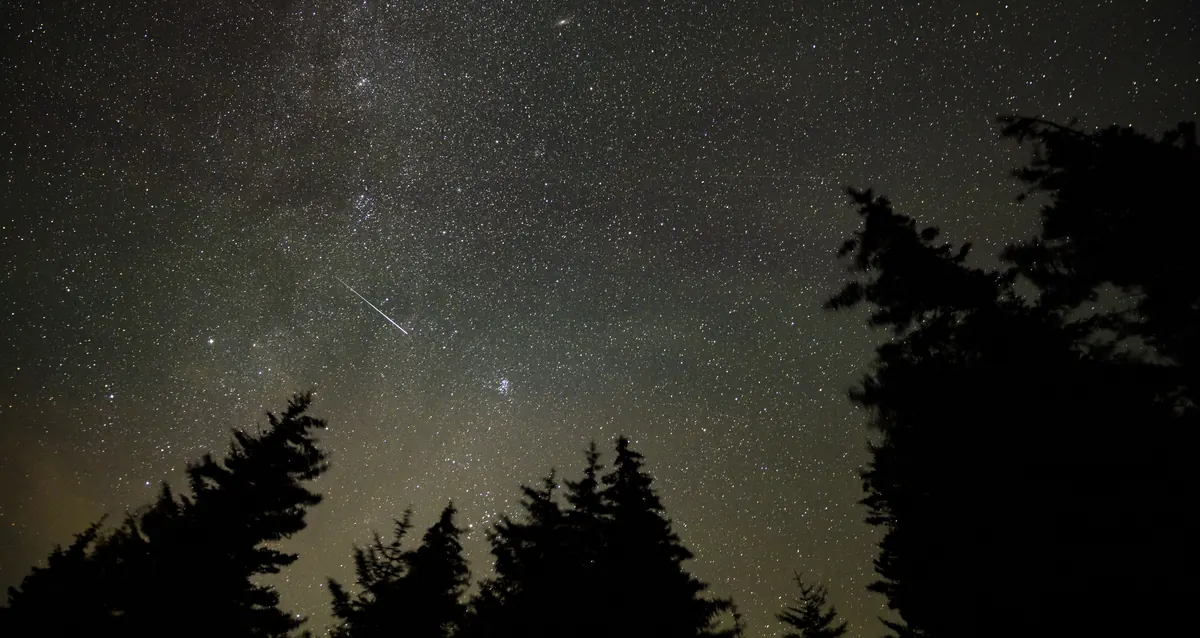
A comet found twice over
The Perseids are the leftovers of comet 109P/Swift-Tuttle, which Lewis Swift and Horace Tuttle found in 1862. In 1865 Giovanni Schiaparelli worked out that the comet and the August meteors follow the same path around the Sun.
The comet takes 133 years to go around once and last came through the inner solar system in 1992. Its nucleus is about 26 kilometers across, nearly twice the size of the object thought to have ended the dinosaurs. Each pass strips off more dust, and the dust spreads along the orbit. Earth crosses that trail every year in the second week of August.
The shower is named for Perseus, where the radiant sits, but the constellation is only a signpost. Perseids appear across the whole sky. Trace one backward and it points to Perseus, which is how you tell a Perseid from a stray meteor.
Why this is the shower people know
NASA calls it the most popular and best meteor shower of the year. The meteors hit the atmosphere at 59 kilometers a second, fast enough to leave long wakes of light and color. Some are fireballs, which NASA defines here as brighter than magnitude minus 3, and they come from larger crumbs of the comet.
The timing helps too. The peak falls in summer in the Northern Hemisphere, so you can lie out on a warm night without a coat. NASA says the shower is best from the north and suggests the pre-dawn hours, though some meteors show from around 10 p.m.
Older than the telescope
The first record of the Perseids is dated to AD 36. In Catholic folklore they're the "tears of Saint Lawrence," tied to his feast day on 10 August and to his martyrdom by burning in AD 258. Adolphe Quetelet noticed in 1836 that August has more meteors and, from historical records, predicted a peak on 10 August. Other astronomers confirmed it in 1837, while weather kept Quetelet from seeing it himself.
Wikipedia dates Schiaparelli's comet link to 1866, a year after the date NASA gives. Either way, the Perseids were the first shower tied to a comet.
The next 8 years
The peak is when Earth passes the densest part of the stream, and it falls on almost the same date each year. What changes is the Moon. The table shows the Moon at the peak and how many hours of dark, moon-free sky there are with the radiant above 20 degrees, on the better of the two nights around the peak.
| Year | Peak | Moon at the peak | Good hours, 40 N | Rating, 40 N | Good hours, 30 S | Rating, 30 S |
|---|---|---|---|---|---|---|
| 2027 | August 13, 2027, 08:10 UTC | 86% (waxing gibbous) | 2.3 h | Good | 0.0 h | No dark window |
| 2028 | August 12, 2028, 14:19 UTC | 59% (waning gibbous) | 0.3 h | Poor | 0.0 h | No dark window |
| 2029 | August 12, 2029, 20:28 UTC | 10% (waxing crescent) | 5.7 h | Excellent | 0.0 h | No dark window |
| 2030 | August 13, 2030, 02:37 UTC | 100% (full Moon) | 0.0 h | No dark window | 0.0 h | No dark window |
| 2031 | August 13, 2031, 08:46 UTC | 20% (waning crescent) | 4.2 h | Excellent | 0.0 h | No dark window |
| 2032 | August 12, 2032, 14:55 UTC | 33% (waxing crescent) | 5.7 h | Excellent | 0.0 h | No dark window |
| 2033 | August 12, 2033, 21:04 UTC | 94% (waning gibbous) | 0.0 h | No dark window | 0.0 h | No dark window |
| 2034 | August 13, 2034, 03:13 UTC | 1% (new Moon) | 5.7 h | Excellent | 0.0 h | No dark window |
Good hours are measured in local solar time and count only times when the Sun is more than 18 degrees below the horizon, the Moon is below the horizon and the radiant is above 20 degrees. Rating: 4 hours or more is excellent, 2 to 4 good, under 2 poor. Peak times are in UTC.
The best and worst year
From 40 degrees north the best of these years is 2034, with 5.7 good hours and the Moon 1% lit at the peak. The worst is 2033, with 0.0 good hours. From 30 degrees south the best is 2034, with 0.0 good hours.
The night of the next peak at 40 degrees north
The better night around the August 13, 2027 peak starts on the evening of August 12, 2027. Times are local solar time.
| What | Local solar time |
|---|---|
| Astronomical darkness | 20:45 to 03:30 |
| Moon above the horizon during the dark hours | 20:45 to 01:10 |
| Radiant above 20 degrees during the dark hours | 21:50 to 03:30 |
| Good window: dark, no Moon, radiant up | 01:10 to 03:30 |
The radiant sits at declination +58 degrees and right ascension 3.2 hours. Rating for that night: good, with 2.3 good hours.
What the Perseids are
The parent is comet 109P/Swift-Tuttle. Swift-Tuttle takes 133 years to orbit the Sun once and is about 26 km across. It was discovered in 1862 by Lewis Swift and Horace Tuttle and last passed the Sun in 1992. NASA's fast facts say about 25 meteors an hour under dark skies, and the text says about 50 to 100 an hour at the peak.
Giovanni Schiaparelli worked out in 1865 that Comet Swift-Tuttle is the source of the Perseids.
The name comes from the radiant in the constellation Perseus.
 Meteor shower calendarEvery major shower with the Moon at its peak.
 Sky calendarEclipses, planets and meteor showers.
 Milky Way seasonThe best nights for the galaxy, park by park.
Questions people ask
When do the Perseids peak?
The next peak is August 13, 2027 at about 08:10 UTC. The shower is active 17 July to 24 August.
How many Perseids can you see an hour?
The ZHR, an ideal rate under perfect skies with the radiant overhead, is 100. NASA's fast facts say about 25 meteors an hour under dark skies, and the text says about 50 to 100 an hour at the peak.
Will the Moon spoil the Perseids next time?
At the next peak the Moon is 86% lit (waxing gibbous). From 40 degrees north that gives 2.3 dark, moon-free hours with the radiant up on the better night.
Which year is best for the Perseids?
Of the next 8 years, 2034 has the least moonlight problem at 40 degrees north, with 5.7 good hours.
Good years and bad ones
Rates vary. After Swift-Tuttle's 1992 return the shower produced strong outbursts, with a ZHR of 200 to 500 in 1993. In 2009 the ZHR was 173, though a gibbous Moon washed out the fainter meteors. The 2016 and 2021 peaks each had a ZHR of about 150.
A dust filament pulled off the comet in 1865 can give a mini-peak the day before the maximum. The largest meteoroids have masses of about 7 kilograms. Esko Lyytinen calculated that Earth could meet a dense debris field in 2028, possibly giving a storm on 11 or 12 August with at least 1,000 meteors an hour at the zenith. It's a model result, not a promise. The Moon at the 2028 peak, by the sky engine, is 59% lit (waning gibbous), which is the sort of detail that decides whether a forecast storm could be seen.
Watching the Perseids
Go somewhere away from street lights, lie flat and take in as much sky as you can. Give your eyes about 30 minutes to adapt, and keep your phone in your pocket. Binoculars and telescopes narrow the view, and a meteor shower rewards the widest one.
The next peak is August 13, 2027, with the Moon 86% lit (waxing gibbous). At 40 degrees north, 4 of the 8 peaks from 2027 to 2034 give four hours or more of dark, moon-free sky with the radiant up: 2029, 2031, 2032 and 2034. The Moon is under a quarter lit at the peak in 2029, 2031 and 2034. It's three-quarters lit or more in 2027, 2030 and 2033, and in those years only the brightest meteors show. The Moon matters more here than for a rarer shower, because most of the Perseids are modest streaks, and a bright Moon is what hides them.
The shower is spread over weeks. It runs 17 July to 24 August, so if the peak night is moonlit, a night when the Moon sets earlier can suit better.
Two rates, one shower
The International Meteor Organization gives the Perseids a ZHR of 100. NASA's fast facts say about 25 an hour under dark skies, and its main text says 50 to 100 at the peak. NASA's page doesn't reconcile them, and neither does this one, because they measure different things.
The ZHR is a ceiling. It assumes a perfect sky and a radiant straight overhead. Real skies are brighter and the radiant is lower, so a person sees a fraction of what falls. Treat the NASA dark sky figure as the number to expect from a good site.
If you want the Milky Way in the same sky, the Milky Way season guide shows which parks have it overhead in August. The meteor shower calendar lines up the year's other showers, and the Southern Delta Aquariids overlap the start of the Perseids.
Who's under the peak
The calculated peak is August 13, 2027 at 08:10 UTC. In local solar time that's the middle of the night (10 p.m. to 3 a.m.) for Los Angeles, and evening, dawn or daytime for London, New York, Sao Paulo, Johannesburg, Delhi, Beijing and Sydney.
The hour of the peak moves from year to year, because a calendar year isn't a whole number of Earth orbits. Across 2027 to 2034 it ranges from 02:37 to 21:04 UTC, so the part of the world that sits under the peak changes with it.