The evening shower that sometimes storms
The Draconids are best seen after sunset from the Northern Hemisphere, unlike most showers. They're slow, at about 20 kilometers a second, the slowest of the major showers on this calendar, so the meteors are short and faint.
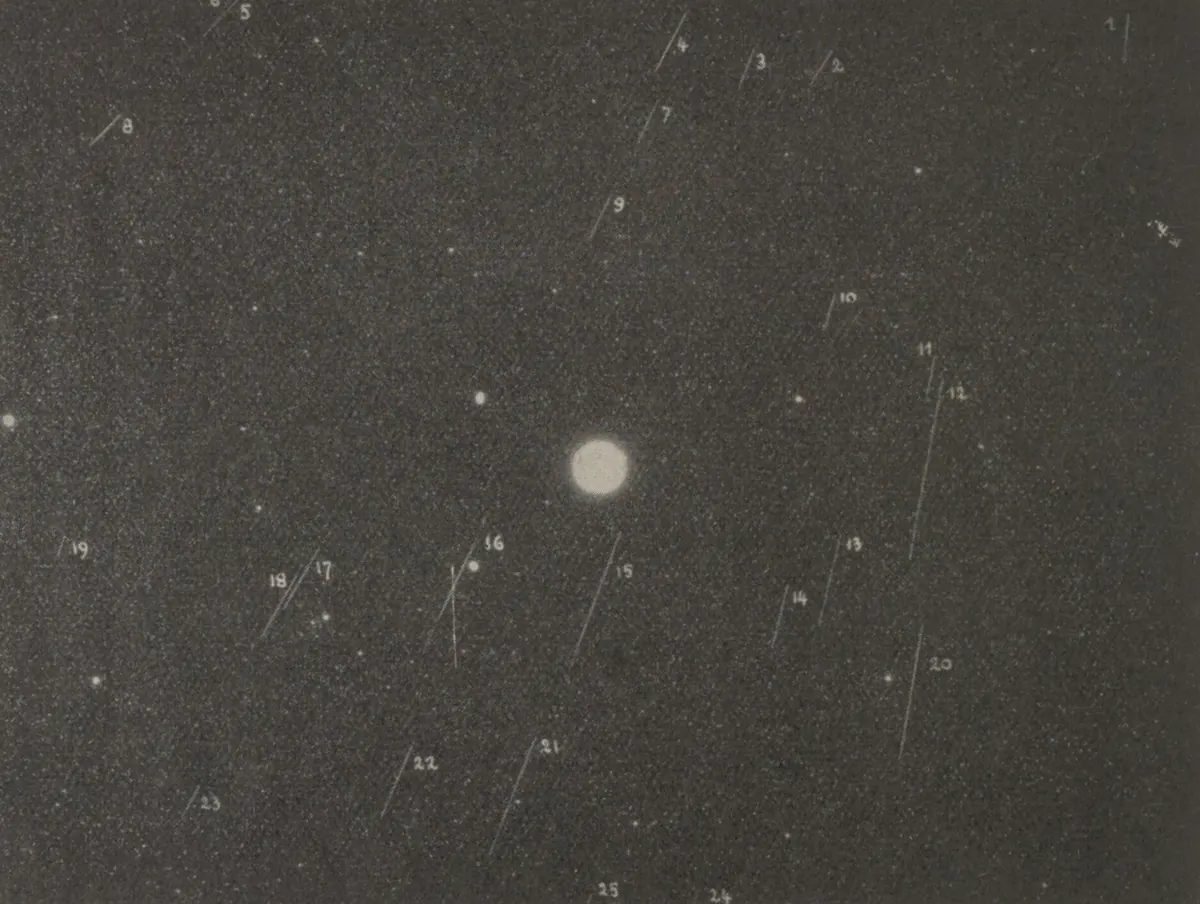
In most years that makes them dull. Then, a few times a century, comet 21P/Giacobini-Zinner lays down a dense ribbon of dust and the shower storms. NASA reports about 500 Draconid meteors a minute seen in Europe in 1933 and 50 to 100 a minute in the United States in 1946. Storm estimates are loose, so treat those as rough.
Outbursts in between
Smaller outbursts followed. In 2011 the outburst came as predicted, but a waxing gibbous Moon hid many of the meteors. In 2012 the Canadian Meteor Orbit Radar recorded a peak rate of about 9,000 an hour, from dust the comet released in 1966.
Radar and eyes disagree
Counting methods matter. Radar logged a ZHR of 174 in 1952, and in 2005 it logged 150 while visual observers counted 40. Radar picks up meteors too faint for the eye, so the two numbers describe different parts of the stream.
The great storm was on 9 October 1933. Most of the dust is too fine to see, and the rates people quote for 1933 depend on who counted and how.
The next 8 years
The peak is when Earth passes the densest part of the stream, and it falls on almost the same date each year. What changes is the Moon. The table shows the Moon at the peak and how many hours of dark, moon-free sky there are with the radiant above 20 degrees, on the better of the two nights around the peak.
| Year | Peak | Moon at the peak | Good hours, 40 N | Rating, 40 N | Good hours, 30 S | Rating, 30 S |
|---|---|---|---|---|---|---|
| 2027 | October 9, 2027, 07:25 UTC | 67% (waxing gibbous) | 0.2 h | Poor | 0.0 h | No dark window |
| 2028 | October 8, 2028, 13:34 UTC | 79% (waning gibbous) | 1.2 h | Poor | 0.0 h | No dark window |
| 2029 | October 8, 2029, 19:43 UTC | 2% (new Moon) | 4.8 h | Excellent | 0.0 h | No dark window |
| 2030 | October 9, 2030, 01:52 UTC | 94% (waxing gibbous) | 0.0 h | No dark window | 0.0 h | No dark window |
| 2031 | October 9, 2031, 08:01 UTC | 42% (waning crescent) | 4.8 h | Excellent | 0.0 h | No dark window |
| 2032 | October 8, 2032, 14:10 UTC | 15% (waxing crescent) | 4.8 h | Excellent | 0.0 h | No dark window |
| 2033 | October 8, 2033, 20:19 UTC | 100% (full Moon) | 0.0 h | No dark window | 0.0 h | No dark window |
| 2034 | October 9, 2034, 02:28 UTC | 10% (waning crescent) | 4.8 h | Excellent | 0.0 h | No dark window |
Good hours are measured in local solar time and count only times when the Sun is more than 18 degrees below the horizon, the Moon is below the horizon and the radiant is above 20 degrees. Rating: 4 hours or more is excellent, 2 to 4 good, under 2 poor. Peak times are in UTC.
The best and worst year
From 40 degrees north the best of these years is 2029, with 4.8 good hours and the Moon 2% lit at the peak. The worst is 2030, with 0.0 good hours. From 30 degrees south the best is 2029, with 0.0 good hours.
The night of the next peak at 40 degrees north
The better night around the October 9, 2027 peak starts on the evening of October 8, 2027. Times are local solar time.
| What | Local solar time |
|---|---|
| Astronomical darkness | 19:05 to 04:35 |
| Moon above the horizon during the dark hours | 19:05 to 23:50 |
| Radiant above 20 degrees during the dark hours | 19:05 to 23:55 |
| Good window: dark, no Moon, radiant up | 23:50 to 23:55 |
The radiant sits at declination +54 degrees and right ascension 17.5 hours. Rating for that night: poor, with 0.2 good hours.
What the Draconids are
The parent is comet 21P/Giacobini-Zinner. Giacobini-Zinner swings through the inner solar system about every 6.5 years. In most years the Draconids are very weak. The ZHR of 5 is the IMO's normal figure, and the shower is known for rare outbursts.
Close passes through dusty filaments produced storms of more than 10,000 Draconids an hour in 1933 and 1946, according to NASA.
Smaller outbursts followed in 1985, 1998, 2011 and 2018. Outbursts seem to be linked to how soon before October the comet passed the Sun.
At about 20 km/s the Draconids are the slowest of the major showers, so they leave short, faint trails.
 Meteor shower calendarEvery major shower with the Moon at its peak.
 Sky calendarEclipses, planets and meteor showers.
 Milky Way seasonThe best nights for the galaxy, park by park.
Questions people ask
When do the Draconids peak?
The next peak is October 9, 2027 at about 07:25 UTC. The shower is active 6 to 10 October.
How many Draconids can you see an hour?
The ZHR, an ideal rate under perfect skies with the radiant overhead, is 5. In most years the Draconids are very weak. The ZHR of 5 is the IMO's normal figure, and the shower is known for rare outbursts.
Will the Moon spoil the Draconids next time?
At the next peak the Moon is 67% lit (waxing gibbous). From 40 degrees north that gives 0.2 dark, moon-free hours with the radiant up on the better night.
Which year is best for the Draconids?
Of the next 8 years, 2029 has the least moonlight problem at 40 degrees north, with 4.8 good hours.
Watching the Draconids
Look north in the evening, after the sky is fully dark. The next peak is October 9, 2027, with the Moon 67% lit (waxing gibbous). At 40 degrees north, 4 of the 8 peaks from 2027 to 2034 give four hours or more of dark, moon-free sky with the radiant up: 2029, 2031, 2032 and 2034. The Moon is under a quarter lit at the peak in 2029, 2032 and 2034. It's three-quarters lit or more in 2028, 2030 and 2033, and in those years only the brightest meteors show.
In a normal year the rate is a handful an hour or fewer, and the IMO's ZHR of 5 is its normal figure. The shower is worth a special trip only when an outburst is forecast, and then the timing, within an hour or two of the predicted peak, matters more than the date.
What drives the outbursts
The comet swings through the inner solar system about every 6.5 years. Outbursts seem to be linked to how soon before October the comet passed the Sun, which is why forecasters look at the comet's position, not at the calendar.
For regular watching, the Orionids that follow in October and the Taurids after them are better bets. See the meteor shower calendar for the Moon at every peak.
Who's under the peak
The calculated peak is October 9, 2027 at 07:25 UTC. In local solar time that's the middle of the night (10 p.m. to 3 a.m.) for New York and Los Angeles, and evening, dawn or daytime for London, Sao Paulo, Johannesburg, Delhi, Beijing and Sydney.
The hour of the peak moves from year to year, because a calendar year isn't a whole number of Earth orbits. Across 2027 to 2034 it ranges from 01:52 to 20:19 UTC, so the part of the world that sits under the peak changes with it.