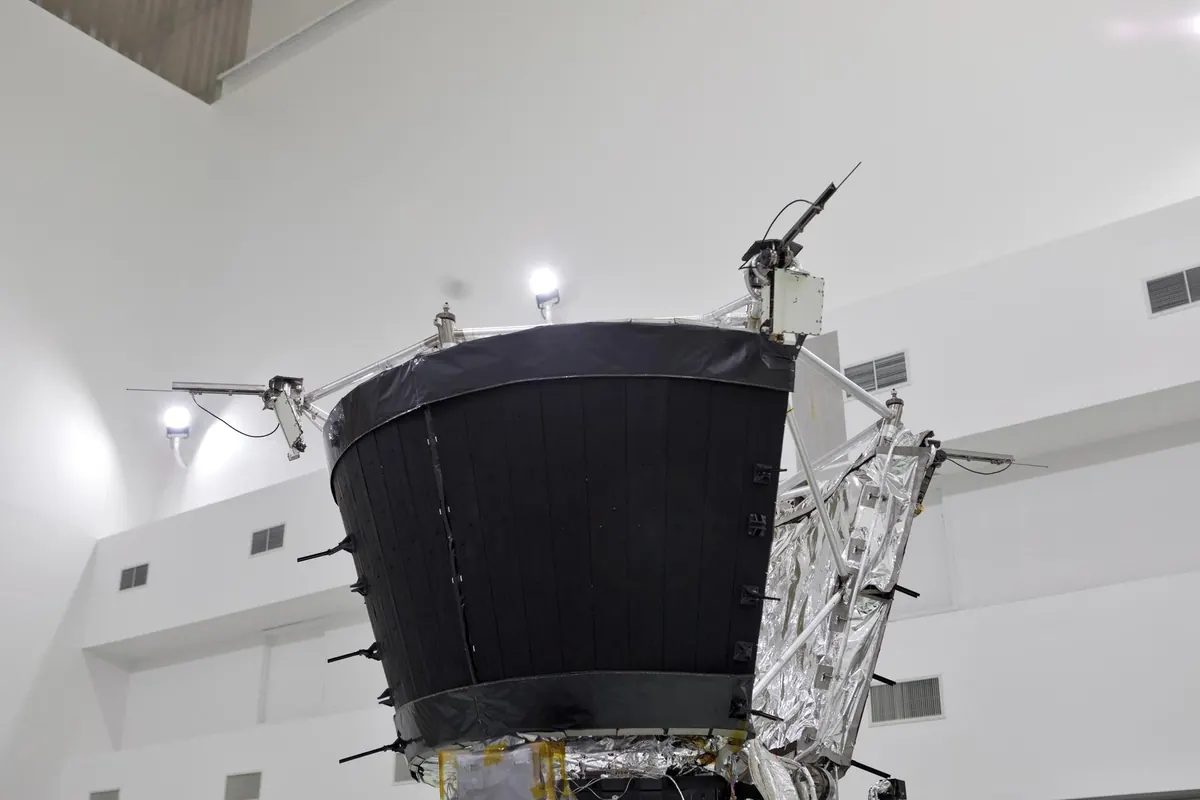
How close is close?
The headline distance, 6.2 million kilometers (3.9 million miles) from the Sun's surface, is easier to grasp with a few comparisons. Earth is about 150 million kilometers from the Sun, so Parker's closest pass is roughly 24 times closer. The Sun's radius is about 696,000 kilometers, so the spacecraft is only about nine solar radii above the surface. The previous record, set by the German-American Helios 2 in 1976, was about 43 million kilometers, and 43 divided by 6.2 gives the 'seven times closer' that NASA quotes.
It launched on 12 August 2018 on a Delta IV Heavy, one of the most powerful rockets of its day, because getting that close takes a surprising amount of energy. The Sun's pull is easy to fall into, but shedding the speed Earth carries around the Sun is hard, so the spacecraft needs a big push to get started.
The man the mission is named for
Eugene Parker proposed the solar wind in the 1950s, at a time when many scientists doubted a steady stream of particles could leave the Sun. Spacecraft later confirmed it. The mission is the first NASA named for a living researcher, and he watched the launch. He died on 15 March 2022 at the age of 94, after the probe had already flown through the corona.
Why go so close?
Parker was built to answer two questions that have puzzled scientists for more than 60 years: why the corona is far hotter than the surface below it, and how the solar wind speeds up. It was designed to fly more than seven times closer to the Sun than any earlier spacecraft, close enough to sample the corona directly, and to help forecast space weather that can disturb satellites and electronics on Earth. The probe is named for Eugene Parker, who predicted the solar wind in the 1950s. The mission was the first named for a living researcher, and he watched the launch.
How it survives
| What | Value |
|---|---|
| Launch | 12 August 2018, on a Delta IV Heavy |
| Mass at launch | 685 kg |
| Planned orbits | 24 over seven years |
| Closest approach | about 6.2 million km (3.9 million miles) from the Sun |
| Speed at closest approach | about 700,000 km/h (430,000 mph) |
| Heat shield | 11.43 cm thick carbon composite, withstanding about 1,377 degrees Celsius |
| Instruments | four suites, studying magnetic fields, plasma, energetic particles and imaging the solar wind |
The spacecraft hides behind an 11.43 cm carbon-composite shield. At closest approach it moves at about 700,000 km/h, a speed NASA compares to getting from Philadelphia to Washington, D.C., in one second.
Touching the Sun
On 14 December 2021 NASA announced that Parker had flown through the corona and sampled particles and magnetic fields there. It was the first time a spacecraft had touched the Sun. Eugene Parker died on 15 March 2022, aged 94.
Measured: we know this
- Parker flew through the corona and sampled it, announced on 14 December 2021.
- At closest approach it moves at about 700,000 km/h.
Inferred: we think this
- Space weather from the Sun can change the orbits of satellites and interfere with electronics. Parker data are meant to help forecast it.
Unknown: we don't know
- Why the corona is much hotter than the Sun's surface, the photosphere.
- How the solar wind is accelerated, and what the sources of high-energy solar particles are.
What would settle it
- More close passes. Parker is working through a planned set of 24 orbits, each closer than the last.
In human terms
- At closest approach it covers the distance from Philadelphia to Washington, D.C., in about a second.
- It'll fly more than seven times closer to the Sun than any earlier spacecraft.
Questions people ask
Has a spacecraft touched the Sun?
In a sense, yes. Parker Solar Probe flew through the Sun's corona, and NASA announced it on 14 December 2021. It's the first spacecraft to do so.
How does Parker Solar Probe survive the heat?
An 11.43 cm thick carbon-composite shield protects it and can withstand about 1,377 degrees Celsius. The instruments stay behind the shield.
Why is the Sun's atmosphere hotter than its surface?
Nobody knows yet. It's one of the long-standing questions that Parker was designed to help answer.
 Travel time to the SunHow long it takes to get there by different means.
 James Webb Space TelescopeWhere it sits and what it has found.All probesEvery spacecraft page on the site.Scale of the solar systemThe solar system as a street.
Reading the speed
The probe's top speed of about 700,000 kilometers per hour is about 430,000 miles per hour, or close to 195 kilometers every second. That's not thrust. It's the result of falling toward the Sun on a tight orbit, and the spacecraft slows again as it climbs back out. Each orbit swings it close for a brief time and leaves it far away for much longer, which is why the data comes in bursts.
The heat shield is 11.43 centimeters thick, about four and a half inches, and the side facing the Sun is rated for about 1,377 degrees Celsius. The instruments behind it stay far cooler, and the spacecraft turns itself to keep them hidden. The mission also uses four instrument suites to measure the wind and fields it flies through.
Why the Sun runs hot at the top
Here's the puzzle Parker was sent to help solve. The Sun's visible surface is about 5,500 degrees Celsius, but the corona above it's hotter, at a million degrees or more. Heat normally flows from hot to cold, so an atmosphere hotter than the surface shouldn't happen without energy moving upward some other way. Scientists have ideas, involving magnetic waves and small explosions, but they couldn't test them until a spacecraft could sit inside the corona and measure the fields and particles directly.
The second puzzle is the speed of the wind. It leaves the Sun at hundreds of kilometers per second and gets faster as it moves out, so somewhere close to the Sun it's being pushed. Parker's close passes are chosen to cross that region, which is why each orbit is designed to go a little closer than the last.
What the planets get from it
The Sun's wind is the stream that reaches every planet in the solar system. Parker samples it where it's still being formed, so its readings are the closest thing to a starting point for the wind that later passes Earth and the other planets. The mission plan calls for 24 close passes over about seven years, and each one adds a new measurement. For a spacecraft with a different kind of job, see Juno at Jupiter, or put the distances in perspective on the scale of the solar system page.