The core clears 10 degrees during full darkness on most nights from March to September. In January, February, October, November and December it's out of reach, either too close to the Sun or too low in the dark.
Core score by month
| Month | Core score | Best week | Moon-free core hours a night | Average cloud |
|---|---|---|---|---|
| January | 0 | Core not visible | 0 | 75% |
| February | 0 | No moon-free core hours | 0 | 77% |
| March | 3 | March 10 to 16 | 0.6 | 77% |
| April | 10 | April 7 to 13 | 1.4 | 73% |
| May | 15 | May 4 to 10 | 2.2 | 73% |
| June | 34 | June 1 to 7 | 3.3 | 58% |
| July | 45 | July 1 to 7 | 3.0 | 39% |
| August | 25 | August 1 to 7 | 1.8 | 43% |
| September | 8 | September 1 to 7 | 0.6 | 48% |
| October | 0 | October 1 to 7 | 0.0 | 64% |
| November | 0 | Core not visible | 0 | 73% |
| December | 0 | Core not visible | 0 | 77% |
Times are for the best seven nights in each month. Moon-free means the moon is below the horizon. The core counts as visible above 10 degrees in full darkness, when the Sun is more than 18 degrees below the horizon.
The best nights in 2027
- June: June 6 is the best night. The core is above 10 degrees and the moon is down from 11:52 pm to 3:12 am, with the moon 9% lit that night.
- July: July 1 is the best night. The core is above 10 degrees and the moon is down from 11:42 pm to 2:42 am, with the moon 5% lit that night.
- August: August 1 is the best night. The core is above 10 degrees and the moon is down from 10:52 pm to 12:42 am, with the moon 0% lit that night.
Clock times are Mountain time with daylight saving applied. The best nights fall around the new moon, so the dates shift by about 11 days each year.
About Yellowstone National Park
Yellowstone, mostly in Wyoming, is the oldest national park in the world and still one of the most surprising. More than half the planet's geysers are here, including Old Faithful, plus hot springs in unreal colors, a vast canyon and big herds of bison, elk and wolves. The whole park sits on top of a giant volcano.
President Ulysses Grant signed the law creating it on March 1, 1872. Wolves, wiped out by the 1920s, were brought back in 1995. Many Native nations, including the Crow, Shoshone and Blackfeet, used this land long before it was a park.
Yellowstone National Park is a national park in Idaho, Montana and Wyoming. The National Park Service places its center at 44.60 degrees north and 110.55 degrees west, and the sky calculations on this page use that point. Visitor information, fees and alerts are on the park's own page. National Park Service (opens in a new tab).
How Yellowstone National Park compares
Its best monthly core score of 45 ranks 41 of 54 national park units that can see the core. The highest is Lassen Volcanic National Park at 86, and the lowest is Voyageurs National Park at 13. Cloud at Yellowstone National Park runs from 39% in July to 77% in February.
The score ranks months and parks. It isn't a forecast for any night, and it leaves out local weather, smoke and light from nearby towns. How the core score works.
How dark is the sky?
The Park Service models how much artificial light brightens the sky across the lower 48. At the point used for Yellowstone National Park, it puts the added glow at about 2% of the natural brightness of a moonless sky (a ratio of 0.016). That makes it 2nd darkest of the 47 parks it covers. Lower is darker. This is a model, not a reading taken at the park, and it describes one point, so the edges of a large park can differ.
Questions people ask
When is the best time to see the Milky Way at Yellowstone National Park?
June, July and August are the best months. The best week of 2027 is July 1 to 7.
Can you see the Milky Way at Yellowstone National Park all year?
The core clears 10 degrees during full darkness on most nights from March to September. In January, February, October, November and December it's out of reach, either too close to the Sun or too low in the dark.
How dark is the sky at Yellowstone National Park?
The Park Service models how much artificial light brightens the sky across the lower 48. At the point used for Yellowstone National Park, it puts the added glow at about 2% of the natural brightness of a moonless sky (a ratio of 0.016). That makes it 2nd darkest of the 47 parks it covers. Lower is darker. This is a model, not a reading taken at the park, and it describes one point, so the edges of a large park can differ.
Does the moon matter at Yellowstone National Park?
Yes. A bright moon hides the Milky Way. The best night in July is July 1, when the moon is 5% lit and the core is above 10 degrees from 11:42 pm to 2:42 am.
The lights inside the park
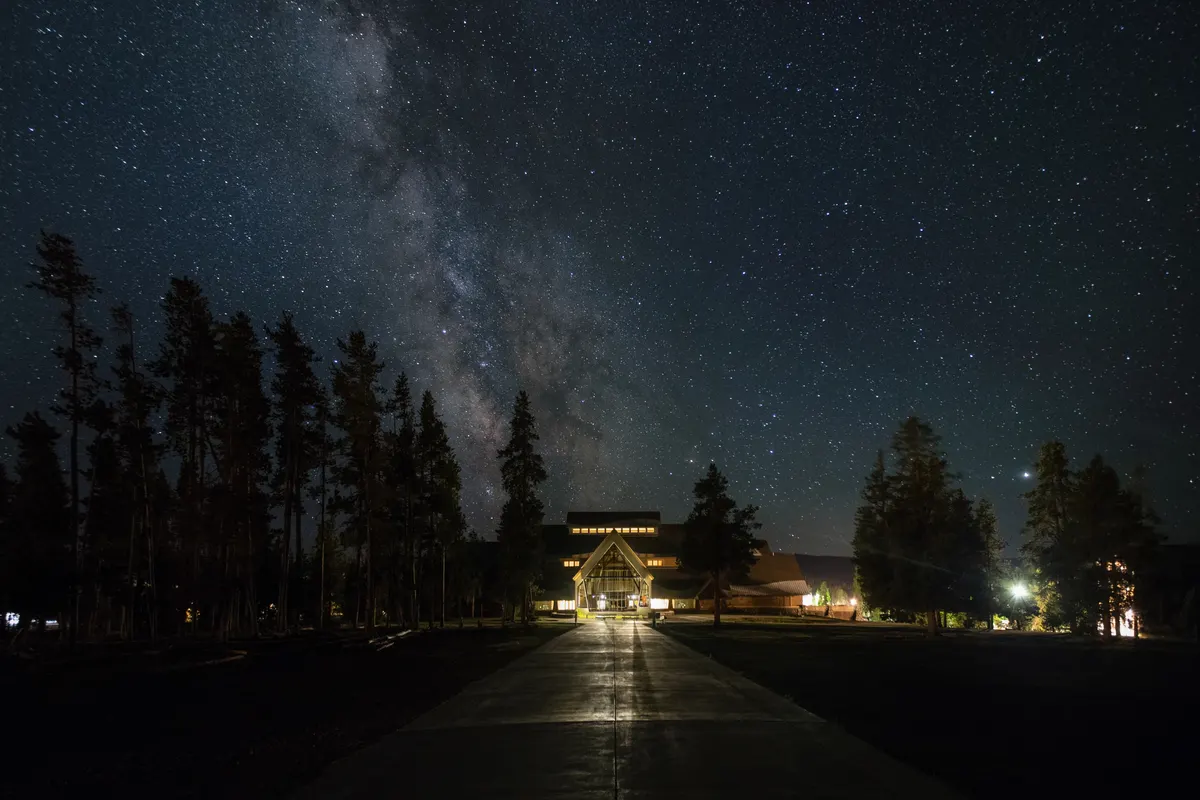
Most of Yellowstone is free of artificial light, the Park Service says, but the developed areas aren't. There are more than 5,000 light fixtures in them, and the park has been replacing older bright ones with low-wattage fixtures that are fully shielded and aim light downward. Only 46 percent of the fixtures are on at night, and 75 percent of those are fully shielded.
Light matters to wildlife too. The Service says artificial light disrupts behavior, feeding and reproduction, and in Yellowstone it harms long-eared bats, blotched tiger salamanders and songbirds.
Smoke and cloud
Smoke and cloud matter as much as lights. Yellowstone is a Class I airshed, and wildland fire smoke is the largest source of particulate matter in the Greater Yellowstone area. If the air is smoky, a dark site won't help.
Our cloud data show the same caution. Average cloud runs from 39 percent in July to 77 percent in February, with 65 percent over the year. For a park-run telescope night, past seasons have included one at the Madison Information Station parking lot, with telescopes available at 10:30 pm; the Park Service listing we read is dated June 28 and 29, 2019, so ask at a visitor center for current plans. The Grand Teton page covers the park next door.
How it fits our numbers
In our 2027 numbers, Yellowstone peaks in July with a core score of 45 out of 100. The best week is July 1 to 7, with about 3.0 moon-free hours a night and average cloud near 39 percent. Check smoke and road conditions before a late-evening drive, because those can change the plan more than the Moon does. The Milky Way season hub ranks all 54 parks.