The core clears 10 degrees during full darkness on most nights from April to August. In January, February, March, September, October, November and December it's out of reach, either too close to the Sun or too low in the dark.
Core score by month
| Month | Core score | Best week | Moon-free core hours a night | Average cloud |
|---|---|---|---|---|
| January | 0 | Core not visible | 0 | 72% |
| February | 0 | Core not visible | 0 | 70% |
| March | 0 | No moon-free core hours | 0 | 72% |
| April | 2 | April 8 to 14 | 0.3 | 72% |
| May | 7 | May 4 to 10 | 0.9 | 68% |
| June | 12 | June 1 to 7 | 1.3 | 63% |
| July | 14 | July 1 to 7 | 0.9 | 39% |
| August | 6 | August 1 to 7 | 0.4 | 45% |
| September | 0 | Core not visible | 0 | 54% |
| October | 0 | Core not visible | 0 | 66% |
| November | 0 | Core not visible | 0 | 72% |
| December | 0 | Core not visible | 0 | 71% |
Times are for the best seven nights in each month. Moon-free means the moon is below the horizon. The core counts as visible above 10 degrees in full darkness, when the Sun is more than 18 degrees below the horizon.
The best nights in 2027
- May: May 9 is the best night. The core is above 10 degrees and the moon is down from 2:45 am to 3:35 am, with the moon 19% lit that night.
- June: June 1 is the best night. The core is above 10 degrees and the moon is down from 1:15 am to 2:25 am, with the moon 8% lit that night.
- July: July 1 is the best night. The core is above 10 degrees and the moon is down from 1:15 am to 2:05 am, with the moon 5% lit that night.
Clock times are Mountain time with daylight saving applied. The best nights fall around the new moon, so the dates shift by about 11 days each year.
About Glacier National Park
Glacier takes up a big corner of northwestern Montana, with jagged peaks, deep lakes and trails that fill with wildflowers in July. The Going-to-the-Sun Road crosses the mountains and is one of the great drives in North America. The glaciers that gave the park its name have been shrinking for decades.
Glacier became a national park in 1910. The Blackfeet Nation, whose reservation borders the park, has lived in this region for generations. In 1932 the park joined Canada's Waterton Lakes to form the world's first International Peace Park.
Glacier National Park is a national park in Montana. The National Park Service places its center at 48.68 degrees north and 113.80 degrees west, and the sky calculations on this page use that point. Visitor information, fees and alerts are on the park's own page. National Park Service (opens in a new tab).
How Glacier National Park compares
Its best monthly core score of 14 ranks 51 of 54 national park units that can see the core. The highest is Lassen Volcanic National Park at 86, and the lowest is Voyageurs National Park at 13. Cloud at Glacier National Park runs from 39% in July to 72% in March.
The score ranks months and parks. It isn't a forecast for any night, and it leaves out local weather, smoke and light from nearby towns. How the core score works.
How dark is the sky?
The Park Service models how much artificial light brightens the sky across the lower 48. At the point used for Glacier National Park, it puts the added glow at about 9% of the natural brightness of a moonless sky (a ratio of 0.091). That makes it 14th darkest of the 47 parks it covers. Lower is darker. This is a model, not a reading taken at the park, and it describes one point, so the edges of a large park can differ.
Questions people ask
When is the best time to see the Milky Way at Glacier National Park?
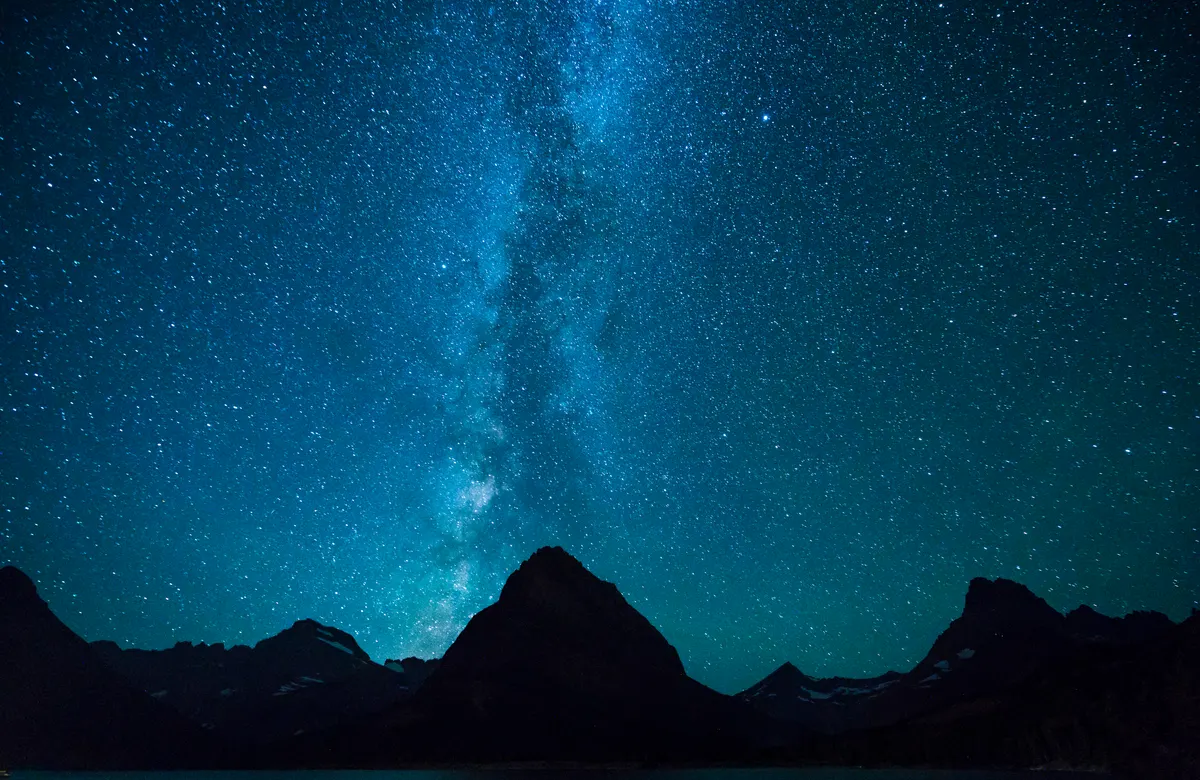
May, June and July are the best months. The best week of 2027 is July 1 to 7.
Can you see the Milky Way at Glacier National Park all year?
The core clears 10 degrees during full darkness on most nights from April to August. In January, February, March, September, October, November and December it's out of reach, either too close to the Sun or too low in the dark.
How dark is the sky at Glacier National Park?
The Park Service models how much artificial light brightens the sky across the lower 48. At the point used for Glacier National Park, it puts the added glow at about 9% of the natural brightness of a moonless sky (a ratio of 0.091). That makes it 14th darkest of the 47 parks it covers. Lower is darker. This is a model, not a reading taken at the park, and it describes one point, so the edges of a large park can differ.
Does the moon matter at Glacier National Park?
Yes. A bright moon hides the Milky Way. The best night in July is July 1, when the moon is 5% lit and the core is above 10 degrees from 1:15 am to 2:05 am.
Farther north, the long summer twilight changes everything: see why the core never rises high enough in Alaska.
A dark sky park that crosses a border
Glacier and Waterton Lakes National Park in Canada were announced as a provisional Gold Tier Waterton-Glacier International Dark Sky Park on April 28, 2017. Parks Canada called it the first trans-boundary park of its kind in the program. When the news came, Glacier had retrofitted about 29 percent of its fixtures against a target of 67 percent in three years, and the Glacier National Park Conservancy paid for the lighting inventory, the joint application and the retrofits.
The Park Service makes the case in everyday terms: 80 percent of Americans can't see the Milky Way from their backyard.
Where the programs happen
Nightly programs run in summer, usually July and August, from dusk until midnight, at Apgar on the west side and St. Mary on the east. No tickets or reservations are needed. At St. Mary, the Dusty Star Observatory has a 20-inch telescope.
The Logan Pass Star Parties are the special ones. They're hosted by rangers, volunteers and the Big Sky Astronomy Club, and they need a ticket, which cost $5 per vehicle in 2025 and went on sale the day before. Vehicles had to reach the Logan Pass lot by 9:30 pm for a 10 pm start, and the 2025 dates were July 25 and August 22. Check the park page for current dates. Another northern Rockies option is Grand Teton, and the Milky Way season hub has the full ranking.
How it fits our numbers
In our 2027 numbers, Glacier peaks in July with a core score of 14 out of 100. The best week is July 1 to 7, with about 0.9 moon-free hours a night and average cloud near 39 percent. Logan Pass sits on the Going-to-the-Sun route, so check the park for access rules before you plan a late-evening visit.