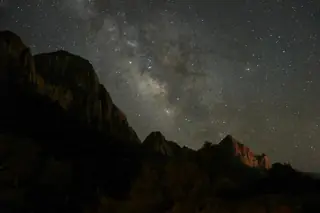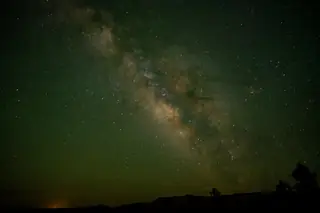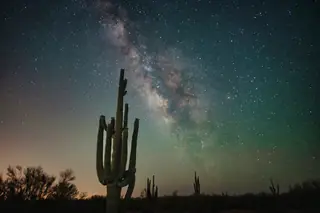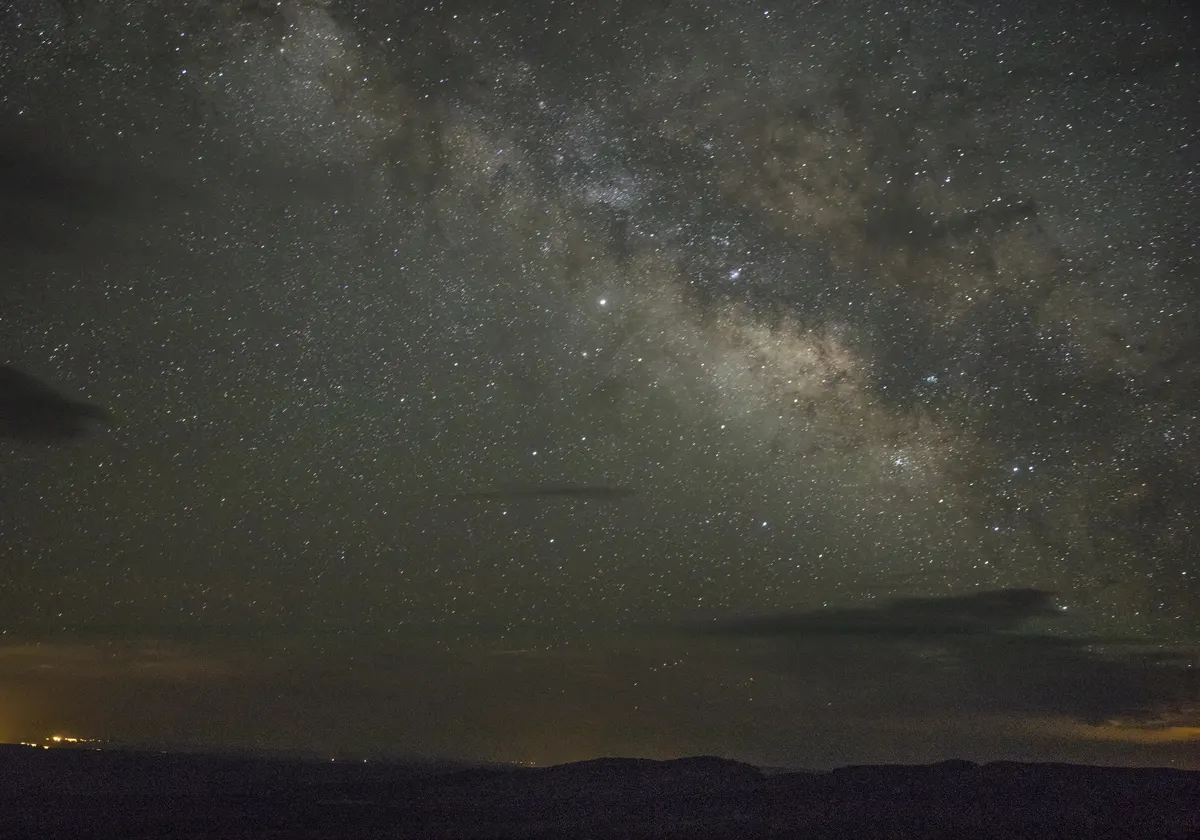
The core clears 10 degrees during full darkness on most nights from February to October. In January, November and December it's out of reach, either too close to the Sun or too low in the dark.
Core score by month
| Month | Core score | Best week | Moon-free core hours a night | Average cloud |
|---|---|---|---|---|
| January | 0 | Core not visible | 0 | 49% |
| February | 7 | February 10 to 16 | 0.6 | 52% |
| March | 23 | March 10 to 16 | 1.8 | 48% |
| April | 40 | April 6 to 12 | 2.8 | 43% |
| May | 61 | May 3 to 9 | 3.9 | 38% |
| June | 74 | June 1 to 7 | 5.2 | 26% |
| July | 51 | July 1 to 7 | 5.0 | 49% |
| August | 45 | August 1 to 7 | 3.2 | 44% |
| September | 27 | September 21 to 27 | 1.5 | 29% |
| October | 7 | October 1 to 7 | 0.4 | 33% |
| November | 0 | Core not visible | 0 | 39% |
| December | 0 | Core not visible | 0 | 52% |
Times are for the best seven nights in each month. Moon-free means the moon is below the horizon. The core counts as visible above 10 degrees in full darkness, when the Sun is more than 18 degrees below the horizon.
The best nights in 2027
- May: May 6 is the best night. The core is above 10 degrees and the moon is down from 11:58 pm to 3:48 am, with the moon 1% lit that night.
- June: June 3 is the best night. The core is above 10 degrees and the moon is down from 10:08 pm to 3:18 am, with the moon 0% lit that night.
- July: July 1 is the best night. The core is above 10 degrees and the moon is down from 9:38 pm to 2:48 am, with the moon 5% lit that night.
Clock times are Mountain time, which doesn't observe daylight saving. The best nights fall around the new moon, so the dates shift by about 11 days each year.
About Grand Canyon National Park
The Grand Canyon is about 278 river miles long, up to 18 miles wide and about a mile deep on average. The Colorado River carved it through layers of rock that hold nearly two billion years of geological history. The South Rim is open all year, and the North Rim, higher and cooler, closes in winter.
Pueblo peoples, the Havasupai and others lived here long before John Wesley Powell led a river expedition through the canyon in 1869. It became a national monument in 1908 and a national park in 1919.
Grand Canyon National Park is a national park in Arizona. The National Park Service places its center at 36.00 degrees north and 112.12 degrees west, and the sky calculations on this page use that point. Visitor information, fees and alerts are on the park's own page. National Park Service (opens in a new tab).
How Grand Canyon National Park compares
Its best monthly core score of 74 ranks 9 of 54 national park units that can see the core. The highest is Lassen Volcanic National Park at 86, and the lowest is Voyageurs National Park at 13. Cloud at Grand Canyon National Park runs from 26% in June to 52% in December.
The score ranks months and parks. It isn't a forecast for any night, and it leaves out local weather, smoke and light from nearby towns. How the core score works.
How dark is the sky?
The Park Service models how much artificial light brightens the sky across the lower 48. At the point used for Grand Canyon National Park, it puts the added glow at about 17% of the natural brightness of a moonless sky (a ratio of 0.171). That makes it 20th darkest of the 47 parks it covers. Lower is darker. This is a model, not a reading taken at the park, and it describes one point, so the edges of a large park can differ.
Questions people ask
When is the best time to see the Milky Way at Grand Canyon National Park?
May, June and July are the best months. The best week of 2027 is June 1 to 7.
Can you see the Milky Way at Grand Canyon National Park all year?
The core clears 10 degrees during full darkness on most nights from February to October. In January, November and December it's out of reach, either too close to the Sun or too low in the dark.
How dark is the sky at Grand Canyon National Park?
The Park Service models how much artificial light brightens the sky across the lower 48. At the point used for Grand Canyon National Park, it puts the added glow at about 17% of the natural brightness of a moonless sky (a ratio of 0.171). That makes it 20th darkest of the 47 parks it covers. Lower is darker. This is a model, not a reading taken at the park, and it describes one point, so the edges of a large park can differ.
Does the moon matter at Grand Canyon National Park?
Yes. A bright moon hides the Milky Way. The best night in June is June 3, when the moon is 0% lit and the core is above 10 degrees from 10:08 pm to 3:18 am.
How Grand Canyon earned its dark sky certification
The park's night sky badge wasn't handed over for having a big empty hole in the ground. It was earned with a lighting retrofit. Grand Canyon got provisional International Dark Sky status in 2016, and the terms gave it three years to bring 67 percent of its light fixtures into compliance. Before the work began, 35 percent of the park's lights already met the standard.
By late May 2019 the figure stood at 69 percent, and in June 2019 the Park Service announced full certification. The park said it planned to push further, and the areas still to be done at that point were the North Rim, Desert View, Phantom Ranch and Tuweep. If you want to see what a similar job looks like in another Utah-Arizona canyon park, Bryce Canyon was certified in the same year.
The Grand Canyon Star Party
The park's best-known sky event is the Grand Canyon Star Party, which is free and open to the public with no tickets or sign-up. The Park Service lists the 2027 dates as May 29 to June 5. It begins at sunset, so you can arrive for the light on the rim and stay for the telescopes.
The 2026 edition shows how the format works. It ran on the South Rim only, because the Dragon Bravo Fire kept the North Rim event from going ahead. Evening talks started at 8 pm, ranger constellation tours ran at 9, 9:30 and 10 pm, and the telescopes sat in the large lot behind the Visitor Center. The park says viewing is best after 9 pm. Check the Park Service page for the 2027 schedule, because it doesn't yet say which rims will host. For the rest of the year, our Milky Way season guide ranks the months at all 54 parks.