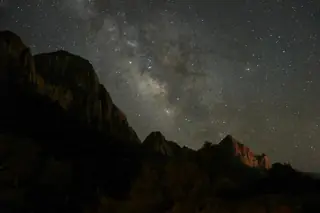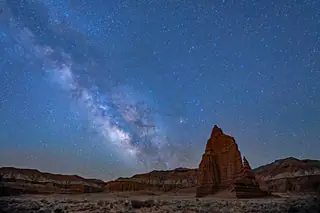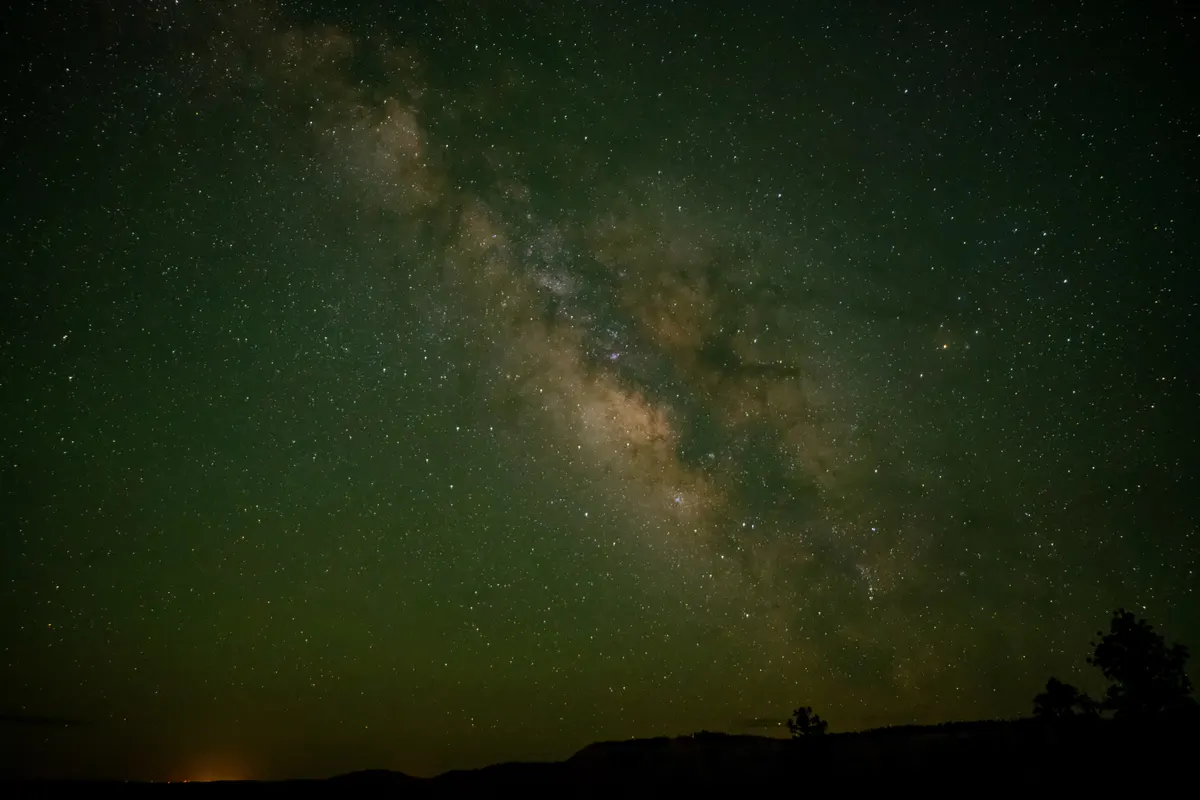
The core clears 10 degrees during full darkness on most nights from February to October. In January, November and December it's out of reach, either too close to the Sun or too low in the dark.
Core score by month
| Month | Core score | Best week | Moon-free core hours a night | Average cloud |
|---|---|---|---|---|
| January | 0 | Core not visible | 0 | 49% |
| February | 5 | February 10 to 16 | 0.4 | 52% |
| March | 20 | March 10 to 16 | 1.6 | 50% |
| April | 35 | April 6 to 12 | 2.6 | 46% |
| May | 54 | May 3 to 9 | 3.7 | 41% |
| June | 74 | June 1 to 7 | 4.9 | 26% |
| July | 54 | July 1 to 7 | 4.7 | 46% |
| August | 46 | August 1 to 7 | 3.0 | 39% |
| September | 24 | September 21 to 27 | 1.4 | 30% |
| October | 6 | October 1 to 7 | 0.4 | 35% |
| November | 0 | Core not visible | 0 | 41% |
| December | 0 | Core not visible | 0 | 52% |
Times are for the best seven nights in each month. Moon-free means the moon is below the horizon. The core counts as visible above 10 degrees in full darkness, when the Sun is more than 18 degrees below the horizon.
The best nights in 2027
- May: May 9 is the best night. The core is above 10 degrees and the moon is down from 12:58 am to 4:38 am, with the moon 19% lit that night.
- June: June 5 is the best night. The core is above 10 degrees and the moon is down from 11:08 pm to 4:08 am, with the moon 3% lit that night.
- July: July 1 is the best night. The core is above 10 degrees and the moon is down from 10:48 pm to 3:38 am, with the moon 5% lit that night.
Clock times are Mountain time with daylight saving applied. The best nights fall around the new moon, so the dates shift by about 11 days each year.
About Bryce Canyon National Park
Bryce Canyon isn't really a canyon at all. It's a line of huge natural amphitheaters cut into the edge of the Paunsaugunt Plateau, filled with thousands of rock spires called hoodoos. At around 8,000 to 9,000 feet, the rim gets cold, and frost and erosion do the carving.
It was named for Ebenezer Bryce, a Mormon settler who homesteaded the area in 1874. Bryce Canyon became a national monument in 1923 and a national park in 1928. The Paiute people tell their own stories about the hoodoos, which they link to the Legend People who were turned to stone.
Bryce Canyon National Park is a national park in Utah. The National Park Service places its center at 37.58 degrees north and 112.18 degrees west, and the sky calculations on this page use that point. Visitor information, fees and alerts are on the park's own page. National Park Service (opens in a new tab).
How Bryce Canyon National Park compares
Its best monthly core score of 74 ranks 8 of 54 national park units that can see the core. The highest is Lassen Volcanic National Park at 86, and the lowest is Voyageurs National Park at 13. Cloud at Bryce Canyon National Park runs from 26% in June to 52% in February.
The score ranks months and parks. It isn't a forecast for any night, and it leaves out local weather, smoke and light from nearby towns. How the core score works.
How dark is the sky?
The Park Service models how much artificial light brightens the sky across the lower 48. At the point used for Bryce Canyon National Park, it puts the added glow at about 8% of the natural brightness of a moonless sky (a ratio of 0.077). That makes it 11th darkest of the 47 parks it covers. Lower is darker. This is a model, not a reading taken at the park, and it describes one point, so the edges of a large park can differ.
Questions people ask
When is the best time to see the Milky Way at Bryce Canyon National Park?
May, June and July are the best months. The best week of 2027 is June 1 to 7.
Can you see the Milky Way at Bryce Canyon National Park all year?
The core clears 10 degrees during full darkness on most nights from February to October. In January, November and December it's out of reach, either too close to the Sun or too low in the dark.
How dark is the sky at Bryce Canyon National Park?
The Park Service models how much artificial light brightens the sky across the lower 48. At the point used for Bryce Canyon National Park, it puts the added glow at about 8% of the natural brightness of a moonless sky (a ratio of 0.077). That makes it 11th darkest of the 47 parks it covers. Lower is darker. This is a model, not a reading taken at the park, and it describes one point, so the edges of a large park can differ.
Does the moon matter at Bryce Canyon National Park?
Yes. A bright moon hides the Milky Way. The best night in June is June 5, when the moon is 3% lit and the core is above 10 degrees from 11:08 pm to 4:08 am.
Fifty years of ranger astronomy
Bryce Canyon's night sky program began in 1969, when the park's Chief of Interpretation and Visitor Services added a night sky program to the offerings. The first Astronomy Festival followed in 2001, with help from the Salt Lake Astronomical Society.
The numbers show how popular it became. The park says 100 to 300 visitors gather around the telescopes on a program night, and in 2006 more than 27,000 people took part in astronomy programs over the year. In 2019 the park marked 50 years of astronomy programming, and on August 13 of that year it was certified as an International Dark Sky Park.
What the sky looks like from the rim
The Park Service's own description is plain. On a clear night with a new Moon you can see thousands of stars and the band of the Milky Way. On a clear day you can see nearly 200 miles, to the Black Mesas in eastern Arizona, which gives you a sense of how little haze sits between the park and the horizon.
The park recommends a clear night with a new Moon. The Park Service also points out that light pollution is a problem with an easy fix, because reducing it's as easy as throwing a switch. If you're building a southern Utah trip, Capitol Reef and Zion both have their own dark sky pages here.
What the telescopes show
The park's astronomy pages describe the sort of targets visitors look at: Jupiter, about 48 light minutes away, the Ring Nebula, about 1,500 light years away, and the Andromeda Galaxy, more than 2 million light years away. The Service notes that at a truly dark location over 10,000 stars can be seen in one night.
In our 2027 numbers, Bryce Canyon peaks in June with a core score of 74 out of 100. The best week is June 1 to 7, with about 4.9 moon-free hours a night and average cloud near 26 percent.