The core clears 10 degrees during full darkness on most nights from February to October. In January, November and December it's out of reach, either too close to the Sun or too low in the dark.
Core score by month
| Month | Core score | Best week | Moon-free core hours a night | Average cloud |
|---|---|---|---|---|
| January | 0 | Core not visible | 0 | 54% |
| February | 3 | February 10 to 16 | 0.3 | 54% |
| March | 18 | March 10 to 16 | 1.4 | 50% |
| April | 31 | April 6 to 12 | 2.5 | 49% |
| May | 48 | May 3 to 9 | 3.5 | 45% |
| June | 69 | June 1 to 7 | 4.7 | 31% |
| July | 55 | July 1 to 7 | 4.5 | 45% |
| August | 40 | August 1 to 7 | 2.8 | 44% |
| September | 21 | September 1 to 7 | 1.3 | 32% |
| October | 5 | October 1 to 7 | 0.3 | 36% |
| November | 0 | Core not visible | 0 | 43% |
| December | 0 | Core not visible | 0 | 56% |
Times are for the best seven nights in each month. Moon-free means the moon is below the horizon. The core counts as visible above 10 degrees in full darkness, when the Sun is more than 18 degrees below the horizon.
The best nights in 2027
- May: May 5 is the best night. The core is above 10 degrees and the moon is down from 1:08 am to 4:28 am, with the moon 0% lit that night.
- June: June 2 is the best night. The core is above 10 degrees and the moon is down from 11:18 pm to 3:58 am, with the moon 3% lit that night.
- July: July 1 is the best night. The core is above 10 degrees and the moon is down from 10:48 pm to 3:18 am, with the moon 5% lit that night.
Clock times are Mountain time with daylight saving applied. The best nights fall around the new moon, so the dates shift by about 11 days each year.
About Arches National Park
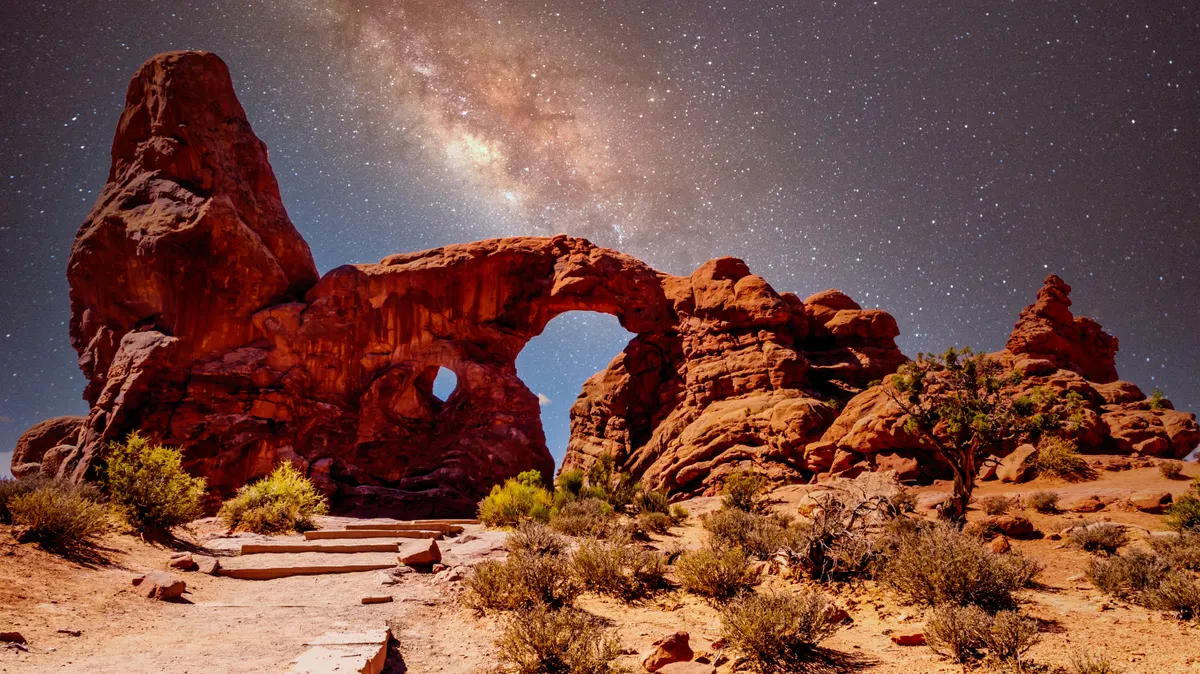
Arches packs more than 2,000 natural sandstone arches into a patch of red desert just north of Moab, Utah. Delicate Arch gets all the attention, but the Windows section and the long, thin Landscape Arch are just as memorable. Most of the park is open slickrock, fins and sand, with very little shade.
President Hoover set it aside as a national monument in 1929, after a Hungarian-born prospector, Alexander Ringhoffer, and a railroad official pushed to protect the area. Congress made it a national park in 1971. Before any of that, the Ute and ancestral Puebloan peoples had used the area for centuries.
Arches National Park is a national park in Utah. The National Park Service places its center at 38.72 degrees north and 109.59 degrees west, and the sky calculations on this page use that point. Visitor information, fees and alerts are on the park's own page. National Park Service (opens in a new tab).
How Arches National Park compares
Its best monthly core score of 69 ranks 15 of 54 national park units that can see the core. The highest is Lassen Volcanic National Park at 86, and the lowest is Voyageurs National Park at 13. Cloud at Arches National Park runs from 31% in June to 56% in December.
The score ranks months and parks. It isn't a forecast for any night, and it leaves out local weather, smoke and light from nearby towns. How the core score works.
How dark is the sky?
The Park Service models how much artificial light brightens the sky across the lower 48. At the point used for Arches National Park, it puts the added glow at about 14% of the natural brightness of a moonless sky (a ratio of 0.144). That makes it 18th darkest of the 47 parks it covers. Lower is darker. This is a model, not a reading taken at the park, and it describes one point, so the edges of a large park can differ.
Questions people ask
When is the best time to see the Milky Way at Arches National Park?
May, June and July are the best months. The best week of 2027 is June 1 to 7.
Can you see the Milky Way at Arches National Park all year?
The core clears 10 degrees during full darkness on most nights from February to October. In January, November and December it's out of reach, either too close to the Sun or too low in the dark.
How dark is the sky at Arches National Park?
The Park Service models how much artificial light brightens the sky across the lower 48. At the point used for Arches National Park, it puts the added glow at about 14% of the natural brightness of a moonless sky (a ratio of 0.144). That makes it 18th darkest of the 47 parks it covers. Lower is darker. This is a model, not a reading taken at the park, and it describes one point, so the edges of a large park can differ.
Does the moon matter at Arches National Park?
Yes. A bright moon hides the Milky Way. The best night in June is June 2, when the moon is 3% lit and the core is above 10 degrees from 11:18 pm to 3:58 am.